
Plant Problems › Peace Lily Yellow Leaves
A single yellow leaf on a peace lily (Spathiphyllum) can be just an old leaf. When several leaves turn yellow, check how the plant is watered, lit and kept, starting with the potting mix. Clemson Extension names root and stem diseases, usually linked to overwatering, as the most common peace lily problem, while a University of Florida IFAS (UF/IFAS) guide for commercial growers names underwatering as the most common problem indoors.
Quick answer
Causes to check:
- One older leaf now and then, the rest healthy: natural aging. Often normal
- Mix stays wet, plant wilts, lower leaves yellow: too much water or root rot. Act soon
- Mix dried out and the plant collapsed: leaves and leaf edges can yellow after a hard wilt. Act soon
- Near a cold window, door or vent: cold damage. Act soon
- In direct sun: pale, bleached or scorched leaves. Fix this week
- Older leaves yellowing in a crowded pot: the roots need more room. Fix this week
- Yellow between green veins: possibly a nutrient shortage, such as magnesium, once the other causes are ruled out. Fix this week
Labels show how quickly to act if a cause is confirmed. They are not a diagnosis; check the signs in each section first.
Is a yellow peace lily leaf normal? Often normal
Leaves don’t last forever. Penn State Extension lists natural aging among the reasons old leaves turn yellow, along with overwatering and a shortage of nitrogen, magnesium or potassium. One older leaf yellowing now and then, while the rest of the plant looks healthy, fits aging. If several leaves turn yellow at once, check the causes below.
Should you remove it?
Yes, once it has died back: the UF/IFAS growers’ guide advises trimming dead leaves and blooms as soon as possible. Peace lily leaves rise directly from the soil (Clemson Extension), so cut the yellow leaf’s stalk off near the base.
Green flowers are normal too
Clemson Extension notes that the white flowers turn pale green as they age. That isn’t a leaf problem.
What the yellow looks like
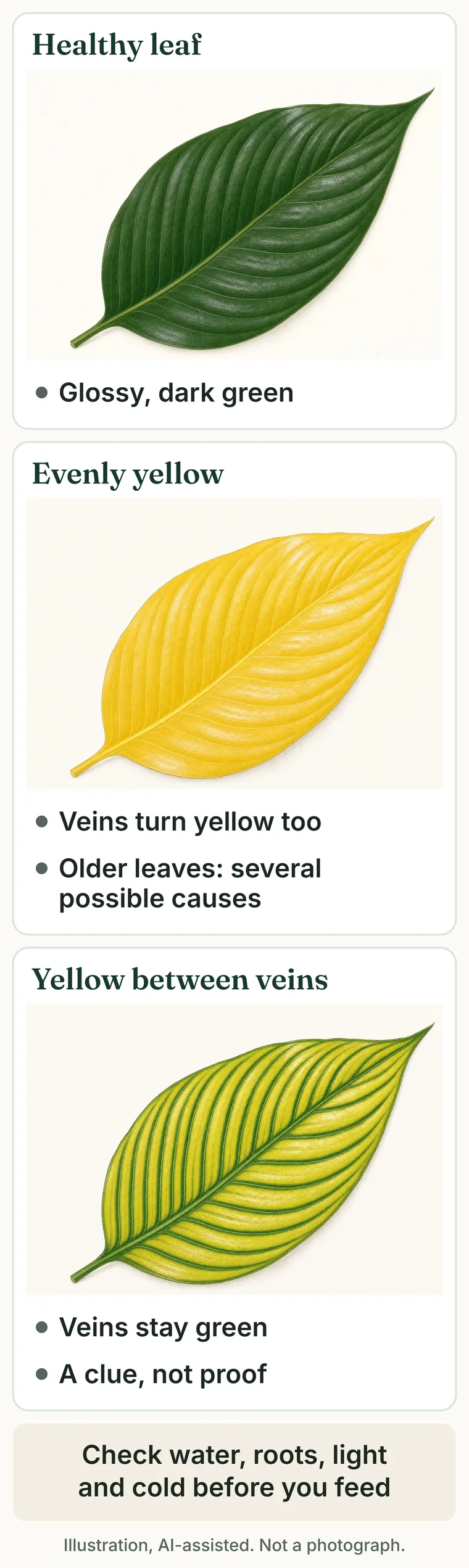
The pattern is a clue, not a diagnosis. Clemson Extension notes that a magnesium shortage can turn the tissue between the veins yellow while the veins stay green. But the UF/IFAS growers’ guide warns that pale leaves from too much light are often mistaken for a nutrient deficiency, and UF/IFAS chilling research notes that slow growth after cold, even without visible damage, can be mistaken for underfeeding. So check water, roots, light and temperature before you add fertilizer.
Too much water or root rot
How urgent: Act soon
Clemson Extension notes that root and stem diseases are the most common problem of peace lilies and are usually associated with overwatering, and that leaving the pot in a saucer of water leads to root rot. South Dakota State University Extension notes that yellow leaves can come from overwatering or underwatering, so feel the mix before you water.
How to tell
- The mix stays wet, yet the plant wilts or looks limp. University of Maryland Extension notes that a peace lily wilts when it needs water but can also wilt when it is overwatered.
- Lower and inner leaves turn yellow: University of Maryland Extension names this, with wilting, as the main sign of too much water.
- Rotting roots are brown to black and may be soft (Clemson Extension).
- The UF/IFAS growers’ guide adds that in waterlogged mix the leaves can wilt or collapse and sometimes die along the edges, and the roots are sparse, sometimes with black tips.
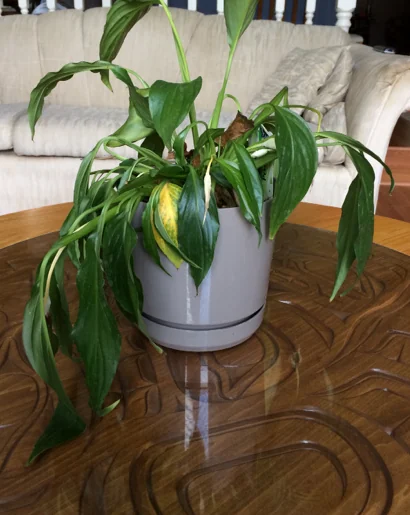
Photo: Scot Nelson, CC0, via Flickr (cropped and resized)
How to fix
- Stop watering, empty the saucer, and let the top of the mix dry slightly before you water again.
- If the plant stays wilted in wet mix, slide it out of the pot and look at the roots. Clemson Extension advises that if only a few roots are infected, you cut them out and repot the plant in sterile potting mix, in a new pot or one scrubbed clean and rinsed in a solution of one part bleach to nine parts water. University of Maryland Extension advises throwing away severely infected plants.
- Don’t move up to a bigger pot unless the roots already filled the old one: Clemson Extension warns that a pot that is too large can keep the mix too wet and lead to root rot.
Prevent it
Keep the mix moist but not soggy, let it dry slightly between waterings, and never leave the plant standing in water (Clemson Extension). The UF/IFAS growers’ guide notes that waterlogging is more likely in cold weather, when the plant needs less water.
Too little water
How urgent: Act soon
Clemson Extension notes that if the mix dries out too much, a peace lily wilts and its leaves and leaf edges turn yellow. The UF/IFAS growers’ guide calls underwatering the most common problem indoors: the whole plant wilts so badly that growers call it a “crash.”
How to tell
- The mix is dry and the pot feels light, and the whole plant droops.
- After it recovers, some leaves stay yellow or brown: the UF/IFAS growers’ guide notes that some yellowing or dead tissue may appear once the plant firms up again.
- Not every droop means dry mix. The same guide notes that a peace lily may droop late in the day in bright light at temperatures above 80 to 85°F even when the mix is moist, and calls this normal.
How to fix
- Water thoroughly until water runs out of the drainage hole, then empty the saucer. The UF/IFAS growers’ guide notes that plants recover within hours.
- If very dry mix won’t take up water, Clemson Extension suggests watering again half an hour later, or setting the pot in a sink or bucket of water, then taking it out once the surface is moist and letting it drain completely.
- Trim leaves that die back.
Prevent it
Check the mix often, especially in warm weather. The same guide notes that frequent drooping leads to brown tips and edges.
Cold and drafts
How urgent: Act soon
Clemson Extension notes that peace lilies prefer 68 to 85°F during the day and about 10°F cooler at night, and advises avoiding temperatures below 60°F, as cold damage may occur. It also warns against spots where heat or air-conditioning vents blow directly on the plant. Sources give different limits: South Dakota State University Extension advises avoiding 55°F or lower, the UF/IFAS homeowner guide prefers 75 to 85°F, and NC State Extension notes that 40 to 60°F slows growth considerably and that long periods below 40°F can damage leaves, stems and roots. This guide uses Clemson’s 60°F.
How to tell
- The plant sits near a cold window or door, or in the path of a vent.
- Damage after a cold spell: in UF/IFAS chilling research, in plants exposed to 38 or 45°F for five days, injury started at the leaf tips and edges and moved inward, turning dead and then black, and mature leaves were more sensitive than young ones. Plants kept at 52°F showed no visible injury, only slower growth.
- Yellowing after a temperature swing: Iowa State Extension notes, for houseplants in general, that any big temperature swing can cause yellowing, browning, wilting or leaf drop.
How to fix
- Move the plant to a spot that stays above 60°F, away from drafts and vents.
- Trim badly damaged leaves.
- Don’t feed to fix slow growth afterward: UF/IFAS chilling research notes that cold can slow growth without visible damage, and that this may be mistaken for underfeeding.
Too much direct sun
How urgent: Fix this week
Clemson Extension notes that peace lilies tolerate low light but grow best in bright indirect light, and that direct sun scorches the foliage. The UF/IFAS growers’ guide notes that too much light bleaches the leaves and that the pale color is often mistaken for a nutrient deficiency.
How to tell
- The plant gets direct sun for part of the day.
- Leaves look pale or washed out, or have scorched, dry patches or edges.
How to fix
- Move the plant out of direct sun into bright, indirect light. South Dakota State University Extension suggests an east- or north-facing window.
- Trim badly scorched leaves.
Crowded roots
How urgent: Fix this week
South Dakota State University Extension notes that older leaves yellow if a peace lily hasn’t been repotted in a while. Clemson Extension adds that peace lilies like to be slightly pot-bound, so repot only when the roots need it.
How to tell
- Roots grow through the drainage holes or circle on top of the mix (Clemson Extension).
- The plant is hard to keep watered: University of Arkansas Extension advises repotting only when the plant begins to crowd its container and is difficult to keep watered.
How to fix
- Repot into a container just 1 to 2 inches larger, gently loosening the roots first (Clemson Extension).
- Clemson notes that you can repot at any time of year, but the plant recovers faster in the growing season.
Nutrients and feeding
How urgent: Fix this week
Clemson Extension notes that peace lilies need very little fertilizer: a balanced liquid houseplant fertilizer at one-quarter of the recommended strength every six to eight weeks in spring and summer. The UF/IFAS homeowner guide suggests a low dose of liquid fertilizer three times a year. Clemson also notes that a magnesium shortage can stunt the plant and turn the tissue between the veins yellow.
How to tell
- Yellow between green veins, possibly with stunted growth (Clemson Extension, on magnesium). The UF/IFAS growers’ guide notes that yellowing with reduced growth from a nutrient shortage frequently occurs in winter, when the soil is cold.
- Too much fertilizer shows differently: Clemson Extension notes that overfertilizing burns the leaf tips and roots brown.
How to fix
- Rule out water, roots, light and cold first (see what the yellow looks like).
- If the plant hasn’t been fed at all, start the light spring and summer feeding above. That is normal care; our sources don’t say it will turn yellow leaves green again.
- If you have been feeding often, stop for a while. NC State Extension advises flushing the soil between fertilizer applications.
Other causes
- Pests: Clemson Extension notes that peace lilies have few insect pests, but that fungus gnats, mealybugs, spider mites and scales can be a problem, and advises checking the leaves often. NC State Extension notes that some pests gather on the undersides of the leaves.
Peace lily at a glance: bright, indirect light, no direct sun · mix moist but not soggy, slightly dry between waterings, never standing in water · 68 to 85°F by day and not below 60°F (Clemson Extension) · a little fertilizer in spring and summer · repot only when the roots crowd the pot, 1 to 2 inches larger · toxic to cats and dogs (ASPCA) · full peace lily care guide
Not sure which cause fits? Start with the potting mix: feel it, then check the roots (see too much water).
Sources
- Clemson Cooperative Extension, Home & Garden Information Center: Peace Lily (HGIC 1512); Houseplant Diseases & Disorders (HGIC 2251); Indoor Plants – Watering (HGIC 1459).
- University of Florida IFAS Extension: Florida Foliage House Plant Care: Spathiphyllum (ENH1216); Cultural Guidelines for Commercial Production of Interiorscape Spathiphyllum (ENH958, a guide for commercial growers); Chilling Injury in Tropical Foliage Plants: I. Spathiphyllum (ENH841).
- NC State Extension: Spathiphyllum (Extension Gardener Plant Toolbox).
- South Dakota State University Extension: Peace Lily: Houseplant How-To.
- University of Maryland Extension: Watering Indoor Plants; Overwatered Indoor Plants; Root Rots of Indoor Plants.
- Penn State Extension: Diagnosing Poor Plant Health.
- Iowa State University Extension and Outreach: How to Care for Houseplants.
- University of Arkansas Cooperative Extension: Plant of the Week: Spath (Peace Lily).
- ASPCA Animal Poison Control: Peace Lily.
