
Plant Problems › Root Rot
Root rot is a general term for any disease in which an organism breaks down a plant’s root system, as University of Wisconsin–Madison Extension defines it. Iowa State Extension calls root rot associated with overwatering one of the major issues for houseplants, and, in a February 2014 article, the most common indoor plant disease its plant clinic was seeing at that time of year.
This guide shows what root rot looks like above and below the soil, how to check the roots, how to treat it, and how to keep it from coming back.
Quick answer
- Root rot: the plant wilts even though the soil is wet, and its roots are soft and mushy instead of firm (and often brown rather than white). Act soon
- If the plant wilts and the soil feels wet, check the roots before you add water. Root rot’s symptoms can be mistaken for a lack of water.
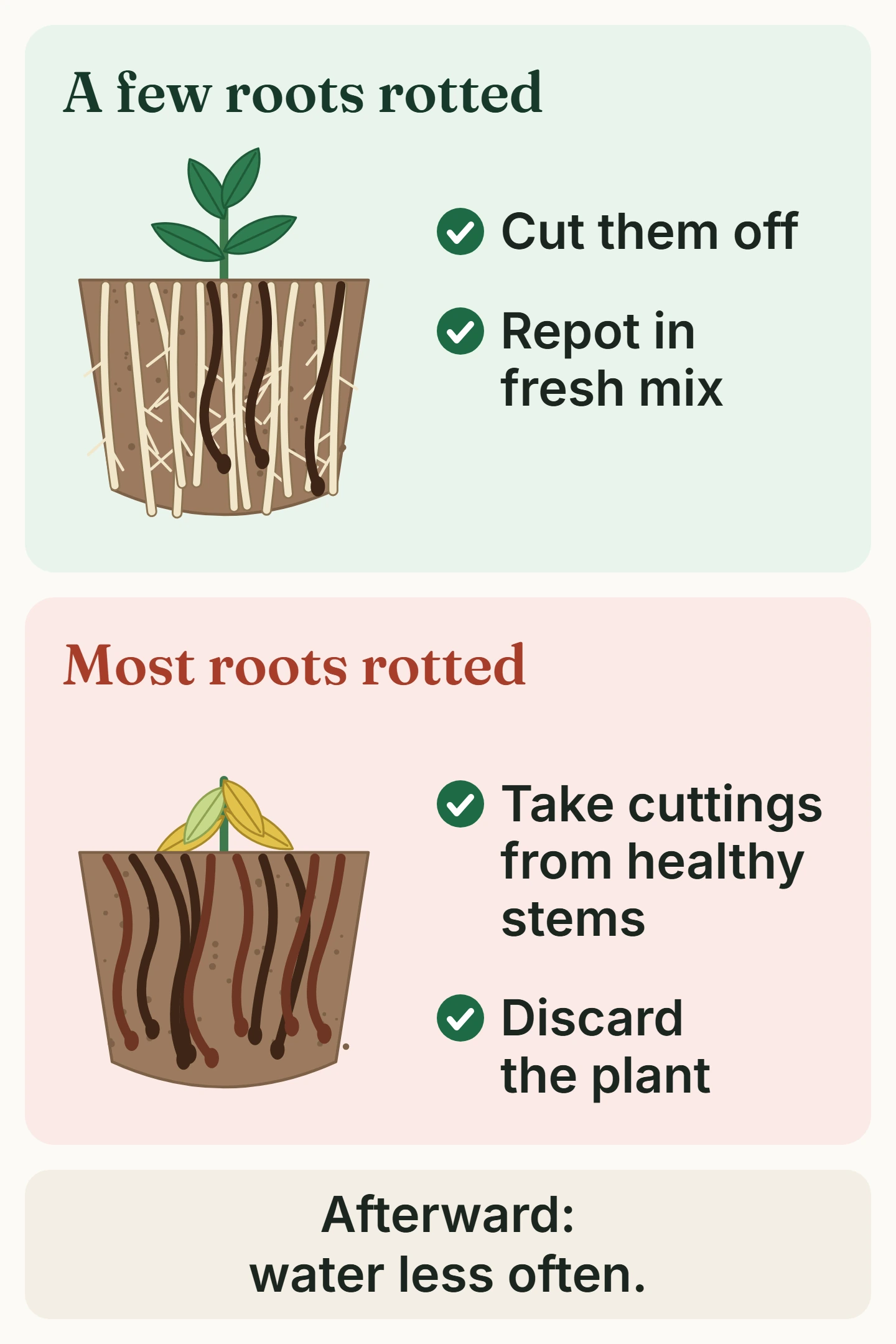
- A few rotten roots: cut them off and repot the plant in sterile potting mix.
- Most roots rotten: Clemson Extension advises discarding the plant. If it grows from cuttings, take cuttings from healthy stems first.
- Afterward, water less often, and never leave the pot standing in water.
Labels show how quickly to act if a cause is confirmed. They are not a diagnosis; check the signs in each section first.
What does root rot look like?
How urgent: Act soon University of Wisconsin–Madison Extension notes that root rots are more commonly acute than chronic and can lead to the death of the plant.
Above the soil
- Wilting in wet soil. The plant wilts even though the soil is wet, as Wisconsin Extension describes. University of Maryland Extension explains why: the roots are so damaged that they cannot move water up to the leaves.
- Often lower leaves first. Iowa State Extension notes that symptoms begin with wilting of the bottom leaves and may move upward until the whole plant collapses. Leaves may yellow and drop.
- Yellowing, browning and poor growth. University of Maryland Extension lists yellowing, browning and dieback of the leaves and poor growth. Wisconsin Extension adds that plants are often stunted, and that yellow or red leaves can look like a nutrient deficiency.
On the roots
- Soft, mushy roots. Iowa State Extension describes rotted roots as mushy and brown or reddish, while healthy roots are firm and white with numerous feeder roots. University of Maryland and Clemson Extension describe rotted roots as brown to black.
- Outer layer slips off. When you pull gently, the outer tissue of a rotted root may slide off and leave a thin, thread-like core, as Iowa State and University of Maryland Extension describe.
- A bad smell. Wisconsin Extension notes that rotted roots may have a bad odor.
- Roots left in the pot. With Pythium root rot, University of Maryland Extension notes, most of the root system is often left behind in the pot when you pull the plant up.
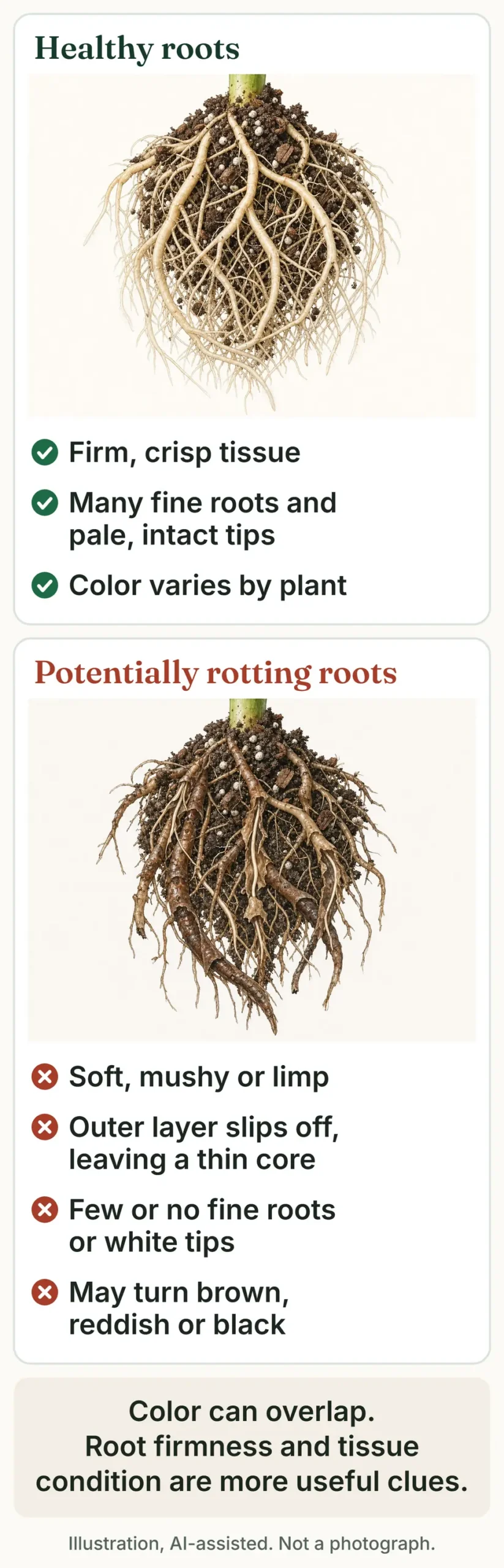
Root color alone can mislead. Penn State Extension, writing for commercial growers, notes that some plants, such as azaleas, naturally have brown roots, and that healthy roots are crisp rather than limp. Squeeze a few roots: firm or mushy tells you more than the color.
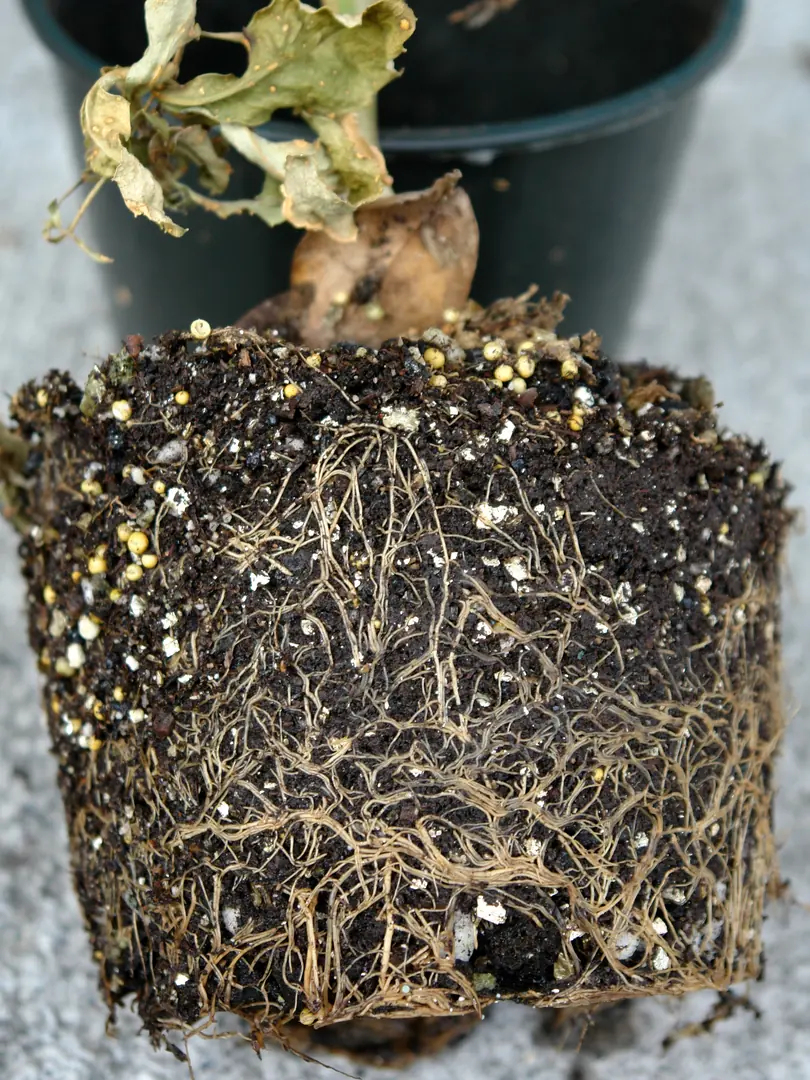
Photo: Scot Nelson, CC0, via Flickr (cropped and resized)
Stem rot and a mushy stem
The same organisms can attack the base of the stem. Clemson Extension notes that with root or stem rot, leaves and stems wilt noticeably, and stems may be girdled at or near the soil line by a ring of brown or black tissue.
- Phytophthora can turn the lower stems black, brown or mushy, which can lead to yellowing and dropping of the lower leaves (University of Maryland Extension).
- Rhizoctonia occurs when it is warm and moist. It grows as coarse, reddish-brown threads, often like spider webs, over infected stems and roots; the roots and lower stems turn brown and collapse (University of Maryland Extension).
Iowa State Extension notes that root and crown rots can affect nearly all indoor plants and are favored by warm, wet conditions. If the stem base is soft, check the roots as well. University of Maryland Extension advises throwing away severely infected plants and taking stem cuttings only from healthy tissue.
How to check for root rot
- Feel the potting mix first. Iowa State Extension stresses checking the roots and the moisture of the mix before you add more water, because its symptoms can commonly be mistaken for a lack of water.
- Ease the plant out of its pot. For small pots, University of Maryland Extension suggests carefully releasing the plant from its pot and looking at the roots.
- Look and squeeze. Healthy roots are firm and usually white or light-colored; rotted roots are mushy and brown, reddish or black (Iowa State, University of Maryland and Clemson Extension). Firmness tells you more than color.
- Pull one root gently. If the outer layer slides off and leaves a thread-like core, that is one common sign of root rot (Iowa State Extension), though other root damage can look similar (see below).
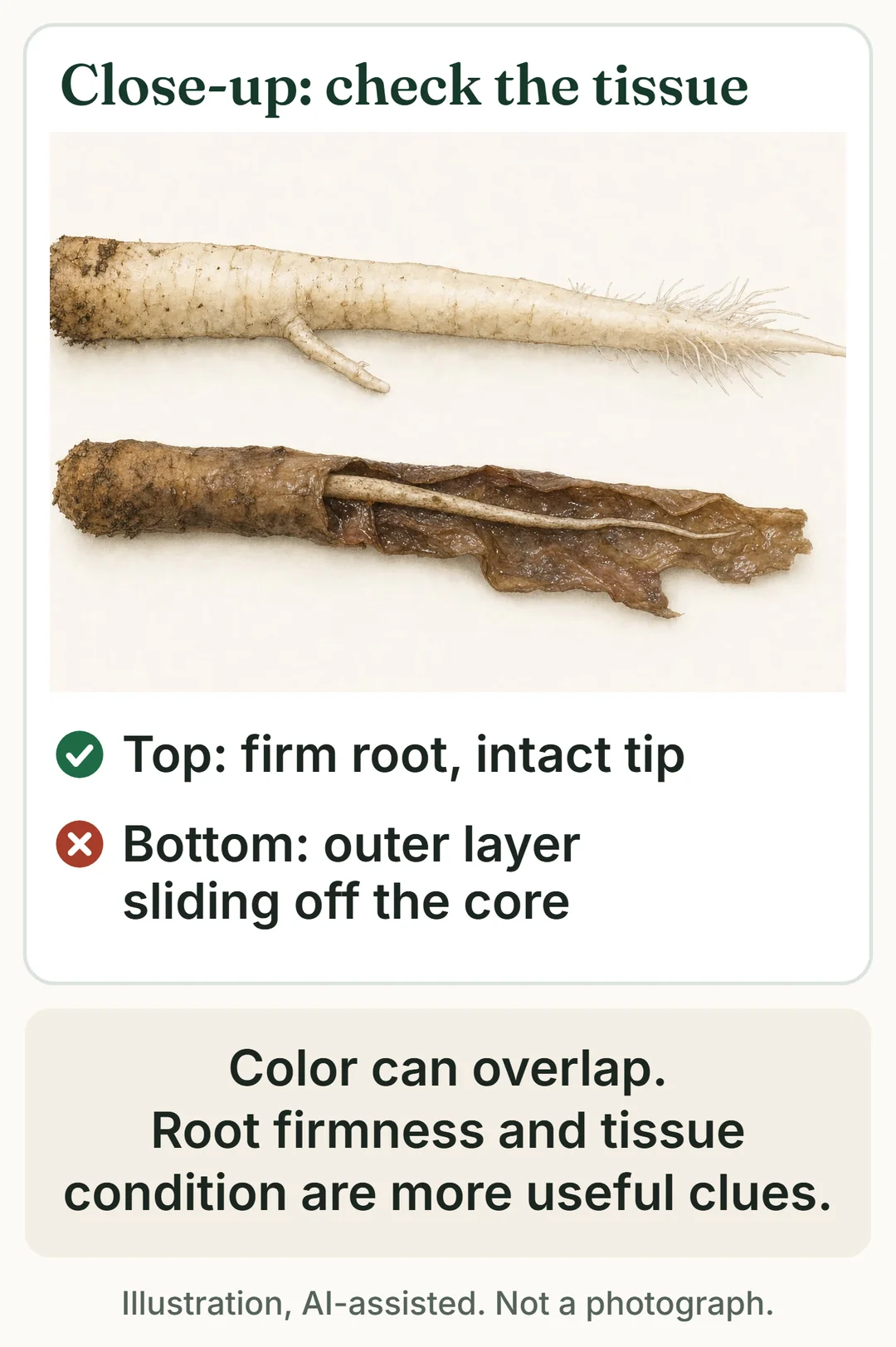
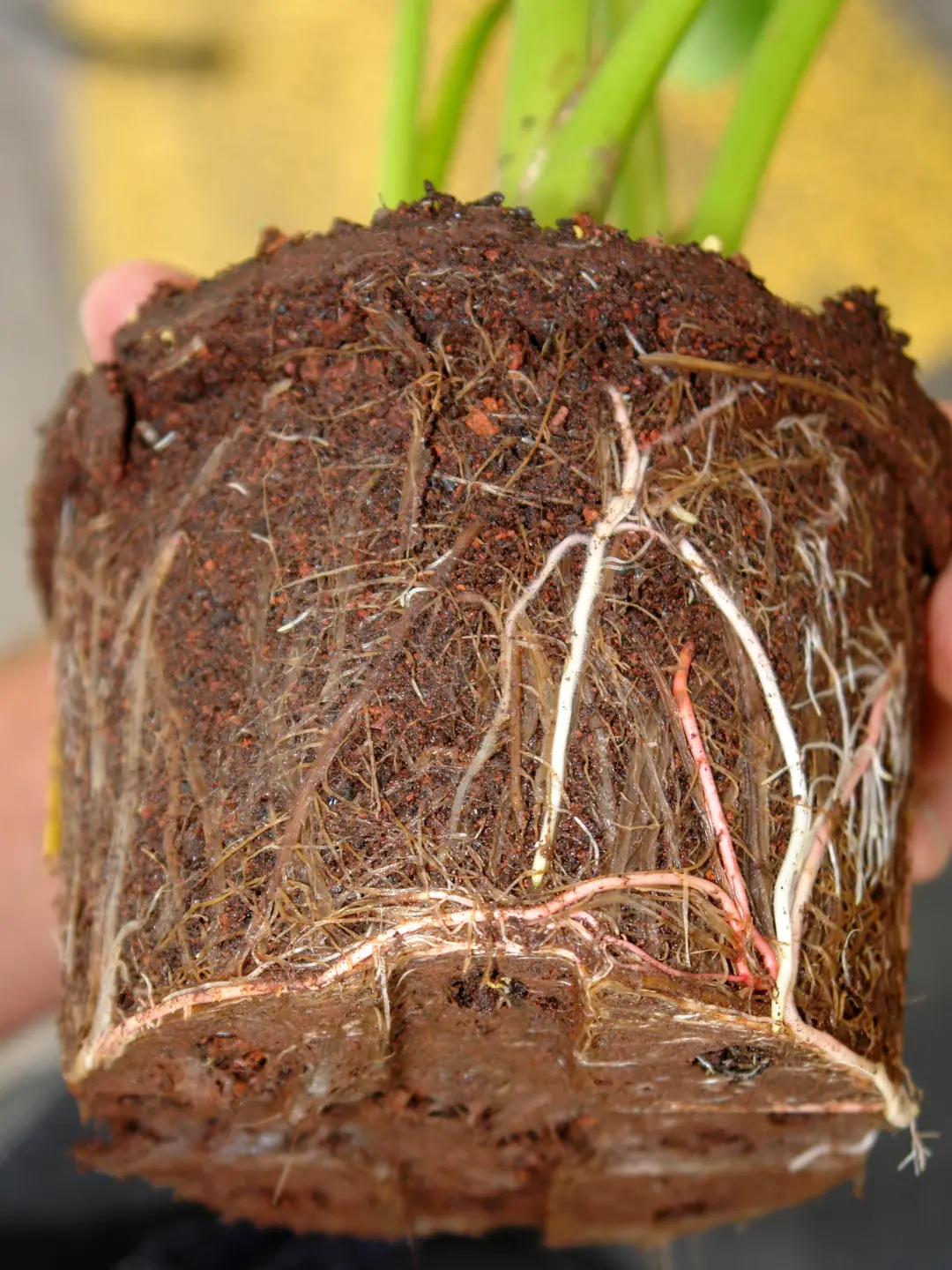
Photo: Scot Nelson, CC0, via Flickr (cropped and resized)
Root rot or something else?
Damaged roots don’t always mean root rot. Penn State Extension, writing for commercial growers, lists other causes of the same root symptoms: too much fertilizer, too much or too little water, chilling, pesticide injury and a pot-bound plant. Wisconsin Extension cautions that very few diseases can be diagnosed accurately by eye, and Iowa State Extension notes that identifying the fungus involved takes a microscope or a lab test.
How to treat root rot
Treatment means removing the rotted roots, giving the plant a clean start, and changing how you water.
- Move the plant away from your other plants. University of Maryland Extension advises separating infected plants from healthy ones.
- Remove the old potting mix and throw it away. Wisconsin Extension advises against reusing potting mix from your houseplants, or water that drained from them, because both can carry root rot fungi.
- Cut off the rotten roots. If only a few roots are infected, Clemson Extension advises cutting them out and repotting the plant in sterile soil.
- Repot in fresh mix. Use a pasteurized commercial potting mix, not garden soil, and a pot with drainage holes. Wisconsin Extension advises against putting rocks or gravel in the bottom, because they can actually hinder drainage.
- Use a new pot or a cleaned one. Wisconsin Extension recommends throwing out plastic pots that held a plant with root rot, because they are often difficult to disinfest adequately. Clemson Extension’s general advice is to scrub reused pots and rinse them in one part bleach to nine parts water.
- Clean up. After working on the plant, disinfest tools, work surfaces and clay pots with a 10% bleach or detergent solution, or alcohol, as Wisconsin Extension advises.
- Water less often. Iowa State Extension suggests reducing how often you water. Wisconsin Extension advises giving enough water for the plant’s growth and to prevent drought stress, but not overwatering, and never letting the plant sit in drainage water.
If most of the roots are rotten
Clemson Extension advises that if most of the roots are dark, soft and dead, it is better to discard the plant. Wisconsin Extension goes further: throwing out a plant with root rot is often the best and most cost-effective option. If the plant grows from cuttings, University of Maryland Extension advises taking stem cuttings only from healthy tissue.
Rotted roots do not come back. Penn State Extension (writing for commercial growers) notes that dead roots do not recover; new roots have to grow.
Should you use a fungicide?
Usually not. Wisconsin Extension does not recommend chemical fungicides for root rots on houseplants, because few products are available to home gardeners and those that are tend to be expensive. Clemson Extension notes that fungicides are available but will probably cost most indoor gardeners more than a new plant.
Penn State Extension, writing for commercial growers, adds that no single fungicide controls all root rot fungi, so the fungus or fungal group has to be identified first, and that repeated applications are necessary.
Does hydrogen peroxide cure root rot?
Hydrogen peroxide is a home remedy often suggested online for root rot, but the evidence for it on houseplants is thin. A 2021 study in the journal HortTechnology notes that, like most home remedies, its use on orchid roots had not been tested in a controlled study, and set out to find out how much the roots can tolerate.
- The roots of ‘Vivaldi’ phalaenopsis orchids dipped once for 3 minutes in 6% or 12% hydrogen peroxide were permanently damaged.
- A single 3% dip, the rate the authors found most often recommended in online orchid sources, caused only minor root damage during the 27-day trial. The authors note that even this could set the plant back, that repeated dips could add damage, and that long-term effects are unknown. It also did not subdue the algae in the root zone, so the authors question whether it would control root rot organisms.
- The authors do not recommend hydrogen peroxide as a home remedy for root decay on phalaenopsis orchids. They advise changing care and watering instead, such as repotting into fresh, well-drained potting mix.
The study tested single 3-minute root dips at 3%, 6% and 12% on one hybrid phalaenopsis orchid, ‘Vivaldi’, not other houseplants; it did not test weaker solutions or soil drenches, and it measured plant damage, not whether the treatment cures root rot. The authors cite a greenhouse study in which seed treatment and soil drenches with 0.25% to 2% hydrogen peroxide suppressed root rot organisms on thyme; we did not review that study. None of the extension guides cited here recommends hydrogen peroxide for root rot; they recommend watering less, cutting out rotted roots and repotting, or discarding badly affected plants.
How to prevent root rot
- Water by need, not by schedule. Iowa State Extension advises watering plants based on their specific needs rather than on a schedule, and avoiding excessive watering.
- Use a pot with drainage holes and no layer of rocks or gravel, and don’t let the plant sit in drainage water (Wisconsin Extension).
- Use pasteurized commercial potting mix, not garden soil. Wisconsin Extension notes that garden soils often contain root rot fungi. Iowa State Extension recommends a well-aerated mix that drains easily.
- Check new plants. Buy from a reputable source and make sure plants are free of root rot before you buy (Wisconsin Extension), and inspect new plants before you put them with your others (University of Maryland Extension).
- Don’t overfeed. Iowa State Extension advises avoiding over-fertilization.
- Keep plants vigorous. Stressed plants are easy targets for root rot organisms, Iowa State Extension notes, so give them adequate but not too much water, good nutrition and no environmental extremes during the winter.
Frequently asked questions
Can a plant recover from root rot?
Sometimes. Rotted roots do not recover; new roots have to grow (Penn State Extension). If only a few roots are affected, Clemson Extension advises cutting them out and repotting in sterile soil. If most roots are dark, soft and dead, it advises discarding the plant.
Is root rot contagious to other plants?
It can spread. Clemson Extension notes that the fungi survive in soil and plant debris, and that their spores can spread by wind, splashing water or moving infested soil. Keep an infected plant away from others, don’t reuse its potting mix or drainage water, and clean your tools and pots afterward.
Why is my plant wilting when the soil is wet?
Roots badly damaged by rot cannot move water to the leaves, so a plant with root rot can wilt in wet soil, as University of Maryland Extension explains. Don’t water it more: check the roots first. A plant that wilts in dry soil is a different problem: it may simply need water.
Should I water a plant with root rot?
Water less, not more. Wisconsin Extension advises reducing soil moisture: give enough water for growth and to prevent drought stress, but don’t overwater.
Not sure it’s root rot? Go back to the root check: if the soil is wet and the plant wilts, look at the roots before you water again.
Sources
- University of Wisconsin–Madison Extension: Root Rots on Houseplants (UW Plant Disease Facts D0096).
- University of Maryland Extension: Root Rots of Indoor Plants; Winter Indoor Plant Problems.
- Iowa State University Extension and Outreach: Root Rots of Houseplants (2014); Prevent Root Rot Problems on Houseplants (1994); Two Common Houseplant Diseases (2005).
- Clemson Cooperative Extension, Home & Garden Information Center: Houseplant Diseases & Disorders (HGIC 2251).
- Penn State Extension: Fungal Root Rots and Chemical Fungicide Use (written for commercial growers).
- Goossen, R. and K. A. Williams. 2021. Characterizing the Phytotoxic Effects of Hydrogen Peroxide Root Dips on Hybrid Phalaenopsis Orchid Plants. HortTechnology 31(6): 810–816.
