
Plant Problems › Money Tree Yellow Leaves
This guide covers the money tree sold as a houseplant, Pachira aquatica, often with braided trunks. Its yellow leaves have several possible causes, and the sources weight them differently: the New York Botanical Garden (NYBG) links yellowing leaves with rotting stems to overwatering, and yellowing in autumn to lower light, while NC State Extension names low humidity and too few nutrients. Start with the potting mix and the stems, then work through the rest.
Quick answer
Causes to check:
- Some leaves yellow and fall in autumn as the light gets lower: a seasonal response. Often normal
- Mix stays wet, yellow leaves, rotting stems: too much water or rot. Act soon
- Leaves drop after a move, repotting or a draft: stress from the change. Fix this week
- Mix dry deep down and leaves wilted or dropping: too little water. Fix this week
- Dry indoor air, especially in winter: low humidity. Fix this week
- Strong direct sun, or a dim spot far from a window: the wrong light. Fix this week
- No fertilizer in the growing season, or roots crowd the pot: nutrients or crowded roots. Fix this week
Labels show how quickly to act if a cause is confirmed. They are not a diagnosis; check the signs in each section first.
Is a yellow money tree leaf normal? Often normal
Sometimes. Penn State Extension’s general plant-diagnosis key (not specific to money trees) lists natural aging among the reasons old leaves turn yellow, along with a shortage of nitrogen, magnesium or potassium, overwatering, pot-bound roots and root rot. NYBG adds that money tree leaves may yellow and fall in autumn, when days shorten and light gets lower; it advises more light if possible and patience, since leaves should return with the next flush of growth.
One older leaf yellowing now and then, while new leaves come in green, fits aging. If many leaves yellow at once, or stems are rotting, check the causes below.
Too much water or rot
How urgent: Act soon
NYBG notes that yellowing leaves and rotting stems mean overwatering, water splashed on the stem, or a potting mix that holds too much water, and that the pot must have a drain hole. NC State Extension notes that money trees don’t tolerate standing water, which can cause root rot.
How to tell
- The mix is still wet below the surface, or water collects in the saucer.
- Leaves turn yellow without wilting: a Colorado Master Gardener answering an Ask Extension question notes that this can point to overwatering. Wilting doesn’t rule out overwatering, though: Clemson Extension notes, for houseplants in general, that root rot also causes wilting, and that watering then can make the problem worse.
- Stems are rotting (NYBG). For houseplants in general, Clemson Extension notes that stems may be girdled at or near soil level by a ring of brown or black tissue.
- Rotting roots are brown to black and may be soft (Clemson Extension, for houseplants in general).
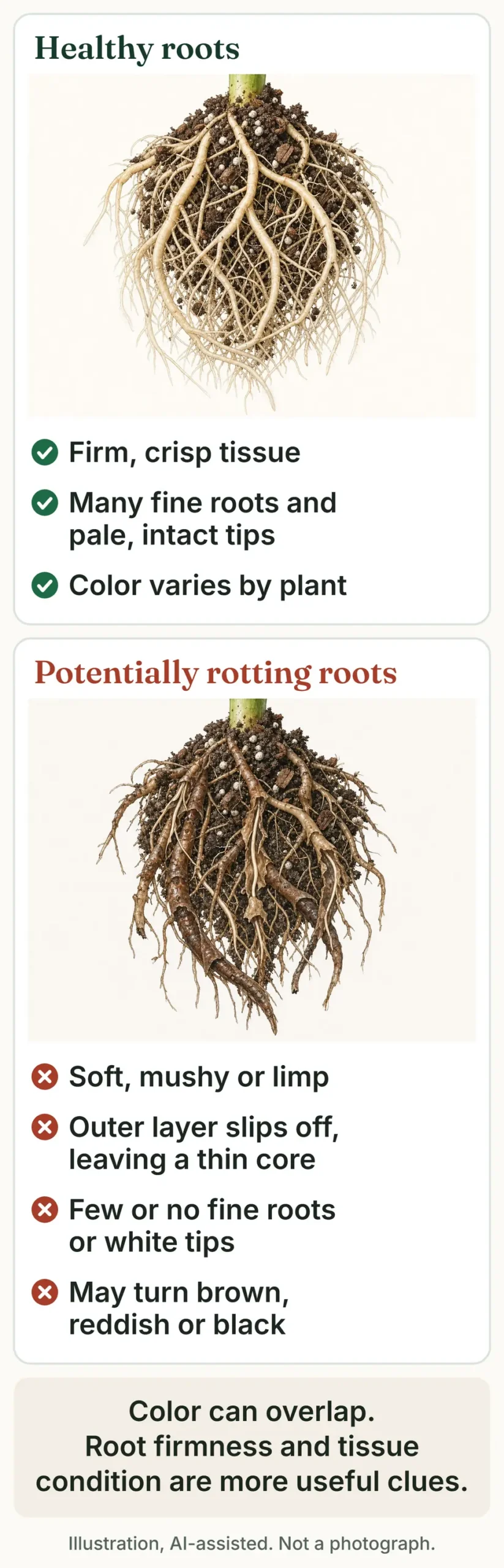
How to fix
- Stop watering until the mix has nearly dried, and empty the saucer. NYBG suggests checking the saucer 15 minutes after watering and removing any water in it.
- Water the mix, not the trunk: NYBG names water splashed on the stem as a cause.
- If the plant keeps declining in wet mix, check the roots. Clemson Extension advises, for houseplants in general, that if only a few roots are infected, you cut them out and repot the plant in sterile potting mix, in a new pot or one scrubbed clean and rinsed in a solution of one part bleach to nine parts water.
- If most roots are dark, soft and dead, Clemson Extension advises discarding the plant, and University of Maryland Extension adds to take stem cuttings only from healthy tissue (both general houseplant guides). NC State Extension notes that money trees grow from softwood cuttings.
Prevent it
NYBG advises watering thoroughly, then letting the mix nearly dry before the next watering, without letting the roots dry out completely, in a pot with a drain hole and a well-draining mix.
Stress from a move, repotting or a draft
How urgent: Fix this week
NYBG notes that money trees dislike being moved, react to hot or cold drafts, and often drop leaves when their roots are disturbed too much. It advises correcting the environment and being patient: the leaves will probably return with the next flush of growth.
How to tell
- The leaves started dropping soon after the plant was moved, repotted or placed near a door, window, heater or air-conditioning vent.
- If leaves turn yellow rather than drop, check the other causes, starting with the mix.
How to fix
- Choose a stable spot away from drafts and heating or cooling vents, and leave the plant there.
- Don’t repot or move it again while it recovers.
Too little water
How urgent: Fix this week
Missouri Botanical Garden and NC State Extension note that money trees drop leaves if the soil gets too dry. The Colorado Master Gardener’s Ask Extension answer adds that wilted yellow leaves can point to underwatering. Wilting alone isn’t proof of thirst: Clemson Extension notes, for houseplants in general, that root rot also causes wilting, so check that the mix is dry before you water. NYBG advises not letting the roots dry out.
How to tell
- The mix is dry deep down and the pot feels light.
- Leaves are wilted or dropping. If the mix is wet instead, see too much water.
How to fix
- Water thoroughly until water runs out of the drainage hole, then empty the saucer.
- If very dry mix won’t take up water, Clemson Extension suggests watering again half an hour later, or setting the pot in a sink or bucket of water, then taking it out once the surface is moist and letting it drain completely.
- From then on, follow NYBG’s routine: water thoroughly, then let the mix nearly dry before the next watering. The Colorado Master Gardener’s quick check is to water when the top two inches are dry.
Dry air
How urgent: Fix this week
NC State Extension notes that yellow leaves can occur if the humidity is too low. NYBG suggests humidity of around 50% and notes that most homes are on the dry side, especially in winter, when leaves can turn crispy.
How to tell
- The plant sits near a heating vent, radiator or fan, or the air is dry in the heating season.
- Leaves look crispy or curl: NYBG links this to low humidity, but also to poor light or an inconsistent watering routine.
How to fix
- Move the plant away from heating vents and fans.
- Raise the humidity around it: NYBG suggests setting the pot, in its saucer, on a larger tray of pebbles kept filled with water.
The wrong light
How urgent: Fix this week
NYBG advises bright, filtered light: a room with sun for most of the day, but not right in the window, because strong direct sun can burn the leaves. In poor light, NYBG notes, money trees can slowly decline. NC State Extension also advises indirect light, noting that direct sun can scorch the leaves. Penn State Extension’s general plant-diagnosis key lists light that is too intense or insufficient among the causes of general yellowing.
How to tell
- Too much: scorched or sunburned patches on leaves that get strong direct sun.
- Too little: the plant slowly declines in a dim spot (NYBG), and leaves may yellow and fall as days shorten in autumn.
How to fix
- Move the plant to bright, filtered light, out of strong direct sun.
- Rotate the pot each time you water, as NYBG suggests, so all sides get light.
Nutrients and crowded roots
How urgent: Fix this week
NC State Extension notes that yellow leaves can occur when the soil lacks nutrients. NYBG advises a balanced, organic fertilizer at half strength every two weeks during the growing period, March to September only, and notes that the plant may need repotting every two or three years. The Colorado Master Gardener suggests a larger pot for a plant that looks root-bound.
How to tell
- The plant hasn’t been fed during the growing season, and water, light and humidity check out.
- Roots fill the pot and the plant wilts between waterings: Clemson Extension notes, for houseplants in general, that a pot-bound plant has too little soil to hold the water for all its roots, so it wilts.
How to fix
- Rule out water, light and drafts first: yellow leaves alone don’t prove a nutrient shortage.
- Feed during the growing season as above, not in winter, and don’t overdo it: Penn State Extension’s general key lists overfertilization among the causes of yellowing young leaves and leaf drop.
- Repot in spring into a pot only one size larger, with a drain hole, disturbing the roots as little as possible (NYBG).
Other causes
- Pests: NC State Extension lists aphids, mealybugs, scale and fungus gnats, and NYBG names scale insects as a common problem. Look along the stems and under the leaves, and isolate an infested plant.
Money tree at a glance: bright, filtered light, no strong direct sun · water thoroughly, let the mix nearly dry, empty the saucer · a stable spot away from drafts and vents (NYBG: 65 to 85°F; NC State: 65 to 75°F) · humidity around 50% · feed lightly from March to September only · it may need repotting every two or three years, one pot size up · the ASPCA lists it as non-toxic to cats and dogs, though eating it can cause nausea, vomiting and loose stool; NC State Extension lists it as a problem for cats, with mild to moderate stomach upset (vomiting, diarrhea and drooling), and names the seeds, which houseplants never produce, as the poisonous part · full money tree care guide
Not sure which cause fits? Start with the potting mix and the stems: feel both. If the mix stays wet or stems are rotting, check the roots (see too much water).
Sources
- New York Botanical Garden, LuEsther T. Mertz Library: Money tree (Pachira aquatica) (research guide); How do I care for my money tree houseplant?.
- NC State Extension Gardener Plant Toolbox: Pachira aquatica.
- Missouri Botanical Garden: Pachira aquatica (Plant Finder).
- Ask Extension: Diagnose problem with Money Tree (answered by a Colorado Master Gardener, Denver County, 2021).
- Penn State Extension: Diagnosing Poor Plant Health.
- Clemson Cooperative Extension, Home & Garden Information Center: Houseplant Diseases & Disorders (HGIC 2251); Indoor Plants – Watering (HGIC 1459).
- University of Maryland Extension: Root Rots of Indoor Plants.
- ASPCA Animal Poison Control: Money Tree (Pachira aquatica).
