
Plant Problems › Overwatered Plant
Missouri Botanical Garden calls overwatering one of the more common causes of plant problems. University of Maryland Extension explains why it is confusing: excess water reduces the oxygen in the soil, which damages the fine roots, so the plant can’t take up water and can look as if it needs more. Check the potting mix before you decide.
Quick answer
Feel the potting mix first, then:
- Mix stays wet below the surface, plant wilting or yellowing: likely overwatered. Stop watering and let it dry. If it is wilting while the mix is still wet, check the roots. Act soon
- Mix dry deep down, plant wilting: likely underwatered. Water thoroughly. Act soon
- Mix moist, plant droops only in hot afternoon sun: it can recover by evening; if it is still limp the next morning, check the roots. Often normal
Labels show how quickly to act if a cause is confirmed. They are not a diagnosis; check the signs in each section first.
Signs of an overwatered plant
None of these signs proves overwatering on its own, so look at them together with the potting mix:
- Wilting or yellowing of the lower and inner leaves: University of Maryland Extension names this as the main sign of too much water.
- Slow, stunted growth with yellowing leaves (Missouri Botanical Garden).
- Scorch and leaf drop, if the excess water continues (University of Maryland Extension).
- Water-soaked spots and blisters on leaves and stems, called edema (Missouri Botanical Garden). Clemson Extension adds that poor light with low temperatures also predisposes plants to it.
- A rotting crown or stem base (Missouri Botanical Garden).
- Mix that stays wet and smells sour or rotten: Missouri Botanical Garden notes that soil kept too long without oxygen usually does.
- Fungus gnats: Clemson Extension notes that these small flies are especially a problem when plants are overwatered.
- Soft, mushy roots: Clemson Extension describes infected roots as brown to black and possibly soft, and University of Maryland Extension notes that with some root rots the outer layer of the root pulls away easily. Color alone isn’t reliable; firmness tells you more.
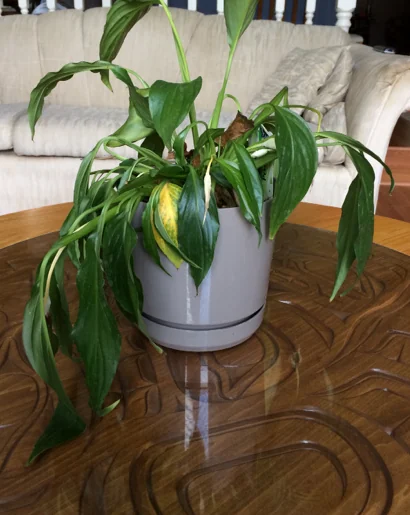
Photo: Scot Nelson, CC0, via Flickr (cropped and resized)
Overwatered or underwatered?
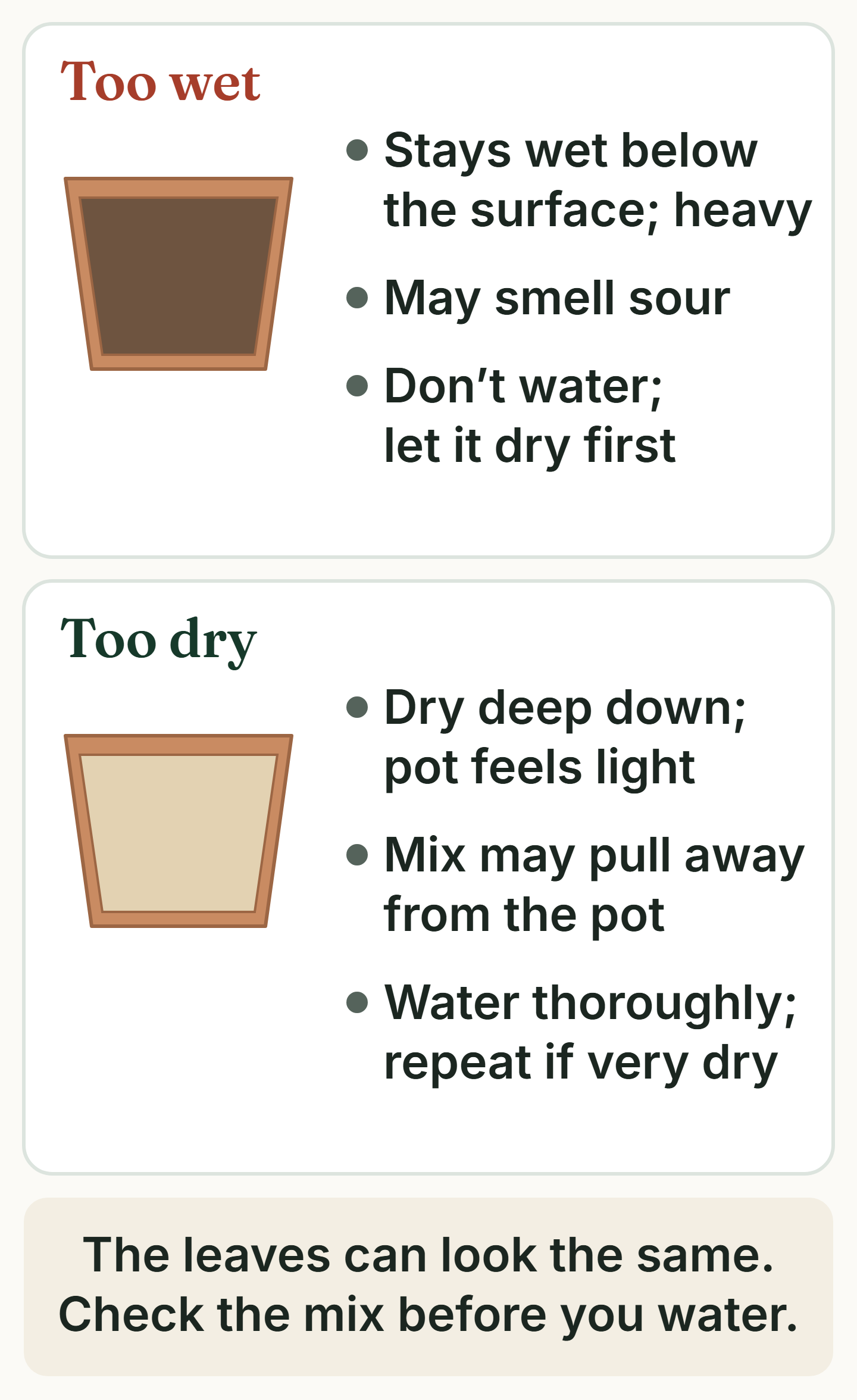
The leaves don’t settle it. University of Maryland Extension notes that plants with too much water show the same symptoms as plants with root rot or drought stress: wilting, yellowing, scorch and leaf drop. Check the potting mix next: mix that stays wet below the surface points toward too much water, and mix that is dry deep down toward too little. It isn’t proof. A plant watered just after drying out also has wet mix, and University of Maryland Extension notes that some root rots make plants wilt even when the mix is only moist, so check the roots if the plant doesn’t improve.
Signs it is too wet
- The mix stays wet below the surface long after watering. Missouri Botanical Garden warns that a dry surface isn’t a reliable sign, because the top dries first.
- The pot stays heavy. University of Maryland Extension notes that the mix gets lighter as it dries, so lifting the pot tells you a lot.
- The mix smells sour or rotten (Missouri Botanical Garden).
Signs it is too dry
- The mix is dry about two inches down, the depth University of Maryland Extension suggests testing with a finger, and the pot feels light. UMD notes that this test works for most plants, but succulents and cacti need far less water.
- The mix has shrunk away from the sides of the pot (University of Maryland Extension).
- Leaves wilt and curl. University of Maryland Extension adds that over a longer dry period, plants can yellow, scorch, brown, drop leaves and grow poorly.
For a large pot, University of Maryland Extension suggests pushing a stick or dowel to the bottom: moist mix sticks to it or darkens it slightly.
Why plants get overwatered
- Watering on a schedule: University of Maryland Extension notes that this can give plants too much or too little water; water when the plant needs it.
- No drainage hole: Iowa State Extension notes that without one the soil stays wet and roots rot and die, and that gravel in the bottom doesn’t make up for it.
- Water left in the saucer: Iowa State Extension and Clemson Extension advise never letting the pot sit in water.
- A heavy, moisture-holding mix: Clemson Extension notes that fine-textured mixes and mixes with a lot of peat moss hold more moisture than loose mixes with bark, sand or perlite.
- Slower growth: Clemson Extension notes that a plant needs less water while growth slows and while it is dormant.
How to save an overwatered plant
- Stop watering, and empty any water in the saucer or outer pot.
- Let the mix dry before you water again: test it with a finger about two inches down, or by the weight of the pot (University of Maryland Extension). Succulents and cacti need far less water than most plants.
- If the plant is wilting while the mix is still wet, or the stem base is soft or dark, slide it out of the pot and look at the roots, as Missouri Botanical Garden suggests. Color varies, so firmness tells you more. Iowa State Extension notes that healthy root tissue is firm and white, and rotted roots are mushy and brown or reddish; University of Maryland Extension adds that with some root rots the outer layer of the root slips off easily.
- If only a few roots are infected, Clemson Extension advises cutting them out and repotting the plant in sterile potting mix, in a new pot or one scrubbed clean and rinsed in a solution of one part bleach to nine parts water.
- If most roots are dark, soft and dead, Clemson Extension advises discarding the plant, and University of Maryland Extension adds to take stem cuttings only from healthy tissue.
- Fix the cause: a pot with a drainage hole, no standing water, and watering by need rather than by the calendar. When you repot, choose a pot no bigger than the roots need: Iowa State Extension advises a container small enough that the potting mix and roots dry out in a reasonable time and don’t sit for long periods in wet soil.
Wilting in wet mix is a warning sign: Clemson Extension notes that root rot also causes wilting, and that watering a plant in that state can make the problem worse.
When to act quickly
- Wilting while the mix is wet: stop watering and check the roots. See how to save it.
- A soft, dark or rotting stem base: check the roots today. See how to save it.
Frequently asked questions
Can an overwatered plant recover?
It depends on the roots. Clemson Extension advises cutting out a few infected roots and repotting, but discarding the plant if most roots are dark, soft and dead. University of Maryland Extension advises taking stem cuttings only from healthy tissue.
Should I repot an overwatered plant?
Not always. If the roots are firm, letting the mix dry may be enough. Repot when you have cut out rotting roots, as Clemson Extension advises, or when the pot has no drainage hole (Iowa State Extension). To keep a decorative pot without a hole, Iowa State suggests setting a slightly smaller pot with a drainage hole inside it.
Is it normal for a plant to droop in the afternoon?
It can be. University of Maryland Extension notes that a plant sometimes wilts on a hot day because water evaporates from the leaves faster than the roots can supply it; with enough moisture in the mix, it firms up again in the evening. If it is still limp the next morning, check the roots.
Not sure what is wrong? Start with the potting mix check.
Sources
- Missouri Botanical Garden: Overwatering.
- University of Maryland Extension, Home & Garden Information Center: Overwatered Indoor Plants; Drought Stress to Indoor Plants; Watering Indoor Plants; Root Rots of Indoor Plants.
- Clemson Cooperative Extension, Home & Garden Information Center: Indoor Plants – Watering (HGIC 1459); Houseplant Diseases & Disorders (HGIC 2251); Common Houseplant Insects & Related Pests (HGIC 2252).
- Iowa State University Extension and Outreach: How to Care for Houseplants; Root Rots of Houseplants (2014).
