
Plant Problems › Monstera Yellow Leaves
A yellow leaf on a monstera (Monstera deliciosa, also called Swiss cheese plant or split-leaf philodendron) can be an old leaf at the end of its life, or a sign that the plant is too wet, too dry, too dark, too cold or underfed. Penn State Extension notes that few diseases affect monsteras and that giving them the conditions they need reduces problems, so start with water, light and temperature. Extension guides say little about yellow monstera leaves specifically, so this guide also uses general houseplant guidance and says so where it does.
Quick answer
Causes to check:
- One older, lower leaf now and then, the rest healthy: natural aging. Often normal
- Cream or white marbling on a variegated cultivar: part of the leaf pattern. Often normal
- Mix stays wet, lower leaves yellow, drops of water on the leaves: too much water or root rot. Act soon
- Near a cold window, door or draft: possible cold or temperature stress. Act soon
- Mix dry deep down, plant drooping: too little water. Fix this week
- Dim spot, long gaps between leaves, new leaves on a mature plant without holes: too little light. Fix this week
- Roots crowd the pot and the mix dries out fast: crowded roots. Fix this week
- Older leaves fading after months without fertilizer: possibly a nutrient shortage, once the other causes are ruled out. Fix this week
Labels show how quickly to act if a cause is confirmed. They are not a diagnosis; check the signs in each section first.
Is a yellow monstera leaf normal? Often normal
Sometimes. Penn State Extension’s general plant-diagnosis key (not specific to monsteras) lists natural aging among the reasons old leaves turn yellow, along with a shortage of nitrogen, magnesium or potassium, overwatering, pot-bound roots and root rot. One older, lower leaf yellowing now and then, while new leaves come in green, fits aging. If several leaves turn yellow at once, or new leaves are affected, check the causes below.
Variegated monsteras
Some cultivars are variegated by design: Penn State Extension and University of Wisconsin–Madison Extension name forms such as ‘Thai Constellation’ and ‘Albovariegata’, and NC State Extension describes ‘Thai Constellation’ as marbled and speckled creamy white and green. NC State also notes that variegated cultivars need more light than dark green ones. A variegated plant can still turn yellow for any of the reasons below, so check them if leaves change color.
Too much water or root rot
How urgent: Act soon
Penn State Extension advises watering thoroughly and letting the top 1 to 2 inches of the mix dry out between waterings, and warns that overwatering can result in root rot. University of Wisconsin–Madison Extension notes that the leaves “sweat” when the mix is too moist and advises watering less to prevent root rot, and watering less in winter.
How to tell
- The mix is still wet below the surface days after watering.
- Drops of water form on the leaves (University of Wisconsin–Madison Extension).
- Lower and inner leaves turn yellow or the plant wilts: University of Maryland Extension names these as the main signs of too much water in houseplants in general.
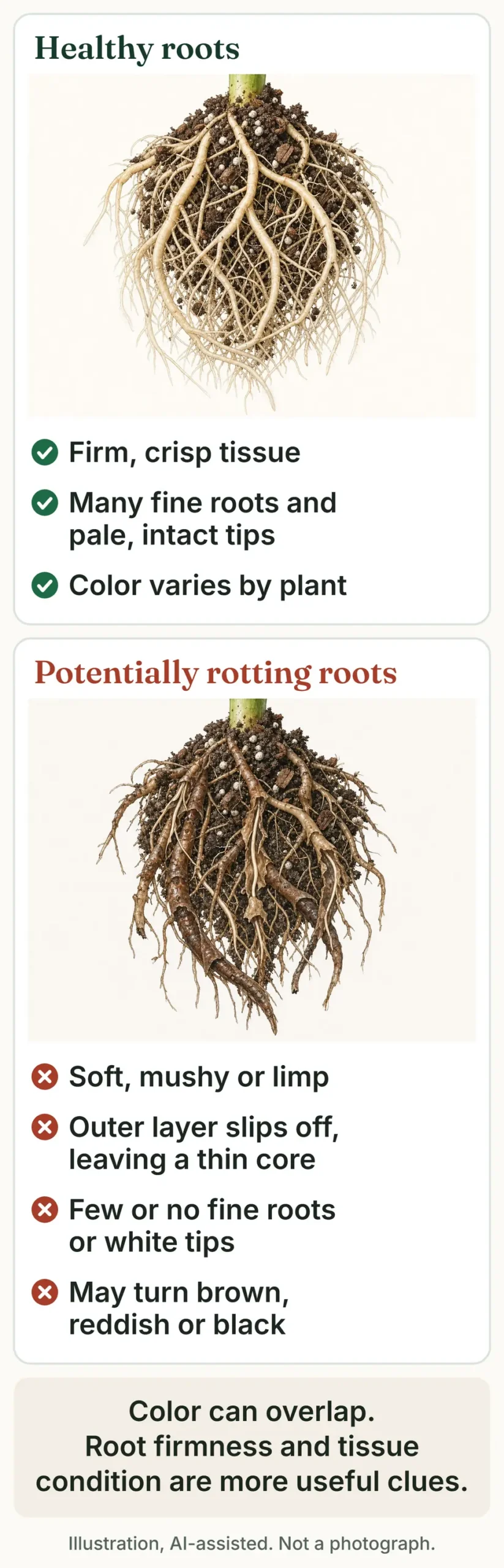
- Rotting roots are brown to black and may be soft (Clemson Extension, for houseplants in general).
How to fix
- Stop watering until the top 1 to 2 inches of the mix are dry, and empty the saucer.
- If the plant keeps wilting in wet mix, slide it out of the pot and check the roots. Clemson Extension advises that if only a few roots are infected, you cut them out and repot the plant in sterile potting mix, in a new pot or one scrubbed clean and rinsed in a solution of one part bleach to nine parts water.
- If most roots are dark, soft and dead, Clemson Extension advises discarding the plant, and University of Maryland Extension adds to take stem cuttings only from healthy tissue (both general houseplant guides). Monsteras grow from stem cuttings (Penn State Extension).
- Wear gloves when you cut or repot: Penn State Extension notes that handling monsteras can cause skin irritation (contact dermatitis).
Prevent it
Use a well-draining soilless potting mix (Penn State Extension), and water less from fall to late winter (Missouri Botanical Garden).
Too little water
How urgent: Fix this week
NC State Extension notes, for a related species (Monstera epipremnoides), that yellow leaves can mean either under- or overwatering. University of Wisconsin–Madison Extension notes that monsteras kept on the dry side grow more slowly. Guides differ on how dry to let the mix get: Penn State Extension says the top 1 to 2 inches, NC State Extension the top quarter to one-third of the pot.
How to tell
- The mix is dry deep down and the pot feels light.
- The plant droops: University of Maryland Extension notes that a plant that is too dry wilts.
How to fix
- Water thoroughly until water runs out of the drainage hole, then empty the saucer.
- If very dry mix won’t take up water, Clemson Extension suggests watering again half an hour later, or setting the pot in a sink or bucket of water, then taking it out once the surface is moist and letting it drain completely.
Too little or too much light
How urgent: Fix this week
Clemson Extension notes, for philodendrons, that yellowing lower leaves can come from too little light or overwatering, and that monsteras, close relatives, don’t develop their holes and cuts when light is too low. Penn State Extension advises bright light near a sunny window but not direct sun, and notes that monsteras get “leggy” in lower light. Missouri Botanical Garden also advises against strong direct sun. University of Wisconsin–Madison Extension differs: it suggests bright light in summer and direct sun in winter.
How to tell
- Too little light: long gaps between leaves, and new leaves on a mature plant coming in without holes or splits. Young plants make small, uncut leaves normally: Penn State Extension and NC State Extension note that only mature leaves develop the holes.
- Too much light: Iowa State Extension notes, for houseplants in general, that bleached or damaged leaves, or leaves that yellow or brown and drop, can mean the light is too strong. University of Wisconsin–Madison Extension warns that leaves sunburn if a monstera moved outside isn’t adjusted to the brighter light gradually.
How to fix
- Move the plant to bright light near a sunny window, out of strong direct sun.
- Make big changes in light gradually.
Cold and drafts
How urgent: Act soon
Penn State Extension and NC State Extension give 60 to 85°F as the right range, and Penn State notes that monsteras “abhor” cold drafts. University of Wisconsin–Madison Extension adds that the plants don’t grow below 50°F. Iowa State Extension notes, for houseplants in general, that any big temperature swing can cause yellowing, browning, wilting or leaf drop.
How to tell
- The plant sits near a cold window or door, or in the path of an air-conditioning vent.
- Leaves yellow or brown after a sudden temperature change (Iowa State Extension, for houseplants in general). Penn State Extension’s general plant-diagnosis key adds that cold injury, as well as crushing or a bacterial infection, can make leaves very dark green, limp and water-soaked.
How to fix
- Move the plant to a spot that stays between 60 and 85°F, away from drafts.
Crowded roots
How urgent: Fix this week
Penn State Extension’s general plant-diagnosis key lists a pot-bound plant among the causes of yellowing old leaves. University of Wisconsin–Madison Extension notes that container-grown monsteras need frequent repotting and ample root room for larger leaves.
How to tell
- Roots circle the pot or grow out of the drainage holes.
- The mix dries out very fast and the plant wilts: Clemson Extension notes, for houseplants in general, that a pot-bound plant has too little soil to hold water for all its roots.
How to fix
- Repot into a pot one size larger with a well-draining soilless mix: Iowa State Extension advises, for houseplants in general, moving up only one (maybe two) container sizes. NC State Extension suggests repotting in spring.
Nutrients and feeding
How urgent: Fix this week
Penn State Extension advises a balanced houseplant fertilizer every two weeks in the growing season and monthly in winter. University of Wisconsin–Madison Extension advises feeding regularly from spring until fall. Penn State’s general diagnostic list links yellowing old leaves to a shortage of nitrogen, magnesium or potassium, but also to aging, overwatering, crowded roots and root rot. Clemson Extension, for houseplants in general, links yellowing and dying lower leaves mainly to a shortage of nitrogen or iron, especially in pot-bound plants.
How to tell
- Older leaves fade or yellow, the plant hasn’t been fed for months, and water, light, temperature and roots check out.
- Too much fertilizer shows differently: Clemson Extension notes, for philodendrons, that it can make leaf tips curl and turn brown.
How to fix
- Rule out water, roots, light and cold first: yellow leaves alone don’t prove a nutrient shortage.
- Feed during the growing season as on the fertilizer label, using one of the schedules above. Don’t add extra to speed things up.
Other causes
- Pests: Penn State Extension and Missouri Botanical Garden list scale, aphids, mealybugs, spider mites and thrips. Clemson Extension notes that spider mites cause light speckling and a faded look, and leaves can turn yellow if the mites aren’t controlled. Check the undersides of the leaves.
- Brown leaf edges instead of yellow: University of Wisconsin–Madison Extension notes that leaf edges turn brown when humidity is too low. Penn State Extension suggests humidity above 50%.
Monstera at a glance: bright light near a sunny window, out of strong direct sun · water thoroughly when the top 1 to 2 inches are dry, less in winter · 60 to 85°F, no cold drafts · humidity above 50% helps · feed in the growing season · a sturdy support to climb · toxic to cats and dogs (ASPCA) · full monstera care guide
Not sure which cause fits? Start with the potting mix: feel it, then check the roots (see too much water).
Sources
- Penn State Extension: Monstera as a Houseplant; Diagnosing Poor Plant Health.
- University of Wisconsin–Madison Extension: Swiss-Cheese Plant, Monstera deliciosa.
- NC State Extension Gardener Plant Toolbox: Monstera deliciosa; Monstera epipremnoides.
- Missouri Botanical Garden: Monstera deliciosa (Plant Finder).
- Clemson Cooperative Extension, Home & Garden Information Center: Philodendron (HGIC 1509, with pothos and monsteras); Houseplant Diseases & Disorders (HGIC 2251); Common Houseplant Insects & Related Pests (HGIC 2252); Indoor Plants – Watering (HGIC 1459).
- University of Maryland Extension: Watering Indoor Plants; Overwatered Indoor Plants; Root Rots of Indoor Plants.
- Iowa State University Extension and Outreach: How to Care for Houseplants.
- ASPCA Animal Poison Control: Cutleaf Philodendron (Monstera deliciosa).
