
Plant Care Guides › Spider Plant Care
Spider plant (Chlorophytum comosum) is a fast-growing houseplant with arching, often striped leaves and long stems that carry small white flowers and baby plants, or plantlets. Wisconsin Extension calls it very easy to grow and propagate and tolerant of neglect, and notes that its thick, fleshy roots store water. This guide covers light, water, soil, temperature, feeding, plantlets and propagation, with a short guide to common problems. Where care guides disagree, we show both views.
Spider plant care at a glance
- Light: bright to medium indirect light; sources differ on direct sun (see Light)
- Water: water thoroughly, then let the top of the mix dry slightly before watering again (Wisconsin Extension; UF/IFAS Extension); water less in winter
- Water quality: sensitive to fluoride; rainwater or distilled water helps (UF/IFAS Extension)
- Soil: a general-purpose potting mix, in a pot with a drainage hole (Wisconsin Extension; New York Botanical Garden)
- Humidity: average household humidity is fine (Wisconsin Extension)
- Temperature: 65 to 75°F by day and 50 to 55°F at night (Clemson Extension); ideal ranges differ by source, and minimums range from 45 to 55°F
- Feeding: light; sources range from monthly to every three to four months during active growth
- Pet safety: non-toxic to cats and dogs (ASPCA)
- Difficulty: easy, though its roots fill a pot quickly
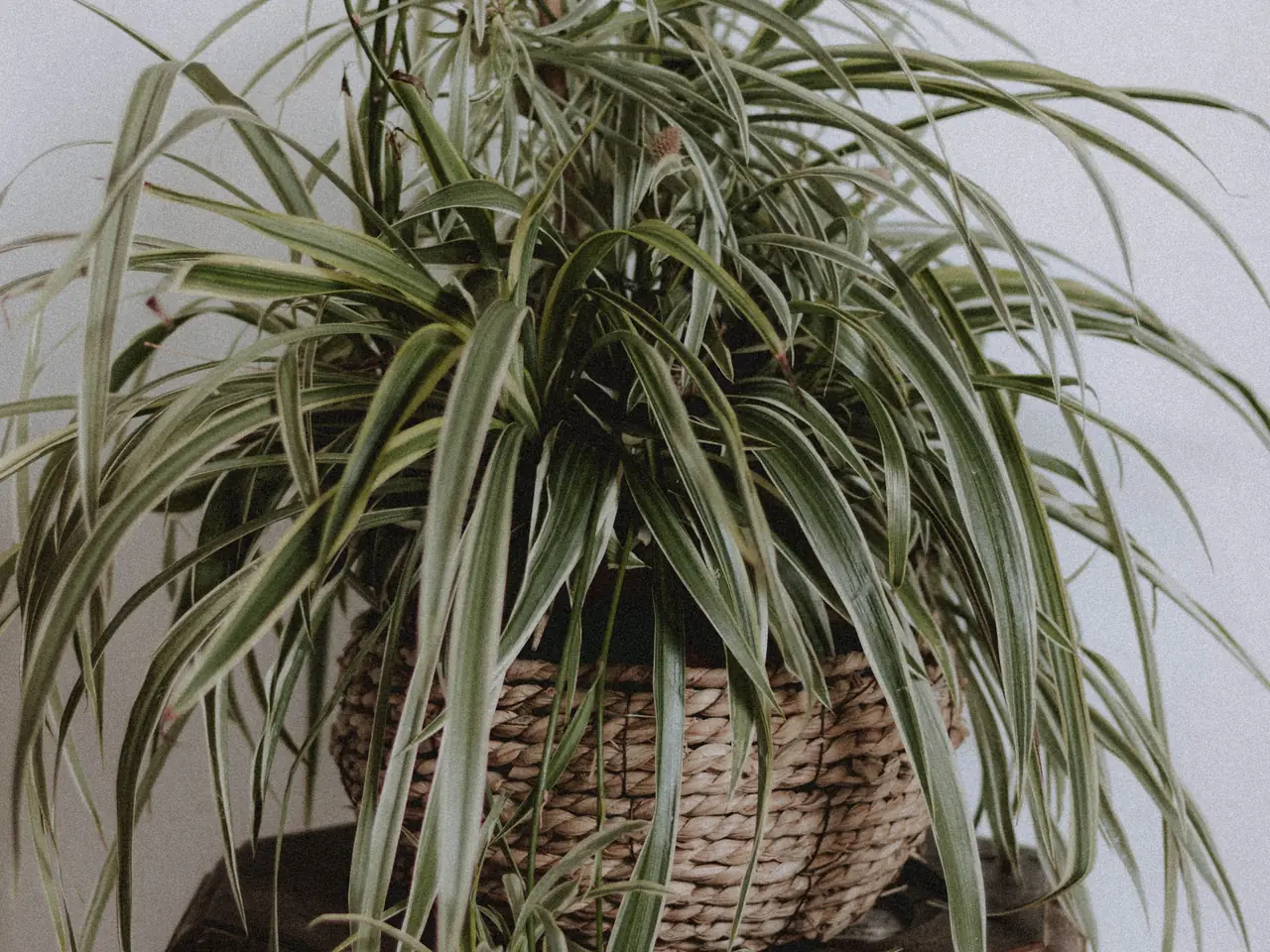
Photo: Mathias Reding, Pexels License, via Pexels (cropped and resized)
Light
Clemson Extension notes that spider plants grow best in bright, indirect light and can tolerate some direct sun, but that midday sun may scorch the leaves. The New York Botanical Garden suggests bright, indirect light a short distance from a window: avoid direct afternoon sun, which can bleach the leaves, though some morning light each day helps. It suggests an east-facing window, or a south-facing one with the plant set a little farther back.
Other sources set the bar lower or warn against any direct sun. Wisconsin Extension suggests medium to bright light, and NC State Extension notes that the plant prefers medium light, can tolerate deep shade and is intolerant of direct sunlight; Colorado State University Extension notes that direct sun will scorch the leaves. Low light has a cost: the New York Botanical Garden notes that spider plants live without strong sun but lose their bright green-and-white contrast. Missouri Botanical Garden notes that they tolerate artificial light very well.
Watering
Wisconsin Extension advises letting the soil dry slightly between thorough waterings, and University of Florida IFAS Extension advises letting the upper inch dry out briefly. The New York Botanical Garden notes that spider plants appreciate consistency: moisten all the soil, water again when it becomes slightly dry, and always empty the run-off water. In an answer about an ailing spider plant, University of Maryland Extension notes that spider plants don’t fare well if kept constantly moist, and that the top inch or more should get fairly dry between waterings.
Sources differ on how moist to keep it: NC State Extension notes that the plant grows best in moist soil but tolerates drought, and Missouri Botanical Garden says to keep it moderately moist. Wisconsin Extension notes that its fleshy roots let it survive inconsistent watering. Water less in winter, when the plant isn’t actively growing (NC State Extension; Colorado State University Extension). The New York Botanical Garden, whose general rule is to water when the soil becomes slightly dry, suggests letting the top half inch dry before watering from November to March. These depth figures, from a half inch to an inch or more, come from different sources and are rules of thumb: Colorado State University Extension notes that plant size, growth, surroundings, container and mix all affect how often a plant needs water.
Water quality matters for this plant. University of Florida IFAS Extension notes that spider plants are particularly sensitive to fluoridated water and suggests rainwater or distilled water if your water is fluoridated. Some guides, such as South Dakota State University Extension, suggest letting tap water stand for 24 hours before use; Missouri Botanical Garden notes that letting water sit doesn’t remove fluoride.
Soil and repotting
Wisconsin Extension and Clemson Extension suggest a general-purpose potting soil. Use a pot with a drainage hole (New York Botanical Garden), filled with potting mix all the way down: in an answer about a spider plant, University of Maryland Extension notes that stones or pot shards in the base of a pot worsen drainage rather than improving it.
The roots fill a pot fast. Colorado State University Extension notes that spider plants need repotting or dividing more often than many houseplants, because their fleshy roots can push the plant out of the pot or even break plastic pots, and Clemson Extension advises dividing and repotting before the roots crack the container. The New York Botanical Garden notes that repotting becomes necessary once the roots force the soil up to the rim, and that spider plants can be repotted in any season. University of Florida IFAS Extension suggests repotting once a year while the plant is young and every other year once it matures.
Sources differ on how snug the pot should be. Wisconsin Extension notes that spider plants grow and produce plantlets best when slightly pot-bound, while University of Maryland Extension, in an older answer, notes that a pot packed with roots leaves too little soil to hold water, which leads to brown leaf tips. A middle course: move up only one size, as the New York Botanical Garden suggests, leaving room for the roots but keeping the pot fairly snug.
Humidity and temperature
Wisconsin Extension notes that spider plants do well with average humidity and cool to average temperatures, though they tolerate warmer conditions. If the air is very dry, NC State Extension suggests a humidifier or a tray of pebbles with water, and the New York Botanical Garden suggests a wet pebble tray. In an answer about a spotted spider plant, University of Maryland Extension advises against misting the leaves, because wet leaves can be easier for fungal and bacterial spores to infect.
Clemson Extension gives 65 to 75°F by day and 50 to 55°F at night as ideal, and South Dakota State University Extension gives the same ranges; Missouri Botanical Garden gives 55 to 70°F as ideal, and University of Florida IFAS Extension calls temperatures above 80°F too warm. Sources differ on the minimum: Missouri Botanical Garden and NC State Extension say to keep the plant above 45°F, the New York Botanical Garden not below 50°F, and University of Florida IFAS Extension calls temperatures below 55°F too cool. Keep the plant away from drafts, air-conditioning vents and heat vents (New York Botanical Garden), and a few feet back from windows in winter (Clemson Extension).
Feeding
Spider plants don’t need much fertilizer. Missouri Botanical Garden advises against over-fertilizing and notes that the plant won’t run short of nutrients, because its tubers store reserve food. Sources differ on how often: Wisconsin Extension and South Dakota State University Extension suggest every three to four months, and Wisconsin adds that you can feed more often at half strength; Colorado State University Extension suggests once a month during active growth; and the New York Botanical Garden suggests a balanced fertilizer at half strength once a month for mature plants. Clemson Extension and South Dakota State University Extension advise waiting four to six months before feeding a newly potted plant.
Don’t overdo it: Wisconsin Extension and the New York Botanical Garden note that too much fertilizer can brown the leaf tips.
Plantlets and flowers
Mature spider plants send out long, wiry stems with small white, star-shaped flowers, and new plantlets form at the ends of those stems after flowering (Wisconsin Extension). You can leave them on for a very full plant or detach them to start new ones (Clemson Extension). The New York Botanical Garden notes that removing plantlets you don’t plan to use spares the plant the resources it would spend on them, though they can also stay on for many years.
Many care guides link these stems to short days. Wisconsin Extension notes that they typically form in response to at least three weeks of short days and long, uninterrupted nights, though indoors they may appear at any time of year; NC State Extension, South Dakota State University Extension and Missouri Botanical Garden give the same three weeks, and Clemson Extension and Colorado State University Extension tie them to the shorter days of fall. The day-length studies, controlled trials on different plants that measured runners rather than plantlets, show a more mixed picture. Hammer (1976) found that short days greatly shortened the time the variegated ‘Vittatum’ took to form its first runners, while an all-green plant he identified as Chlorophytum capense responded much less. Heins and Wilkins (1978) found that all-green spider plants formed more runners when their nights were interrupted with light, and that plants formed runners under every treatment.
Wisconsin Extension, South Dakota State University Extension and the New York Botanical Garden note that a snug pot encourages plantlets. Several sources, including Wisconsin Extension, NC State Extension and Missouri Botanical Garden, note that heavily fertilized plants may form fewer plantlets; a 1979 greenhouse study by Hipp and colleagues, on ‘Variegatum’ in full sun, found that plantlet numbers rose with more fertilizer when plants were watered frequently, but not above low rates when they were watered less often. The New York Botanical Garden also lists light at night as a cause of fewer plantlets, which differs from Heins and Wilkins’s finding on runners. In short, these sources don’t add up to a reliable indoor method or timetable for plantlets; what several care guides point to is a mature plant, a snug pot and no heavy feeding.
Propagation
NC State Extension notes that spider plant propagates easily by plantlets or division. Wisconsin Extension suggests setting a plantlet, still attached to the mother plant, on the surface of a pot of potting mix and cutting the connecting stem once it has rooted, or potting up a plantlet that has already started to form roots. Colorado State University Extension notes that detached plantlets can be rooted in moist potting soil or in water. If you live in Florida, note that a UF/IFAS assessment of non-native plants predicts that spider plant will become invasive there, and UF/IFAS Extension no longer recommends it.
Common problems
These are short summaries; check the signs before you change anything. Visual signs are clues, not proof of a cause.
Brown leaf tips
South Dakota State University Extension notes that brown leaf tips are common on spider plants. Wisconsin Extension lists low humidity, very dry soil, salt buildup and chemicals in tap water, particularly fluoride or chlorine, as possible causes; Clemson Extension adds too much fertilizer, and Colorado State University Extension adds overwatering and drafts. In an older answer, University of Maryland Extension notes that a pot packed with roots can leave too little soil to hold water. So feel the mix before you water: if it is still wet, check the roots instead. Injured leaves can’t heal (University of Maryland Extension, in an answer about a spider plant), so judge a fix by the new leaves. More on spider plant brown tips, cause by cause.
Yellow or curling leaves
Missouri Botanical Garden suggests cutting off yellowed foliage and brown tips, which it notes will occur unless conditions are perfect. In an answer about a spider plant, University of Maryland Extension notes that yellowing can point to over-watering, under-watering, too much or too little light, or a need for fertilizer. The New York Botanical Garden notes that dry, curling leaves that are spotted and yellowing are a sign the plant needs more regular watering while it is growing. Feel the mix before you water more: wet mix points to the opposite problem.
Drooping or limp leaves
Feel the potting mix first. The New York Botanical Garden notes that bleached, limp leaves in winter can mean the room is too warm for the low light, and advises keeping the plant away from heat vents; it also suggests checking that the roots haven’t pushed the soil up so far that water no longer soaks in. For houseplants in general, University of Maryland Extension notes that root rot can make a plant wilt even when the soil is wet. If the mix is dry, water thoroughly: for houseplants in general, Missouri Botanical Garden notes that underwatering makes many plants wilt. If the mix is wet, check the roots before watering again.
Root rot and a dying plant
Wisconsin Extension and Clemson Extension note that overwatering or a mix that doesn’t drain quickly can lead to root rot. Thick, fleshy, tuberous roots are normal for this plant (Clemson Extension). For houseplants in general, University of Maryland Extension notes that healthy roots should be light-colored and firm and diseased roots look dark and soft, and suggests cutting out the rotten portions and replanting the healthy sections; its root-rot page advises clean or new pots and sterile potting mix, and throwing away severely infected plants. Root color varies, so judge firmness as well as color.
Brown spots
In an answer about a spotted spider plant, University of Maryland Extension notes that spotting can come from general stress or a minor leaf-spot infection and that spider plants don’t tend to get serious leaf diseases; for that plant, which had recently been outdoors, it leaned toward too much intense light. Missouri Botanical Garden notes that the foliage scalds in direct sun, and its general watering guide that fluoride can cause brown spots or brown tips on sensitive plants such as spider plants. The New York Botanical Garden notes that brown streaks in the center of the leaf can come from too much water during the winter rest. Injured leaves can’t heal (University of Maryland Extension), so watch whether new growth stays clean. Spots alone don’t confirm a cause.
Pests
Wisconsin Extension notes that spider plants have few pest problems other than scale insects and mealybugs, and Clemson Extension and Missouri Botanical Garden list whiteflies, spider mites, scales and aphids. In an answer about one ailing spider plant, University of Maryland Extension identified the fine speckling in that plant’s photos as feeding damage from spider mites or a similar pest. For houseplants in general, it notes that spider mites feed on the lower leaf surfaces and that webbing may be visible.
Is spider plant safe for pets?
Yes. The ASPCA lists the spider plant (Chlorophytum comosum) as non-toxic to dogs and cats.
Frequently asked questions
Why isn’t my spider plant making babies?
Plantlets form on the flowering stems of mature plants (New York Botanical Garden), so a young plant may simply need time. Wisconsin Extension notes that plants produce plantlets best when slightly pot-bound, and the New York Botanical Garden notes that over-feeding and light at night can reduce them, and that numbers may dip for a while after repotting into a looser pot. Sources and research differ on day length, light at night and feeding (see plantlets and flowers).
Should I cut off the babies?
It’s your choice. The New York Botanical Garden notes that removing plantlets spares the mother plant the resources they use, but that they can also stay on for many years; Clemson Extension notes that leaving them on makes a very full basket.
Can a spider plant grow in low light?
It can tolerate it: NC State Extension notes that the plant can tolerate deep shade, and University of Maryland Extension, in an answer about a spider plant, that it prefers moderate light but tolerates lower levels for a time. Color suffers, though: the New York Botanical Garden notes that without strong light the leaves lose their green-and-white contrast.
How often should I repot a spider plant?
University of Florida IFAS Extension suggests once a year while the plant is young and every other year once it matures. Repot or divide sooner if the roots push the soil up to the rim (New York Botanical Garden), and before they can crack or break the pot (Clemson Extension; Colorado State University Extension).
Sources
- University of Wisconsin–Madison Extension, Wisconsin Horticulture: Spider plant, Chlorophytum comosum.
- Clemson Cooperative Extension, Home & Garden Information Center: Spider Plant (HGIC 1513).
- NC State Extension Gardener Plant Toolbox: Chlorophytum comosum.
- University of Florida IFAS Extension, Gardening Solutions: Spider Plant.
- Colorado State University Extension, PlantTalk Colorado: Spider Plant (#1328).
- South Dakota State University Extension: Spider Plants: Houseplant How-To.
- New York Botanical Garden, Mertz Library: Spider plant (Chlorophytum comosum) (plant guide); How do I repot and propagate my spider plant? (FAQ).
- Missouri Botanical Garden: Chlorophytum comosum (Plant Finder); How to Water Indoor Plants (houseplants in general).
- University of Maryland Extension, Home and Garden Information Center: answers on Ask Extension about spider plants, an ailing plant (2024), leaf spots and yellowing (2024) and a leaf problem (2015); Winter Indoor Plant Problems, Diagnose Indoor Plant Problems and Root Rots of Indoor Plants (houseplants in general).
- Hammer, P. A. 1976. Stolon formation in Chlorophytum. HortScience 11(6):570–572 (day-length research).
- Heins, R. D., and H. F. Wilkins. 1978. Influence of photoperiod and light quality on stolon formation and flowering of Chlorophytum comosum. Journal of the American Society for Horticultural Science 103(5):687–689 (greenhouse research).
- Hipp, B. W., P. F. Colbaugh and M. DiLeo. 1979. Influence of fertility and moisture level on growth of Chlorophytum. HortScience 14(1):65–66 (greenhouse research).
- ASPCA Animal Poison Control: Spider Plant.
