
Plant Problems › Yellow Leaves › Pothos
Most yellow leaves on a pothos come down to watering, light or feeding, and some yellowing is completely normal. This guide helps you tell which one fits your plant and fix it.
Pothos (Epipremnum aureum) is one of the easiest houseplants to grow, but Penn State Extension notes that it will let you know when its needs are not met. Yellow leaves are one of those signals. University of Florida guidelines list older leaves turning yellow as a sign that the potting mix is kept either too wet or too dry, so the soil is the first thing to check.
Quick answer
Most likely causes:
- Overwatering: older leaves turn yellow while the soil is still damp. Fix this week If the roots are brown and soft: Act soon
- Soil kept too dry: leaves droop and older leaves yellow, and the pot feels light. Fix this week
- Low fertility: older leaves keep turning yellow on a plant that has not been fed in many months. Fix this week
- Too much direct sun: yellowing or burned patches on leaves facing a sunny window. Fix this week
- Natural aging: an older leaf near the base of a vine yellows now and then while the tips keep growing. Often normal
Less common: pests such as mealybugs and scale, cold drafts, and the stress of a recent move.
Labels show how quickly to act if a cause is confirmed. They are not a diagnosis; check the signs in each section first.
Is this normal? Often normal
Sometimes. Wisconsin Extension notes that older pothos leaves turn yellow and drop off naturally, so long vines end up with most of their leaves near the tips. An older leaf turning yellow now and then, while new leaves keep coming, is nothing to worry about. Several leaves yellowing at once, yellow new leaves, or yellowing with wilting are worth checking.
Also check your cultivar before you worry. Some pothos are meant to be yellow. University of Florida describes ‘Golden’ as green with yellow variegation and ‘Neon’ as bright chartreuse with no variegation. Penn State Extension describes ‘Lime’ as yellow-green, and Wisconsin Extension describes ‘Lemon Meringue’ as having golden-yellow to light green edges. Color the plant had when you bought it is not yellowing. In low light, variegated pothos can lose some of their color, which looks like fading rather than yellow leaves.
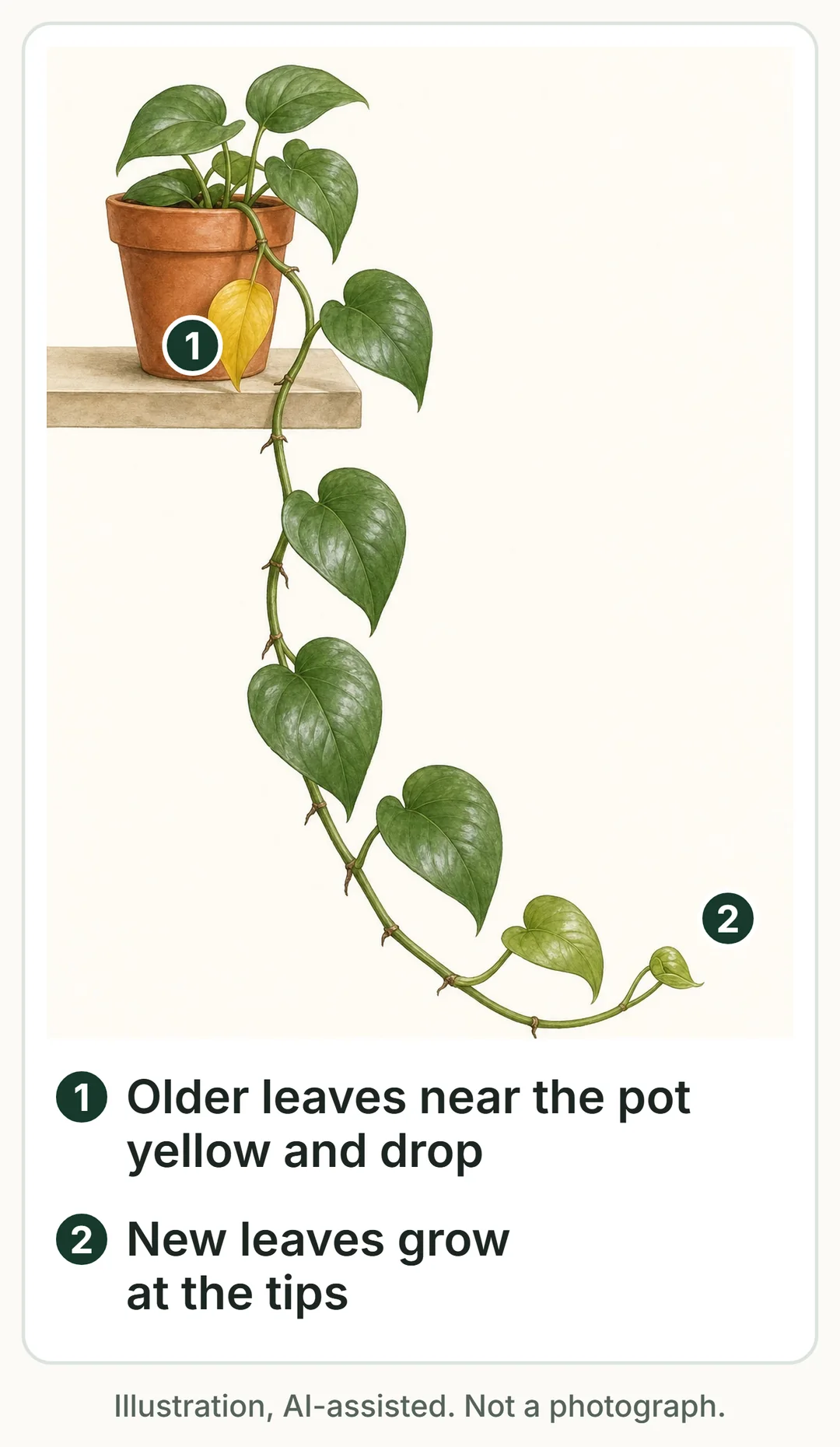
Match what you see
Compare your pothos with these signs, then jump to the matching section.
What you see: Older leaves yellow; the soil is still damp days after watering.
Likely cause: Overwatering
Fix this week
What you see: Yellowing and wilting in wet soil; roots are brown, soft or missing.
Likely cause: Root rot
Act soon
What you see: Drooping leaves and yellow older leaves; the pot is light and the soil dry.
Likely cause: Soil kept too dry
Fix this week
What you see: Yellowing or dry, burned patches on leaves that face a sunny window.
Likely cause: Too much direct sun
Fix this week
What you see: Slow growth and older leaves yellowing on a plant that has not been fed in months.
Likely cause: Low fertility
Fix this week
What you see: A white crust on the soil or pot, with dark leaf tips or edges and yellow leaves.
Likely cause: Too much fertilizer
Fix this week
What you see: White cottony clusters, bark-colored bumps or sticky leaves.
Likely cause: Pests
Act soon
What you see: One older leaf at a time; new growth looks healthy.
Likely cause: Natural aging
Often normal
Overwatering and root rot
How urgent: Fix this week Act sooner if the roots are brown and soft: Act soon
Overwatering is the cause Clemson Extension names first for yellow pothos leaves, and Penn State Extension calls root rot from too much water one of only a few problems with this plant. Pothos is better kept too dry than too wet, Penn State adds, and University of Florida guidelines say that in most indoor locations it does better kept a little on the dry side.
How to tell
- Older leaves turn yellow while the potting mix is still damp below the surface.
- The pot feels heavy, stands in water in a saucer or decorative pot, or has no drainage hole.
- The plant wilts even though the soil is wet.
- The roots are brown, soft or largely missing when you ease the plant out of its pot. Wisconsin Extension describes root rot in pothos as brown or nonexistent roots, most often due to overwatering. Healthy roots are firm.
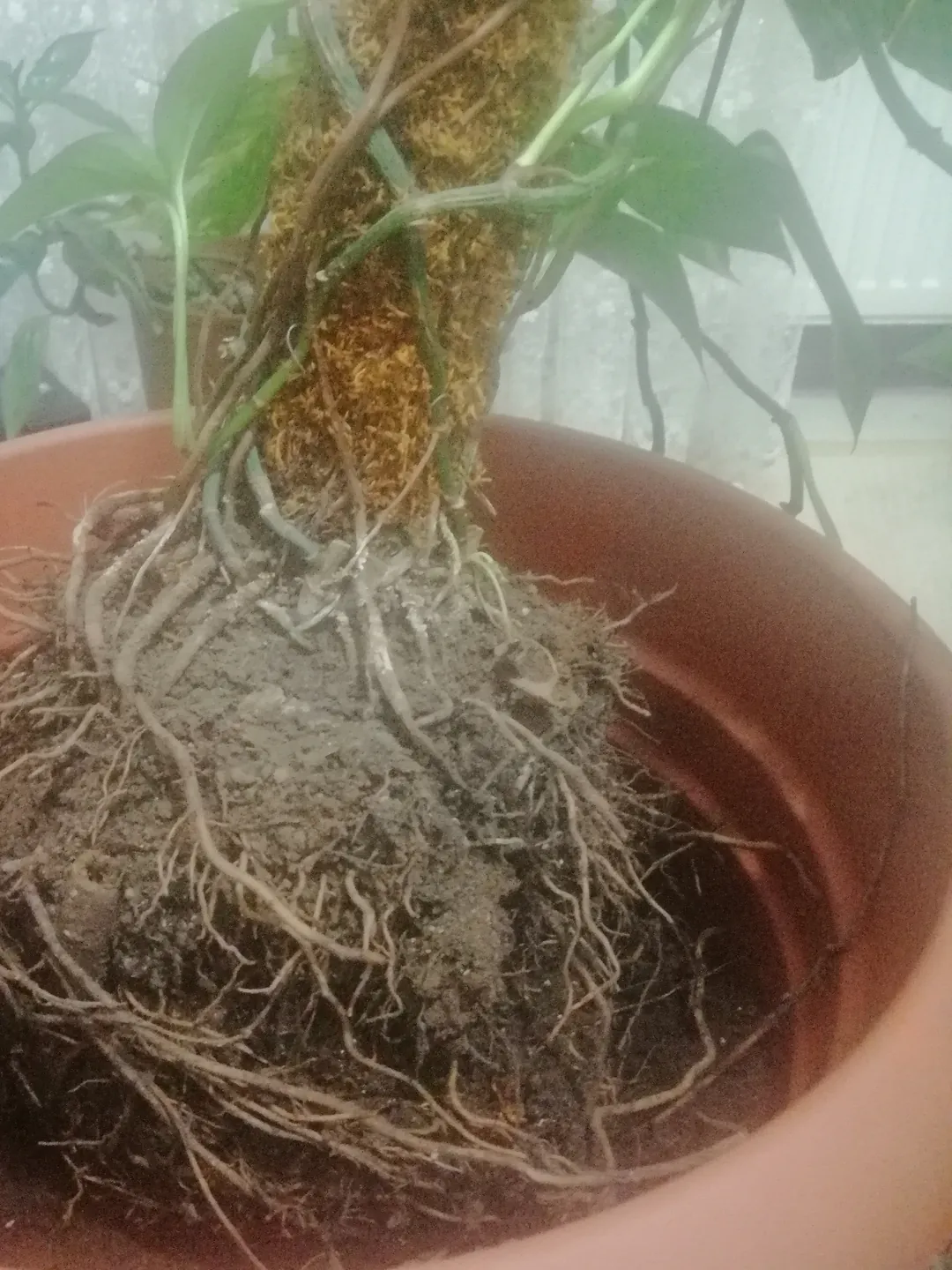
Photo: Satirdan kahraman, CC BY-SA 4.0, via Wikimedia Commons (cropped and resized)
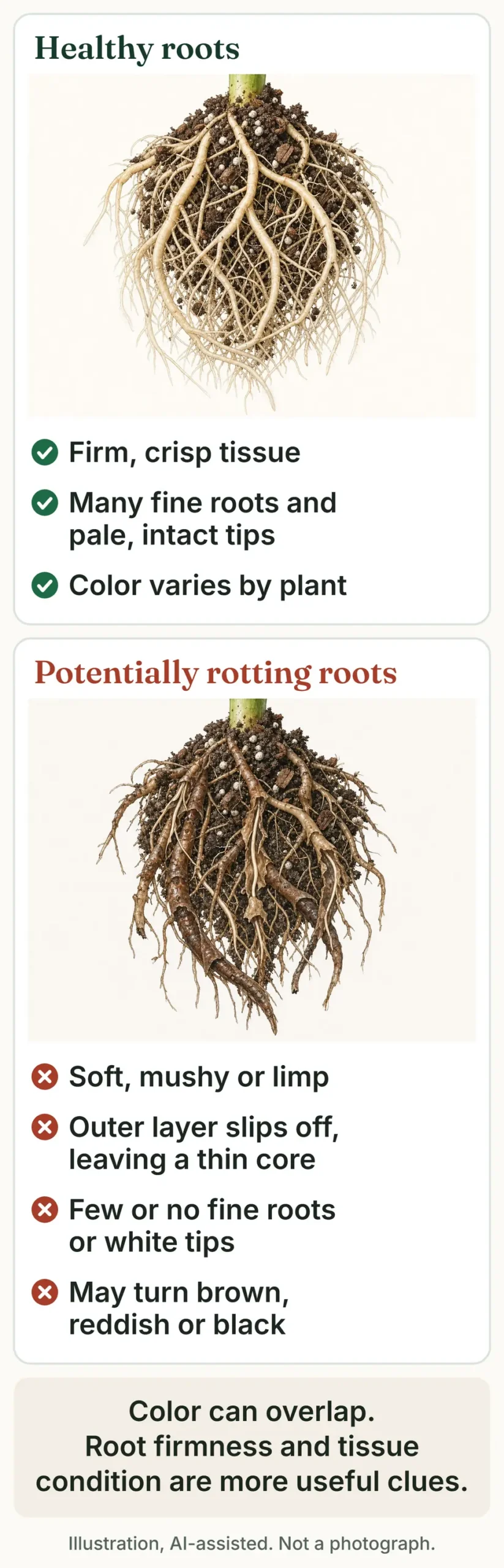
How to fix
- Stop watering, and empty any water standing in the saucer or decorative pot.
- Water again only once the soil has dried. Wisconsin Extension says to water when the soil surface is dry, and Clemson Extension says to let the soil dry between waterings.
- If the pot has no drainage hole or the mix stays soggy, repot into a pot that drains, using an airy, well-draining mix, as Clemson Extension recommends.
- If some roots are brown and soft, University of Maryland Extension advises cutting out the rotten parts and replanting the healthy sections. If most roots are gone, take a few healthy vine tips as a backup: Clemson Extension notes that pothos cuttings root easily in soil or water as long as each has at least one node.
Prevent it
Check the soil before every watering instead of watering on a schedule, use a pot with a drainage hole, and never leave the pot standing in water. After repotting, go easy on water: Penn State Extension warns that excess water after repotting adds stress to pothos.
Soil kept too dry
How urgent: Fix this week
Pothos copes with dry soil better than wet soil, but not indefinitely. University of Florida guidelines list potting mix kept too dry, as well as too wet, as a cause of older leaves turning yellow, and Penn State Extension notes that too little water may lead to leaves temporarily drooping.
How to tell
- The leaves droop and older leaves turn yellow, and the drooping goes away after watering.
- The pot feels light, and the mix is dry well below the surface or has shrunk away from the sides of the pot.
- Roots fill the pot or grow out of the drainage holes. University of Maryland Extension notes that pot-bound plants often show signs of drought, because water runs through too fast.
- Leaf tips or edges turn dark. Wisconsin Extension lists inadequate watering among the causes, along with overwatering and excess fertilizer, so check the soil before deciding which it is.
How to fix
- Water thoroughly, so that water reaches all the roots and drains out of the bottom of the pot, as Clemson Extension advises.
- If the mix has pulled away from the pot, water slowly several times until the mix soaks it up again, as University of Maryland Extension suggests, then let it drain.
- If roots fill the pot, repot into a slightly larger container. Clemson Extension suggests repotting when roots show through the drainage holes or the plant is root-bound, usually every year or two.
Prevent it
Check the soil regularly rather than waiting for the leaves to droop. How fast a pot dries depends on the potting mix, the pot, temperature, humidity and how actively the plant is growing.
Too much direct sun
How urgent: Fix this week
Pothos prefers bright, indirect light, according to Clemson Extension. Penn State Extension notes that direct sun will lead to yellowing leaves, and Wisconsin Extension says pothos does not tolerate much direct sunlight.
How to tell
- Yellow or pale, washed-out leaves, mainly on the side of the plant facing a sunny window.
- Dry, burned patches confined to the white or yellow parts of variegated leaves. University of Florida guidelines list this as a sign of high light or heat.
- Scorched leaves or dying tips. Clemson Extension links these to intense light or low humidity.
How to fix
- Move the plant to a spot with bright light but no direct sun on the leaves.
- Remove badly burned leaves if they look untidy. University of Florida guidelines note that burned leaves cannot recover, so judge the move by the new growth.
- Keep the plant away from heating vents as well. Clemson Extension notes that hot and cold air can dry out the leaves and damage plant cells.
Prevent it
Turn the pot about once a week so that all sides get similar light, as Penn State Extension suggests. Do not overcorrect into deep shade: in low light, new leaves stay small and variegated cultivars lose color, according to University of Florida guidelines.
Feeding: too little or too much
How urgent: Fix this week
Clemson Extension names low fertility, along with overwatering, as a common cause of yellow pothos leaves. Too much fertilizer causes problems too: Wisconsin Extension notes that salt buildup from excess fertilizer can blacken leaf tips and edges, often along with yellowing leaves.
How to tell
- Low fertility: the plant has not been fed for many months, the watering and light check out, and older leaves keep turning yellow. University of Florida guidelines also link small new leaves that lack variegation to low fertilizer rates or low light.
- Too much fertilizer: a white crust on the soil surface or the pot, dark leaf tips or edges, and yellow leaves, especially on a plant that is fed often or at full strength.
How to fix
- Rule out watering and light first. Fertilizer does not fix a watering problem or damaged roots.
- For low fertility, Clemson Extension suggests a houseplant fertilizer every other month during spring and summer; Wisconsin Extension likewise suggests every other month except in winter. Follow the label, and consider half strength: Iowa State Extension notes that most fertilizers are made for outdoor growing and recommends half or quarter strength indoors.
- For a salt crust or suspected overfeeding, flush the pot with plain water several times until it drains freely, then stop feeding for a while. If the buildup is heavy, repot in fresh mix.
- For a plant you just brought home, wait. University of Florida guidelines advise not repotting or fertilizing for about four weeks after a pothos is placed indoors, because it does not need extra stress.
Prevent it
Feed lightly and only while the plant is actively growing. Wisconsin Extension advises skipping feeding in winter, when pothos is not actively growing.
Less common causes
- Pests Act soon: Wisconsin Extension names mealybugs and scale as the most common pests of pothos in homes. Mealybugs look like white, cottony masses in leaf joints, under leaves and even on the roots; scale looks like bark-colored bumps on stems and leaves. Both can leave leaves and nearby surfaces sticky. Spider mites occasionally infest pothos too. Iowa State Extension advises dealing with mealybugs, scale and spider mites right away, before populations become unmanageable. University of Maryland Extension lists these pests among the causes of yellowing houseplant leaves. Keep the plant away from your others while you deal with them. Wisconsin Extension notes that spider mites can be controlled with thorough cleaning and frequent applications of insecticidal soap, and that with mealybugs or scale it is often better to discard the plant and start over with clean cuttings.
- Cold and drafts Fix this week: University of Florida guidelines link scattered brown patches in the center of pothos leaves to several hours at 33–40°F or to abrupt temperature changes. Clemson Extension advises keeping pothos away from air conditioning vents in summer and from windowsills and heating vents in winter. In those guidelines, cold damage shows as brown patches rather than evenly yellow leaves.
- A recent move Often normal: Illinois Extension notes that many plants go through an adjustment period whenever they are moved. Keep care steady, and hold off on repotting and feeding for about four weeks, as University of Florida guidelines advise for newly placed pothos.
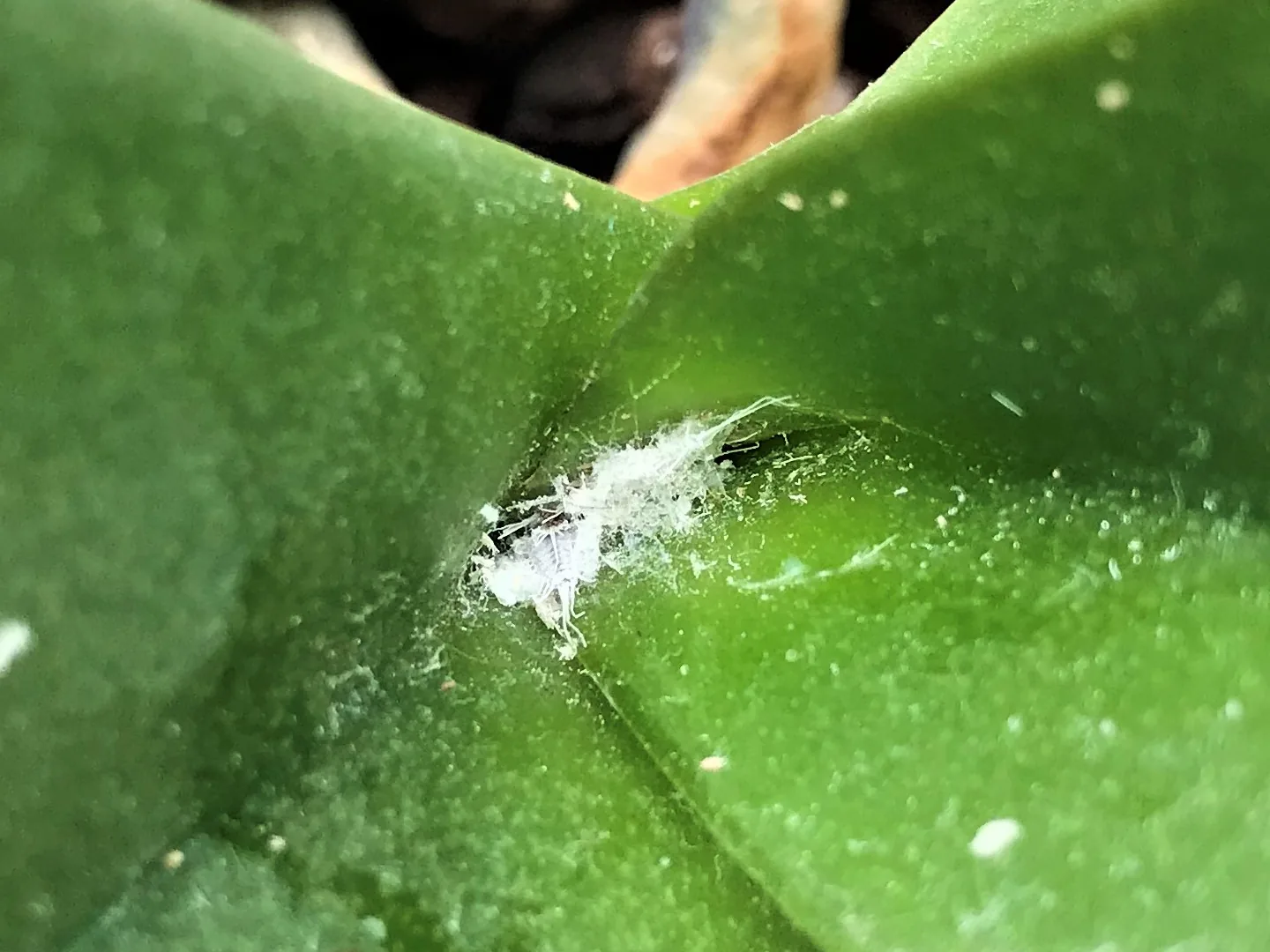
Photo: Sinikka Halme, CC BY-SA 4.0, via Wikimedia Commons (cropped)
Pothos at a glance: bright, indirect light; tolerates low light · water once the soil has dried · airy, well-draining mix · 60–70°F at night, 70–85°F by day · toxic to cats and dogs (ASPCA) · full pothos care guide
Not sure which cause fits? Go back to the signs above and start with the soil and the roots.
Sources
- Clemson Cooperative Extension, Home & Garden Information Center: How to Grow Pothos Indoors (Epipremnum spp.): Care, Cultivars, and Common Problems (HGIC 1568).
- University of Wisconsin–Madison Extension, Wisconsin Horticulture: Pothos, Epipremnum aureum.
- Penn State Extension: Pothos as a Houseplant.
- UF/IFAS Extension: Cultural Guidelines for Commercial Production of Interiorscape Epipremnum (ENH894); New Florida Foliage Plant Cultivar: Pothos ‘Pearls and Jade’ (ENH1180).
- University of Maryland Extension: Diagnose Indoor Plant Problems; Overwatered Indoor Plants; Pot-Bound Indoor Plants; Watering Indoor Plants.
- Iowa State University Extension and Outreach: Diagnosing Houseplant Problems Related to Poor Culture; Diagnosing Houseplant Problems Caused by Insect Pests.
- University of Illinois Extension: Keep houseplants happy with simple solutions.
- ASPCA Animal Poison Control: Golden Pothos.


