
Plant Problems › Dying Plant
A houseplant that looks like it is dying isn’t always beyond saving. If a stem is still green inside, Illinois Extension notes that there is still a chance of saving the plant. The first job is to check what is still alive, then find out what went wrong.
Start with water. Clemson Extension notes that the main cause of death of potted plants is over-watering, and that chronic under-watering also results in wilting, leaf curling and death. Cold, pests, the wrong light and crowded or salty roots can also push a stressed plant into decline.
Quick answer
Causes to check:
- Too much water or root rot: wilting or yellowing even though the potting mix is wet; dark, soft roots. Act soon
- Too little water: wilting and curled leaves, a light pot, and potting mix that has pulled away from the sides. Act soon
- Cold or a draft: leaves that darken, blacken, collapse or drop after a chill. Act soon
- Pests: spider mites, mealybugs or scale; stress from uneven watering can make outbreaks worse. Act soon
- The wrong light: pale, stretched growth, or scorched patches after a move into brighter light. Fix this week
- Crowded roots or salt buildup: roots filling the pot, a pot that dries out fast, brown leaf tips or a white crust. Fix this week
Labels show how quickly to act if a cause is confirmed. They are not a diagnosis; check the signs in each section first.
First, check whether it can be saved
- Scrape a stem. Illinois Extension suggests scraping the stem to see whether the plant is still alive: if there is green underneath, there is still a chance of saving it. It also notes that once a plant goes crispy, very little will bring it back to life. Check more than one stem. The test only works where there is a stem to scrape, and it is a clue, not proof, so check the roots too.
- Look at the roots. Slide the plant out of its pot. University of Maryland Extension notes that healthy roots should be light-colored and firm, and Iowa State Extension that rotted roots are mushy. In one common root rot (Pythium), the outer part of a root pulls away easily from its core (University of Maryland Extension). Root color varies between plants, so firmness tells you more than color.
- Feel the potting mix. Is it wet and heavy, or dry and light? University of Maryland Extension notes that potting mix that has dried out shrinks away from the sides of the pot.
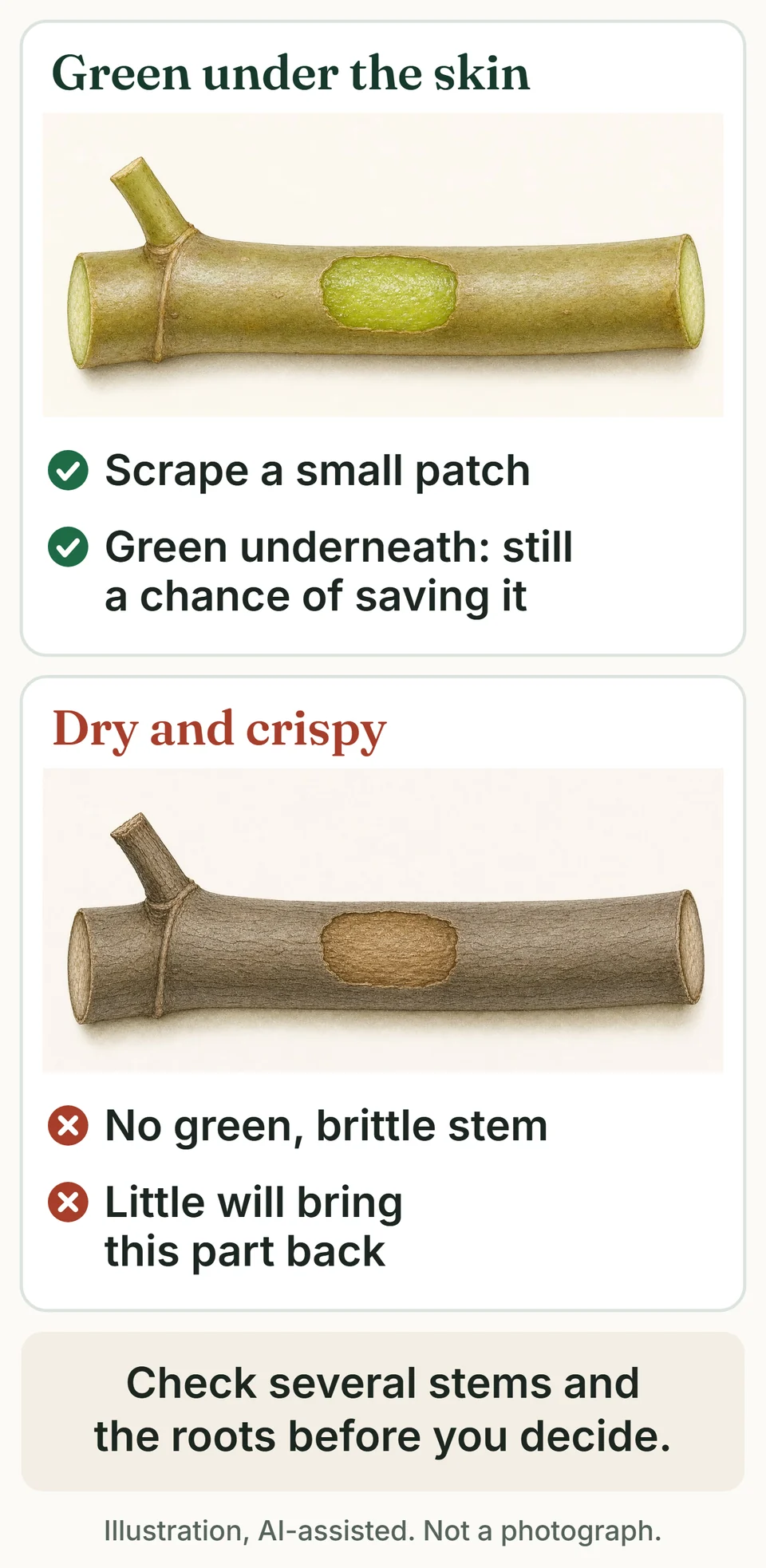
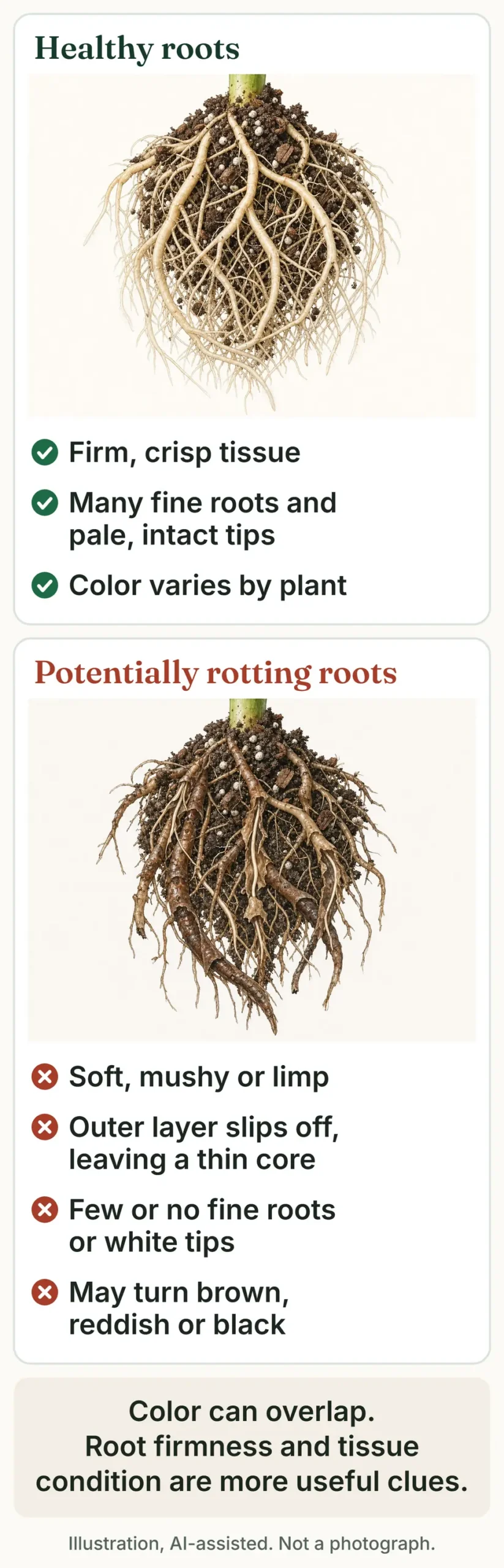
These checks give clues, not a diagnosis: several causes look alike, and Iowa State Extension notes that multiple factors often contribute. If you find green stems or firm roots, work through the causes below. If the plant has gone crispy, or most of its roots are dark, soft and dead, it may be past saving: Clemson Extension notes that when most roots are dark, soft and dead, it is better to discard the plant. Before you do, try a cutting from any stem that is still healthy (see start again from a cutting).
Too much water and root rot
How urgent: Act soon
Clemson Extension explains that roots need both water and oxygen. When they sit in water, they can’t take up oxygen, and they may rot until the whole plant dies. University of Maryland Extension notes that overwatering is the number one reason why indoor plants fail.
How to tell
- Wilting or yellowing of the lower and inner leaves (University of Maryland Extension).
- Wilting even though the potting mix is wet: University of Maryland Extension notes that root rot can damage the roots so much that they can’t move water to the leaves. Iowa State Extension notes that these symptoms can be mistaken for lack of water, so check the roots.
- Roots that are brown to black and soft or mushy, and a stem base that turns black, brown or mushy (University of Maryland Extension).
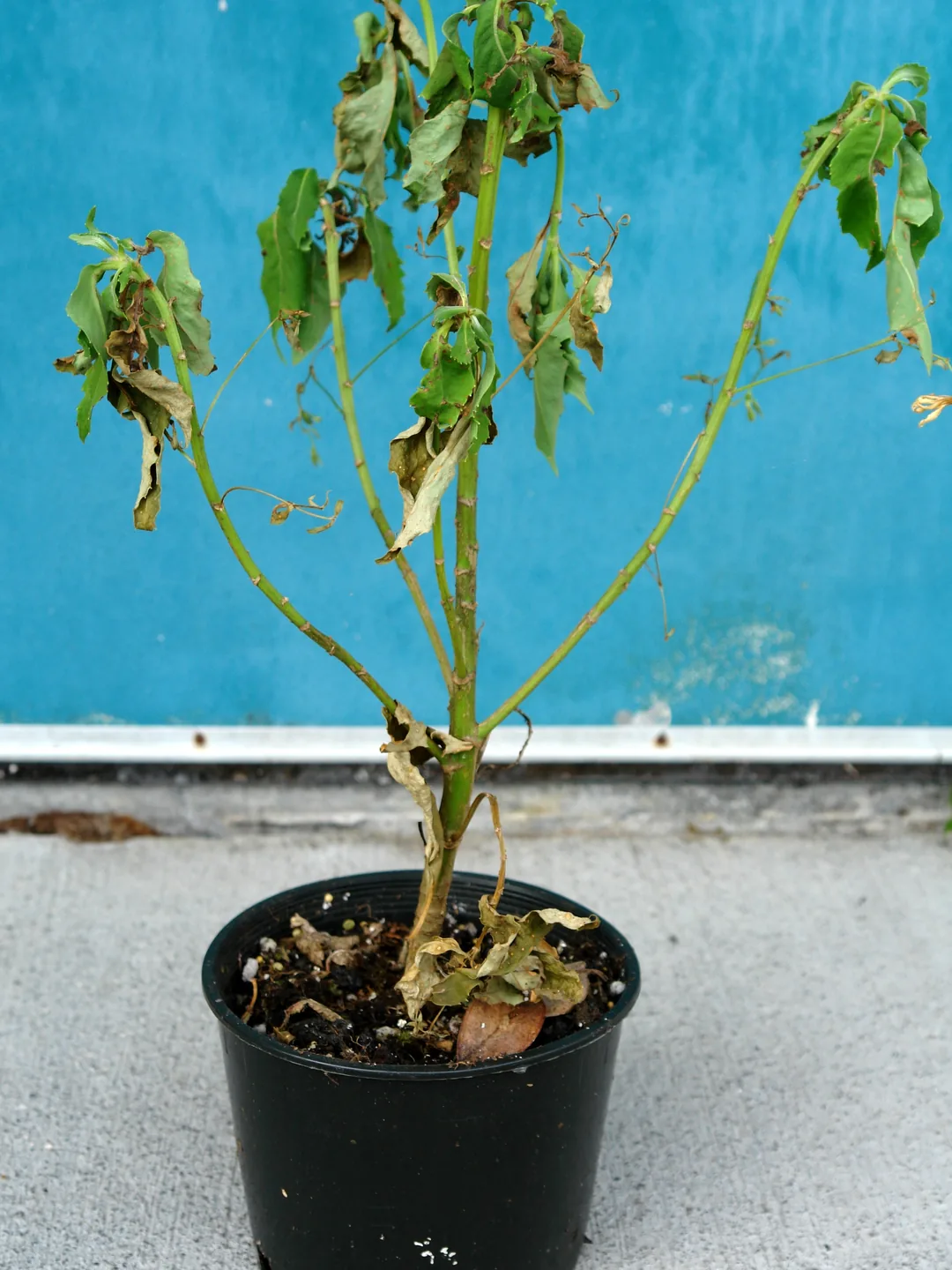
Photo: Scot Nelson, CC0, via Flickr (cropped and resized)
What to do
- Stop watering, and empty any saucer or outer pot that holds water. University of Maryland Extension advises never letting houseplants sit in water.
- Check the roots. If most are dark, soft and dead, Clemson Extension notes that it is better to discard the plant. University of Maryland Extension advises throwing away severely infected plants and taking stem cuttings only from healthy tissue.
- If only a few roots are rotten, Clemson Extension advises cutting them out and repotting the plant in sterile soil, and University of Maryland Extension suggests replanting the healthy sections. Use a clean or new pot (University of Maryland Extension) with a drainage hole (Missouri Botanical Garden), and don’t put the smaller root ball into a much larger pot: Missouri Botanical Garden notes that when a small root ball sits in a large pot, the soil may stay very wet, and the result can be root rot.
- Water again only when the mix has dried: University of Maryland Extension suggests waiting until it is dry about two inches down. Succulents and cacti need far less water.
Too little water
How urgent: Act soon
Missouri Botanical Garden notes that you may be able to save a plant that has dried out if you catch it before the roots begin to die. University of Maryland Extension notes that some plants may die suddenly after long periods of drought.
How to tell
- The plant wilts and turns gray-green (University of Maryland Extension), and leaves may curl.
- After a long dry spell: yellowing, scorched or brown leaves, leaf drop and stunted growth (University of Maryland Extension).
- The pot feels light, and the potting mix has shrunk away from the sides, so water runs straight out of the drainage hole (Missouri Botanical Garden).
- Wilting doesn’t always mean the plant needs water: Clemson Extension notes that damaged or rotting roots also cause wilting, and watering can make that worse. Feel the mix first.
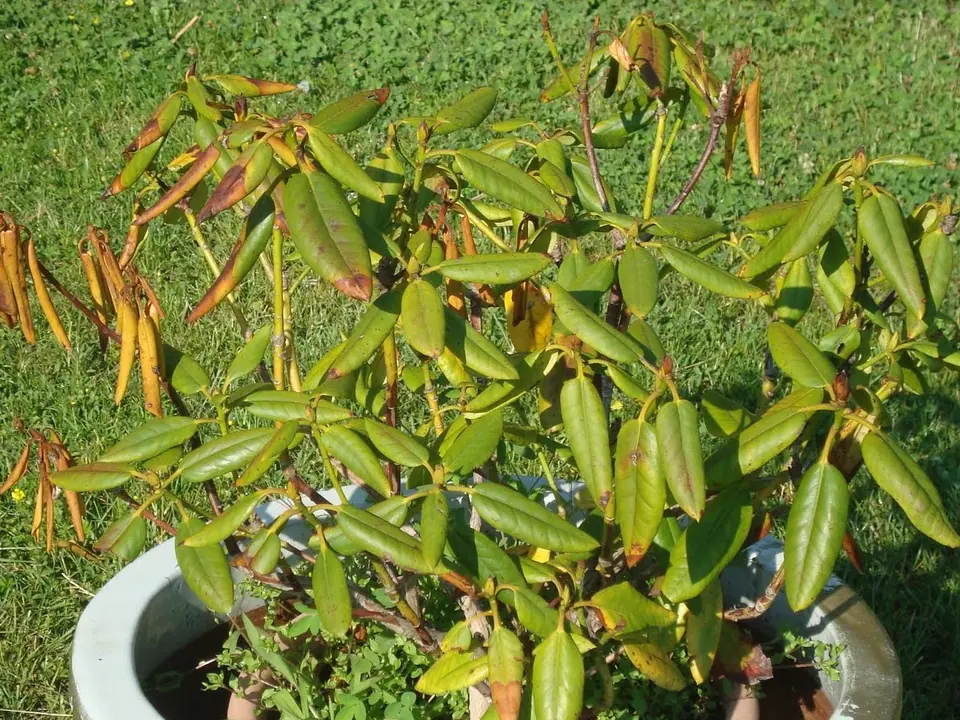
Photo: Scot Nelson, CC0, via Flickr (cropped and resized)
What to do
- If the mix is bone dry, rewet the whole root ball. University of Maryland Extension suggests setting the pot in a sink or bucket of warm tap water, about halfway up the pot, for an hour or two. Keep the water at room temperature, not hot or cold: Clemson Extension gives 62–72°F. Clemson also suggests removing the pot when the surface of the mix is moist, or watering twice, half an hour apart.
- Let the pot drain completely, and empty the saucer (Clemson Extension).
- Cut back dead, dried-out foliage (Illinois Extension).
- From then on, water thoroughly when the top two inches of mix are dry (University of Maryland Extension). Succulents and cacti need far less water.
If the plant stays wilted once the mix is moist again, check the roots: Missouri Botanical Garden notes that roots may already have died from drought, and watering then only makes the dead roots rot.
Cold and drafts
How urgent: Act soon
How to tell
- Leaves or shoots that blacken after cold (University of Maryland Extension).
- Foliage that collapses or turns black after freezing temperatures (Missouri Botanical Garden).
- Leaves or flowers that drop after cold air from a door or window, or a cold trip home from the store (Missouri Botanical Garden). Iowa State Extension notes that big temperature swings can cause yellowing, browning, wilting or leaf drop.
What to do
- Move the plant somewhere warmer, away from cold windows, doors and drafts. University of Maryland Extension advises protecting houseplants from temperatures below 50°F, and Iowa State Extension advises avoiding temperatures below 55°F.
- University of Maryland Extension notes that symptoms of cold injury may continue for up to a week after exposure, so wait about a week before you cut back dead growth.
- In winter, Iowa State Extension advises wrapping houseplants in a bag or sleeve for the trip home.
Pests
How urgent: Act soon
Illinois Extension notes that the stress of inconsistent watering can make outbreaks of mealybugs or spider mites worse. Iowa State Extension advises dealing with mealybugs, scale, spider mites, aphids and whiteflies right away, before populations become unmanageable.
How to tell
- Spider mites: light-colored speckling on the leaves and an overall faded look, often with a silky web in heavier infestations (Clemson Extension).
- Mealybugs: white, cottony insects, often clustered in leaf joints and under the leaves (Iowa State Extension).
- Scale: small bumps clustered or lined up along stems and leaf veins, typically on the undersides (Iowa State Extension).
- Shiny, clear spots on leaves and nearby surfaces, from the honeydew that mealybugs produce (Iowa State Extension).
What to do
- Isolate the plant so the pests don’t spread to your other plants (Iowa State Extension).
- Wipe off a few mealybugs with a cotton swab dipped in rubbing alcohol; scale may need to be scraped off with a fingernail (Clemson Extension). For spider mites on a sturdy plant, Clemson Extension notes that repeated water sprays help control them.
- Keep checking the plant often (Iowa State Extension), and repeat the treatment if the pests come back.
- If insects have taken over, Illinois Extension notes that sometimes it is best to start over with a new plant.
The wrong light
How urgent: Fix this week
How to tell
- Too little light: pale growth that stretches toward the light (Missouri Botanical Garden).
- Too much light, or a sudden move into brighter light: scorched leaves or leaf drop (Iowa State Extension), or tan or white patches on leaves in direct sun from a south or west window (Missouri Botanical Garden).
- Leaf drop can also follow a quick move from a bright spot to a darker one (Iowa State Extension).
What to do
- For low light, move the plant closer to a window or add a grow light (University of Maryland Extension).
- Change the light gradually: Iowa State Extension advises moving plants to a new light level over several weeks.
- Iowa State Extension notes that scorch damage is permanent and that stretched growth will always look spindly, although in nearly all cases the new growth looks better once the light is right. Judge the plant by its new growth.
Crowded roots or salt buildup
How urgent: Fix this week
How to tell
- Crowded roots: a tight mass of roots fills the pot or circles it, water runs through too fast, and the center of the root ball stays dry; leaves may brown at the tips or edges (University of Maryland Extension). Illinois Extension adds roots growing out of the drainage holes and a plant that wilts between normal waterings.
- Salt buildup from fertilizer and water: reduced growth, brown leaf tips, dropping lower leaves, dead root tips and wilting, sometimes with a crust on the mix or pot (University of Maryland Extension).
What to do
- For crowded roots, repot into a larger pot and loosen or cut the tight roots (University of Maryland Extension). Go up one size, about 1 to 2 inches wider (Clemson Extension and Missouri Botanical Garden; Iowa State Extension allows one or maybe two sizes). Clemson Extension advises repotting while a plant is actively growing, not while it is ailing, so if crowded roots are the only problem and the plant isn’t wilting between waterings, you can wait until it is growing again. Until then, check the mix more often, since water runs through a crowded pot quickly.
- For salt buildup, remove any crust on the mix, then pour at least twice the pot’s volume of water through it and let it drain (University of Maryland Extension). Repot if the salt level seems high or the pot drains poorly.
Aftercare: the next few weeks
- Hold off on fertilizer. Iowa State Extension advises fertilizing only when houseplants are actively growing, and waiting at least 2 to 4 weeks after repotting. Illinois Extension suggests feeding plants that survive once they start actively growing again.
- Repot only for a root or soil problem. Clemson Extension’s repotting guide advises against repotting ailing plants, while its disease guide and University of Maryland Extension advise repotting to remove rotten roots or old, salty mix. So repot a struggling plant only when the roots or the mix are the problem.
- Water by feel, not by schedule. University of Maryland Extension notes that plants should be watered when they need it, not on a schedule.
- Expect some leaf drop after a move. Clemson Extension notes that leaf drop after a significant change in a plant’s surroundings should only last about three weeks. If leaves keep dropping or the plant keeps wilting, check the roots and the mix again. New leaves and stems are a good sign of recovery.
If it can’t be saved: start again from a cutting
If the plant can’t be rescued, Illinois Extension suggests taking a few cuttings to grow a new plant. University of Maryland Extension advises taking cuttings only from healthy tissue. Stem cuttings work for many common houseplants with stems and nodes, such as pothos, philodendron, dracaena, English ivy and dumb cane (Iowa State Extension). Check the cuttings for pests before you root them. Illinois Extension notes that some plants, such as succulents, cacti, geraniums and rubber plants, shouldn’t go straight into the rooting mix: let the cut end dry and heal over first.
- Cut a healthy stem piece 3 to 6 inches long with at least two nodes, the points where leaves attach.
- Remove the lower leaves, and set the cutting in moist perlite or another rooting mix with at least one node buried and no leaves below the surface.
- Keep it in bright, indirect light at about 65–75°F, with a loose plastic bag over it to keep the humidity high.
- Most houseplant cuttings form roots in 3 to 6 weeks. Pot them in regular potting soil once the roots are about an inch long.
Steps from Iowa State Extension.
When to act quickly
- Wilting while the potting mix is wet, or a soft, dark stem base: check the roots today, and don’t water. Missouri Botanical Garden warns that watering a plant whose roots are rotting is the “death knell” for it. See too much water.
- Potting mix bone dry and pulled away from the pot: rewet it now; see too little water.
- The plant was exposed to cold: move it somewhere warmer now; see cold and drafts.
- Spider mites, mealybugs or scale on the plant: isolate it now; Iowa State Extension advises dealing with them right away. See pests.
Frequently asked questions
Can a dying plant come back to life?
Sometimes. Illinois Extension notes that green tissue under the stem’s surface means there is still a chance, but that once a plant goes crispy, very little will bring it back. Missouri Botanical Garden adds that a plant that dried out can decline slowly and never recover, even after a thorough watering; in some cases the roots have already died. Check the stems and roots before you decide.
Should I repot a dying plant?
Only if the roots or the potting mix are the problem. Clemson Extension advises against repotting ailing plants, but Clemson and University of Maryland Extension give repotting as the fix for rotten roots, crowded roots and salty mix, and Iowa State Extension for old, compacted mix. For crowded roots, go up one pot size; after cutting out rotten roots, don’t use a much larger pot.
Should I fertilize a dying plant?
Not yet. Iowa State Extension advises fertilizing only when houseplants are actively growing, and University of Maryland Extension notes that salts from fertilizer can build up in the potting mix and, at high levels, damage the roots. Fix the underlying problem first, and feed once new growth appears.
Not sure what went wrong? Go back to the checks: scrape a stem, look at the roots and feel the potting mix.
Sources
- University of Maryland Extension, Home & Garden Information Center: Yellowing Leaves on Indoor Plants; Winter Indoor Plant Problems; Overwatered Indoor Plants; Root Rots of Indoor Plants; Drought Stress to Indoor Plants; Watering Indoor Plants; Diagnose Indoor Plant Problems; Low Light Impacts on Indoor Plants; Pot-Bound Indoor Plants.
- Clemson Cooperative Extension, Home & Garden Information Center: Indoor Plants – Watering (HGIC 1459); Indoor Plants – Transplanting & Repotting (HGIC 1458); Houseplant Diseases & Disorders (HGIC 2251); Common Houseplant Insects & Related Pests (HGIC 2252).
- Iowa State University Extension and Outreach: How to Care for Houseplants; Diagnosing Houseplant Problems from Improper Environmental Conditions; Diagnosing Houseplant Problems Caused by Insect Pests; Root Rots of Houseplants; How to Propagate Houseplants by Stem Tip Cuttings.
- University of Illinois Extension: Bring office plants neglected during pandemic back to life; Repotting; Cuttings.
- Missouri Botanical Garden: Environmental Problems of Indoor Plants.
