
Plant Problems › Curling Leaves
Curling leaves are a symptom with several possible causes: watering problems, heat or dry air, cold, too much light, and pests that feed on new growth. Which leaves curl, which way they curl and what else you see are useful clues, but none of them proves a cause on its own.
Quick answer
Causes to check:
- Dry potting mix: leaves curl and wilt. Act soon
- Wet potting mix: leaves curl and wilt while the mix stays wet; possible root rot. Act soon
- Heat or hot, dry air: leaves that curl downward or brown at the tips near a heater or vent. Fix this week
- Cold: curling leaves that turn brown and drop. Act soon
- Too much direct light: older leaves that curl under, per a Master Gardener guide. Fix this week
- Aphids: curled, distorted new growth; leaves may be sticky. Act soon
- Thrips: scarred leaves and sometimes distorted growth. Fix this week
- Cyclamen or broad mites: stunted, twisted new growth that curls; hard to confirm at home. Act soon
- Prayer plant leaves folding at night: a normal movement. Often normal
Labels show how quickly to act if a cause is confirmed. They are not a diagnosis; check the signs in each section first.
First checks
- Feel the potting mix. Dry all the way down, or wet? Both can make leaves curl; see watering.
- Note which leaves curl. Aphids feed on new growth (University of California IPM), and cyclamen and broad mites distort the growing tips (Missouri Botanical Garden). Curling older leaves, or leaves facing a window, heater or vent, suggest light, heat or cold.
- Look closely under the leaves and at the shoot tips. University of California IPM notes that aphids are found on new growth or under the leaves and often leave white cast skins and sticky honeydew. Cyclamen and broad mites are too small to see without strong magnification.
- Think about recent changes: a move to a sunnier spot, a new heater or vent, a cold draft or a new plant brought home.
Curling up or curling down?
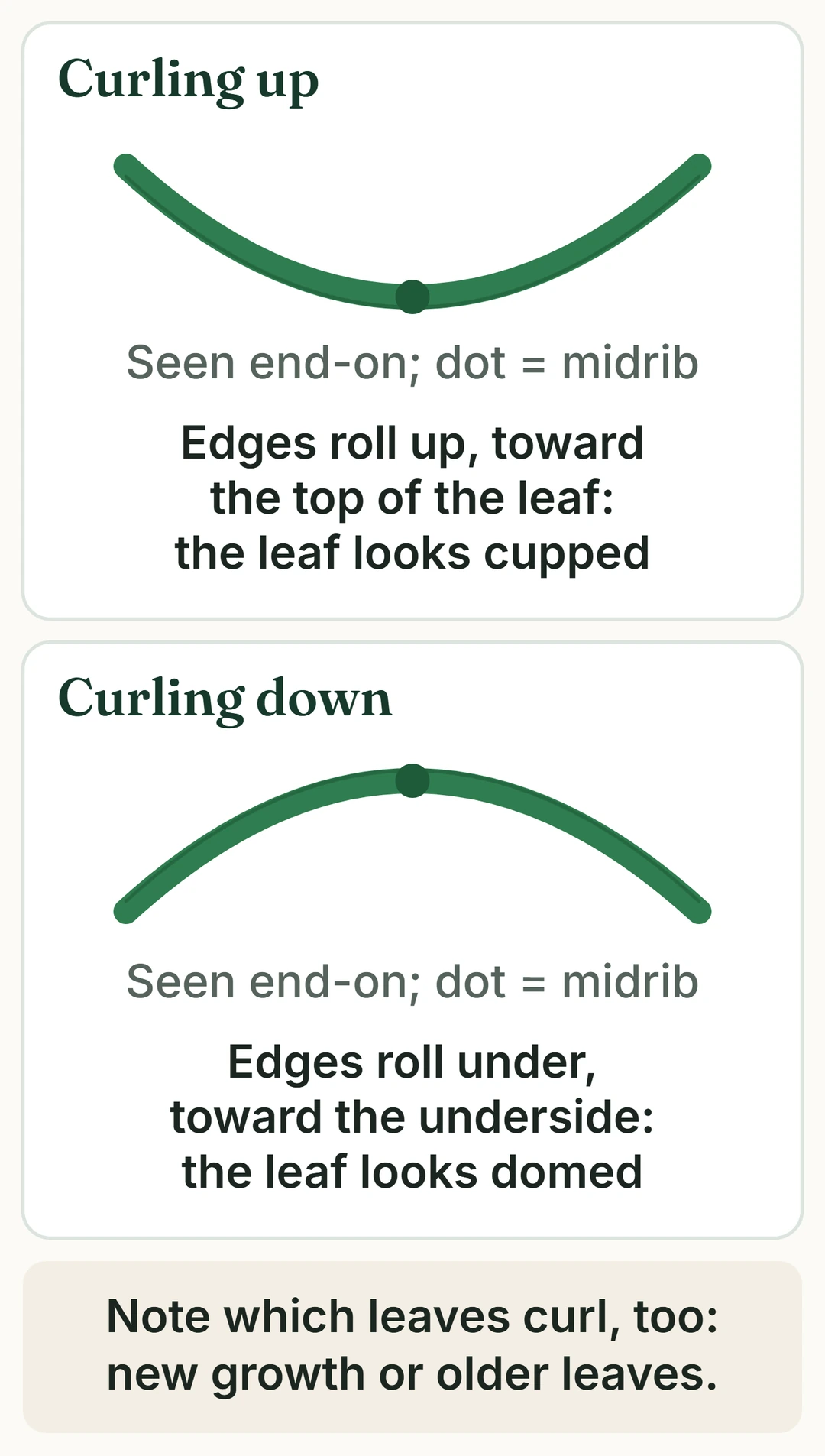
- Curling down or under: a University of California Master Gardener guide links older leaves that curl under to too much light, and leaves that curl downward to too much heat; no other source we used gives a direction for these. Missouri Botanical Garden notes that broad mites cause deformed leaves that usually curl downward.
- Curling up (cupped): Missouri Botanical Garden notes that cyclamen mite feeding makes leaves generally curl upward, but University of California IPM describes downward-cupped leaf margins from both cyclamen and broad mites. Our sources name no common cause of upward curling, so check watering, light and pests first.
- No set direction: our sources give no direction for watering problems or aphids.
Direction is a weak clue, not proof. University of California IPM notes that damage like that of cyclamen and broad mites can also come from poor growing conditions, some nutrient deficiencies and herbicides.
Watering: dry or wet potting mix
How urgent: Act soon
University of Maryland Extension notes that plants wilt and leaves curl when the roots can’t supply enough water to the stems and leaves, and Clemson Extension that chronic under-watering results in wilting, leaf curling and death. Too much water can do the same: University of Maryland Extension notes that excess water damages fine roots and leaves the plant unable to take up water.
How to tell
- Dry: the mix is dry all the way down, the pot feels light, and the leaves curl and droop.
- Wet: a University of California Master Gardener guide lists leaves that curl and wilt, with stems turning mushy and the soil usually wet, as signs of too much water. Roots that are brown to black and soft point to root rot (University of Maryland Extension).
What to do
- If the mix is dry all the way down, water thoroughly until water runs out of the drainage hole, then empty the saucer.
- If the mix is wet, don’t water. Check the roots, and let the mix dry before you water again.
- Water by need, not on a schedule (University of Maryland Extension); succulents and cacti need far less water.
Heat, dry air or cold
How to tell
- Heat Fix this week: the University of California Master Gardener guide lists leaves that turn yellow, curl downward or wilt as signs of too much heat. Missouri Botanical Garden notes that a south- or west-facing window can get quite hot, and, writing about herbs grown indoors, that the leaves closest to a radiator, stove or forced-air vent brown and curl at the tips.
- Dry air Fix this week: Iowa State Extension notes that most indoor plants grow best at 40 to 50% humidity, that homes can drop to 10% in winter, and that low humidity can lead to brown leaf tips and edges.
- Cold Act soon: Missouri Botanical Garden notes that curling leaves that turn brown and drop indicate that it is too cold, and advises keeping plants away from air conditioning vents in summer. University of Maryland Extension lists protecting plants from temperatures below 50°F as the response to cold injury.
What to do
- Move the plant away from heaters, hot air outlets, air conditioning vents and cold or drafty windows.
- Raise humidity for plants that need it: Iowa State Extension suggests grouping plants, a pebble tray (keep the bottom of the pot above the water, or the mix stays wet and the roots can rot) or a humidifier, and notes that misting doesn’t raise humidity for more than a few minutes.
Too much direct light
How urgent: Fix this week
A University of California Master Gardener guide links older leaves that curl under, new leaves that are smaller than the old ones, and leaves that brown around the margins to too much light. Missouri Botanical Garden notes that bright light can also cause brown-tipped, scorched margins.
What to do
- Move the plant farther from the window, or filter the light with a sheer curtain (University of California Master Gardeners).
- Change the light gradually: Iowa State Extension advises moving plants to a new light level over several weeks, and notes that scorched leaves stay damaged.
Aphids and thrips
University of California IPM notes that aphids feed on new growth and under the leaves and can attack many houseplants, sometimes causing leaves to curl and become distorted, and that thrips feed on leaves and flowers, causing scarring and sometimes distorted growth.
How to tell
- Aphids Act soon: small, soft-bodied insects clustered on shoot tips and under leaves, with shiny, sticky honeydew and white cast skins (University of California IPM). Iowa State Extension notes that their feeding can cause curled, yellow and deformed leaves, and advises dealing with aphids right away.
- Thrips Fix this week: slender insects less than 1/8 inch long, under the leaves and in tight crevices; they can cause stippling like mites and leave shiny black specks (University of California IPM).
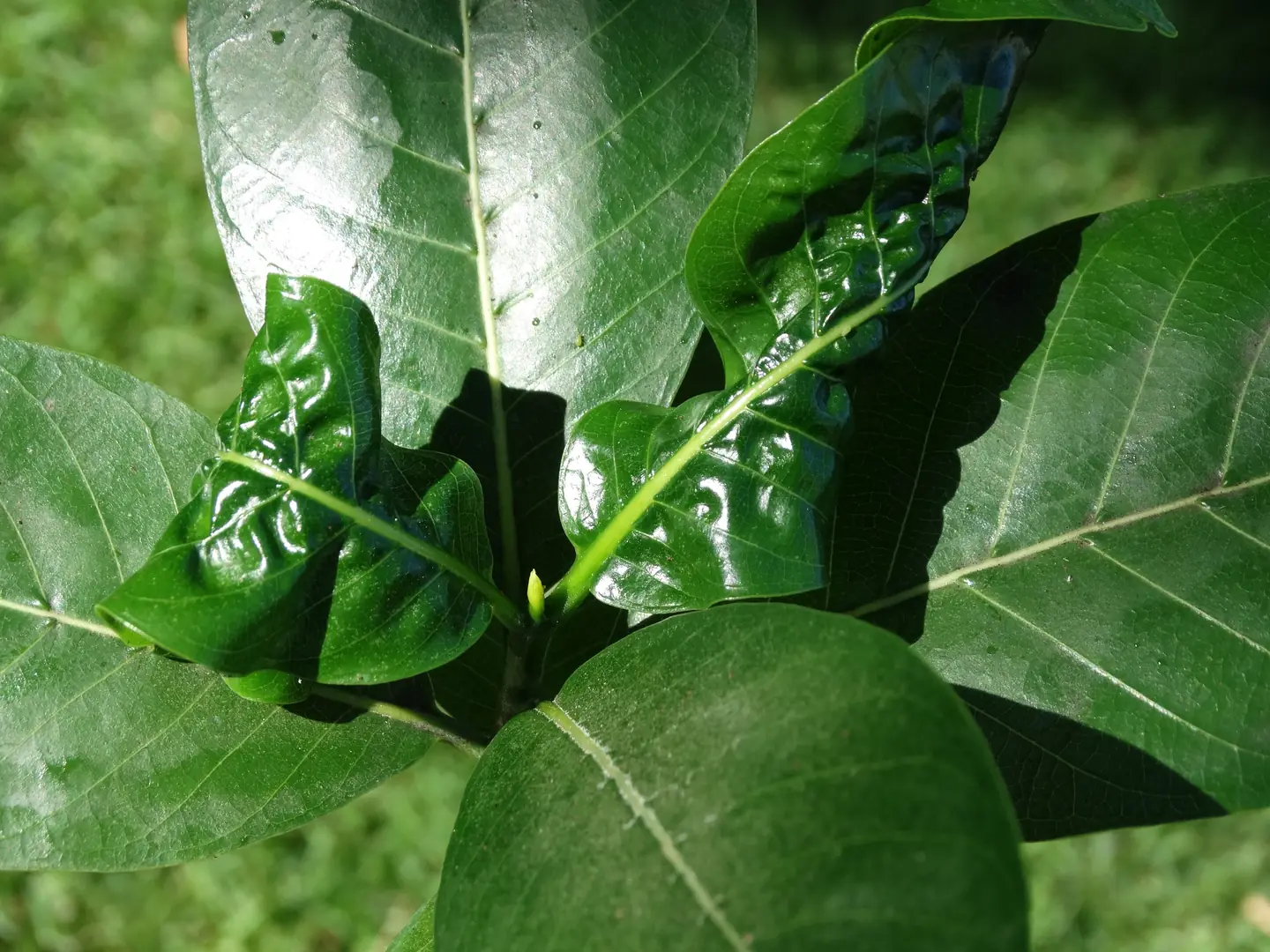
Photo: Scot Nelson, CC0, via Flickr (resized)
What to do
- Isolate the plant right away so the pests don’t spread (University of California IPM).
- Wash the insects off with a spray of water, and remove badly infested shoots (University of California IPM).
- For heavier infestations, University of California IPM suggests insecticidal soap or horticultural oil labeled for your plant and the pest; check the label, since not every plant tolerates them. Clemson Extension advises testing soap on a small part of the plant first and never spraying a plant under drought stress, so water a dry plant first.
Cyclamen and broad mites
How urgent: Act soon
These mites are too small to see with the naked eye; Missouri Botanical Garden notes that they usually aren’t noticed until they have caused significant damage, and that they attack many plants, including African violets, cyclamen, begonias, ivy and many indoor tropical plants. University of California IPM notes that the damage can look like chemical injury, so infestations may be misidentified, and that poor growing conditions and some nutrient deficiencies can cause similar symptoms.
How to tell
- New growth at the tips is stunted, twisted or deformed, and flowers may be few or misshapen (Missouri Botanical Garden).
- Missouri Botanical Garden notes that cyclamen mite leaves generally curl upward and become stiff and brittle, and that broad mite leaves usually curl downward, often with bronzing underneath. University of California IPM describes thickened, brittle foliage with stunted, downward-cupped leaf margins from both mites.
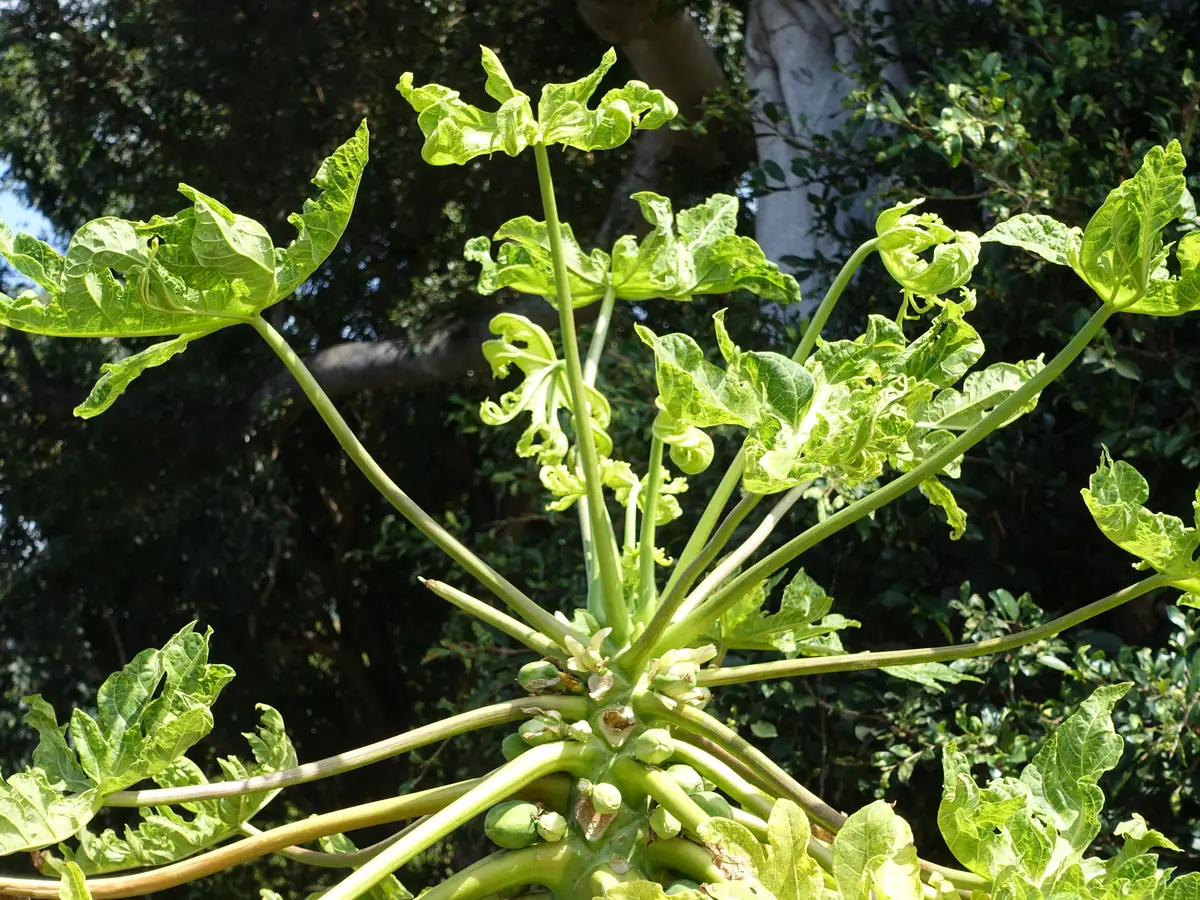
Photo: Scot Nelson, CC0, via Flickr (resized)
What to do
- Isolate the plant, and rule out watering, heat, cold, light and spray injury first. To confirm mites, University of California IPM notes that you need a microscope or at least a 20× hand lens, and Missouri Botanical Garden that hand lenses usually aren’t powerful enough. Finding nothing with a lens doesn’t rule them out; a local Extension office can help.
- If mites are confirmed, Missouri Botanical Garden notes that disposing of an infested plant is often wise, because these mites are difficult to control and multiply quickly, and University of Maryland Extension advises discarding plants infested with cyclamen mites.
- If you treat instead, spray insecticidal soap or horticultural oil so that it reaches under the leaves and into the shoot tips (Missouri Botanical Garden), after checking the label and the cautions above. University of California IPM notes that the mites are protected from sprays when they feed in buds or distorted tissue, and that by the time damage becomes apparent, the mites may no longer be present.
- Inspect new plants before you bring them home, and pass on any with curled or deformed tips (Missouri Botanical Garden).
Curling that is normal
Prayer plants Often normal: Illinois Extension notes that a prayer plant folds up its leaves in darkness. If the leaves stay folded or curled in daylight, go back to the first checks.
Other causes
- Viruses: University of Maryland Extension lists distorted or stunted growth among the symptoms. These overlap with the other causes on this page, so don’t assume a virus from looks alone.
- Spray injury: Clemson Extension notes that pesticide injury can distort leaves and buds.
- Nutrient problems: University of California IPM notes that some nutrient deficiencies, such as boron or zinc, can cause damage that looks like mite injury.
When to act quickly
- Curling and wilting with wet potting mix, or a soft, dark stem base: stop watering and check the roots today. See watering.
- Curling and wilting with bone-dry mix: water it now. See watering.
- Curling, browning leaves after cold: move the plant away from the cold now. See heat, dry air or cold.
- Twisted, curled new growth, or insects on the shoot tips: isolate the plant now. See aphids and thrips and mites.
Curling leaves by plant
Guides for curling leaves on specific plants:
Frequently asked questions
Will curled leaves flatten out again?
Leaves damaged by pests, mites or scorch may stay misshapen, so judge the plant by its new leaves. Iowa State Extension notes that scorch damage is permanent, and a University of California Master Gardener guide notes that a houseplant can take a few weeks to several months to recover once its problem is corrected.
Does low humidity make leaves curl?
Our sources link low humidity mainly to brown leaf tips and edges: Iowa State and Clemson Extension both describe brown tips from low humidity or hot, dry air. Missouri Botanical Garden describes tips that brown and curl on herbs kept near radiators, stoves or heat vents. Check watering, heat and pests first.
Should I cut off curled leaves?
Remove shoots that are badly infested with pests, as University of California IPM suggests. Leaves that are curled but still green keep feeding the plant, so you can leave them until new growth fills in.
Not sure what is wrong? Go back to the first checks.
Sources
- University of California Statewide IPM Program: Pest Notes: Houseplant Problems (UC ANR Publication 74172); Broad Mite and Cyclamen Mite.
- University of California Cooperative Extension Master Gardeners of Tulare-Kings Counties: Common Ailments of Houseplants (adapted from a Washington State University Extension bulletin).
- Missouri Botanical Garden: Indoor Plants or Houseplants (factsheet); Cyclamen and Broad Mites; Herb Problems Indoors.
- University of Maryland Extension, Home & Garden Information Center: Drought Stress to Indoor Plants; Watering Indoor Plants; Overwatered Indoor Plants; Root Rots of Indoor Plants; Diagnose Indoor Plant Problems; Viruses of Indoor Plants.
- Clemson Cooperative Extension, Home & Garden Information Center: Houseplant Diseases & Disorders (HGIC 2251); Common Houseplant Insects & Related Pests (HGIC 2252).
- Iowa State University Extension and Outreach: How to Care for Houseplants; Diagnosing Houseplant Problems from Improper Environmental Conditions; Diagnosing Houseplant Problems Caused by Insect Pests.
- University of Illinois Extension: Prayer Plant.
