
Care Basics › How to Propagate Pothos
Pothos (Epipremnum aureum) is one of the easiest houseplants to start from cuttings: Missouri Botanical Garden notes that it is easily propagated from stem cuttings, and NC State Extension that its vines root easily in water. This guide covers where to cut, rooting the cuttings in water or in a rooting mix, how long it takes, potting them up and what to do when a cutting rots. Where sources disagree, most of all on water versus soil, we show both views.
Pothos propagation at a glance
- What to cut: a piece of vine with at least one node, the joint where a leaf meets the stem (Clemson Extension)
- Where to root it: in water or in a moist rooting mix; both work for pothos, but the New York Botanical Garden and several Extension services (for houseplants in general) note that roots formed in water may settle into soil less easily (see Water or mix?)
- Best time: spring through summer, though cuttings can root at other times too
- How long: roots in about 3 to 6 weeks, depending on the source and the conditions
- Light and warmth: bright, indirect light and a warm room; no direct sun
- Rooting hormone: optional; sources differ (see Rooting hormone)
- Safety: the sap can irritate skin, and pothos is toxic to dogs and cats (see Safety)
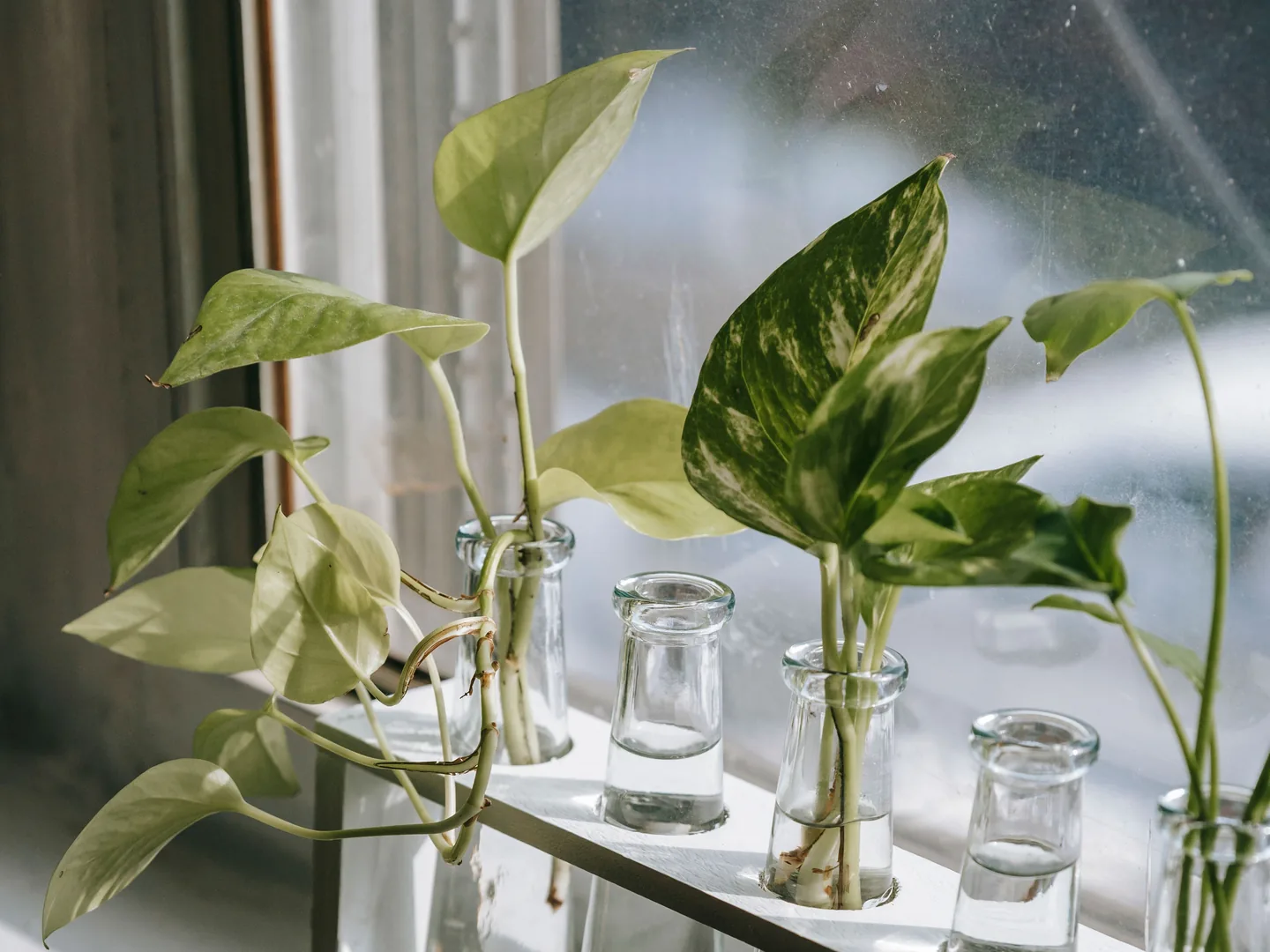
Photo: Teona Swift, Pexels License, via Pexels (cropped and resized)
What you need
- A healthy pothos to take the cuttings from
- Sharp, clean scissors or pruners. For plants in general, Virginia Cooperative Extension suggests dipping the cutting tool in rubbing alcohol or a mix of one part bleach to nine parts water to avoid spreading disease
- For rooting in water: a clean glass or jar and fresh tap water
- For rooting in a mix: a small pot with drainage holes, a moist rooting mix such as equal parts peat moss and coarse perlite (New York Botanical Garden), and a clear plastic bag
Step 1: Take the cuttings
Start with healthy growth. For houseplants in general, Penn State Extension advises starting with plants that are free of disease, insects and stress, and Iowa State University Extension suggests watering the parent plant the day before so that the cuttings are fully hydrated. If the parent plant has yellowing leaves, our guide to why pothos leaves turn yellow explains the common causes.
Every cutting needs at least one node. A node is the point where a leaf joins the stem, and Clemson Extension notes that pothos cuttings should have at least one node to root properly. On pothos you can often spot a node by its aerial root: University of Illinois Extension notes that pothos has one small root at each node. General houseplant guides often ask for more: for stem cuttings in general, Iowa State University Extension, Penn State Extension and University of Illinois Extension suggest at least two nodes, while the pothos sources below also use cuttings with a single node.
There are two common kinds of cutting:
- Tip cuttings: the New York Botanical Garden takes tip cuttings 3 to 4 inches long, cut just below a node, and removes the bottom leaf. For houseplants that root in water, golden pothos among them, University of Maryland Extension suggests a 3- to 5-inch stem with at least one node and some leaves at the tip.
- Single-node cuttings: a short piece of stem with one node and its leaf. A University of Florida IFAS guide for commercial growers calls 1- to 1½-inch stem cuttings with a node and an attached leaf the most common way to propagate pothos, and NC State Extension lists devil’s ivy among plants propagated by single-node cuttings. The stem roots, and the bud at the base of the leaf forms the new shoot (University of Arkansas Extension). A long vine can give several of these, since each node can be treated as a cutting (NC State Extension, plants in general).
Keep the leaf on a single-node cutting. In a study of golden pothos published in HortScience (Wang, 1987), single-node cuttings that kept their leaf grew longer shoots with more leaves than stem cuttings without one, though their first new leaf took about 10 days longer to unfold.
Remove any leaves that would sit under the water or in the mix: no leaves should be submerged (University of Maryland Extension) or buried (Iowa State University Extension), both for houseplants in general. On a tip cutting with large leaves, Iowa State University Extension (houseplants in general) suggests removing some leaves or trimming them down to reduce water loss; the single leaf of a single-node cutting stays on. Avoid long cuttings with many leaves: for houseplants in general, South Dakota State University Extension notes that cuttings 2 to 3 inches long with 2 to 5 leaves generally work better than longer ones with many leaves, which are more likely to wilt and die before they root.
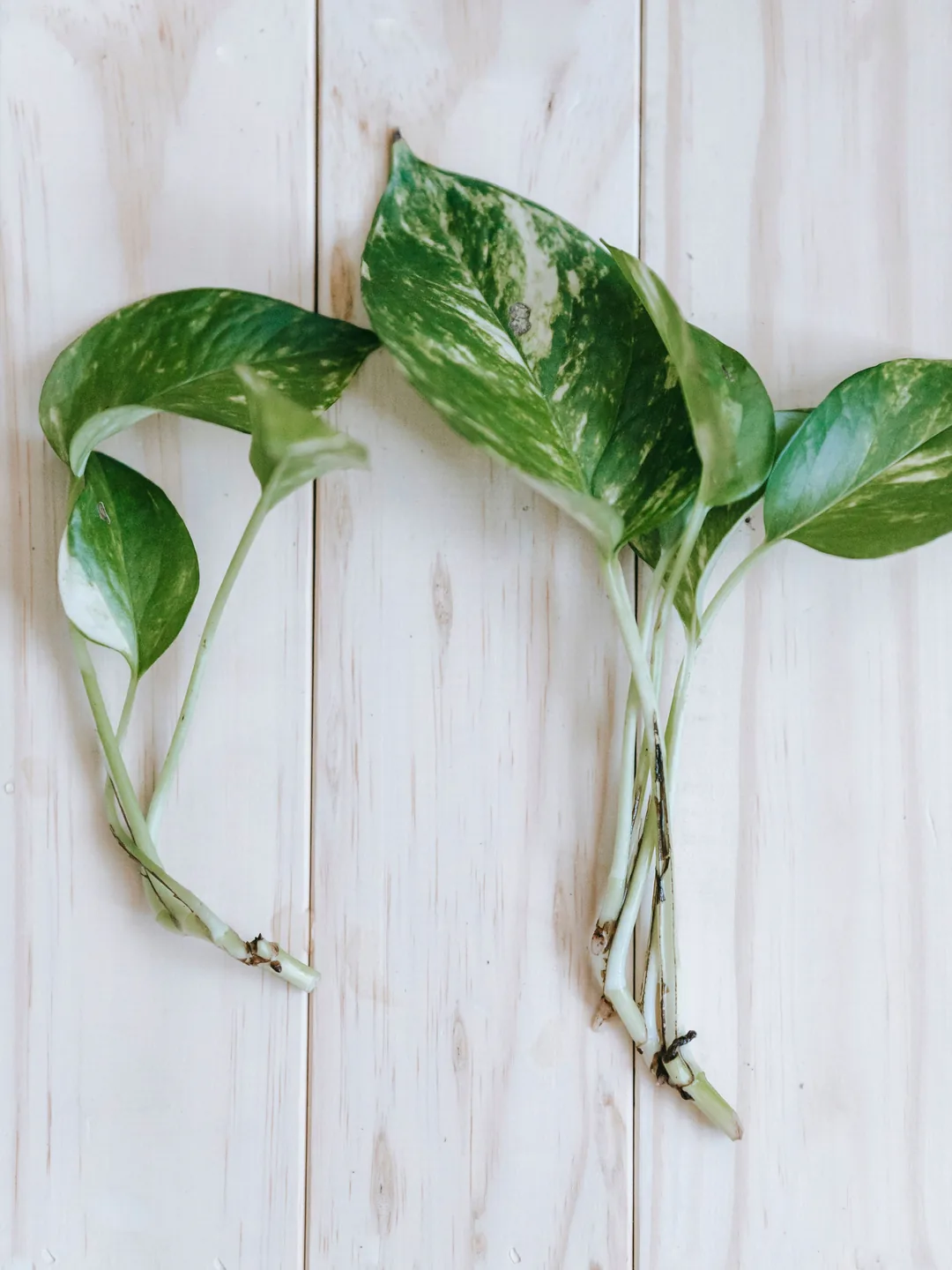
Photo: Teona Swift, Pexels License, via Pexels (cropped and resized)
Can a single leaf grow a new pothos?
A leaf on its own, without a node, is not a good cutting. University of Arkansas Extension’s propagation table marks leaf cuttings as a method that doesn’t work for pothos, and for plants in general, University of Illinois Extension notes that some leaf cuttings form roots but never produce new stems and leaves. Always include a node.
Step 2, option A: Root the cuttings in water
University of Maryland Extension names golden pothos among houseplants that root in plain tap water. Its steps, written for houseplants in general:
- Put the cuttings in a clean container of fresh tap water, with no leaves below the waterline. Roots most often form at or near a node (South Dakota State University Extension), so make sure a node sits under the water.
- Set the container in bright light but out of direct sun, away from cold drafts. A room temperature of about 70°F is ideal.
- Change the water at least twice a week, or whenever it looks cloudy: bacteria in the water can lead to rotting. Iowa State University Extension suggests changing it once or twice a week and never letting the water level drop so far that the new roots are exposed to air.
- When roots have formed, let them grow for another week or two, then plant the cuttings in a small, well-draining pot of potting mix. Iowa State University Extension suggests potting them up when the roots are about 1 inch long.
How fast roots appear varies. NC State Extension shows pothos cuttings rooting in water after 2 weeks, and University of Wisconsin–Madison Extension notes that the vines root in water or vermiculite within 3 to 4 weeks. University of Maryland Extension also suggests choosing cuttings with fairly thin stems, because thicker stems can take longer to root and may rot first.
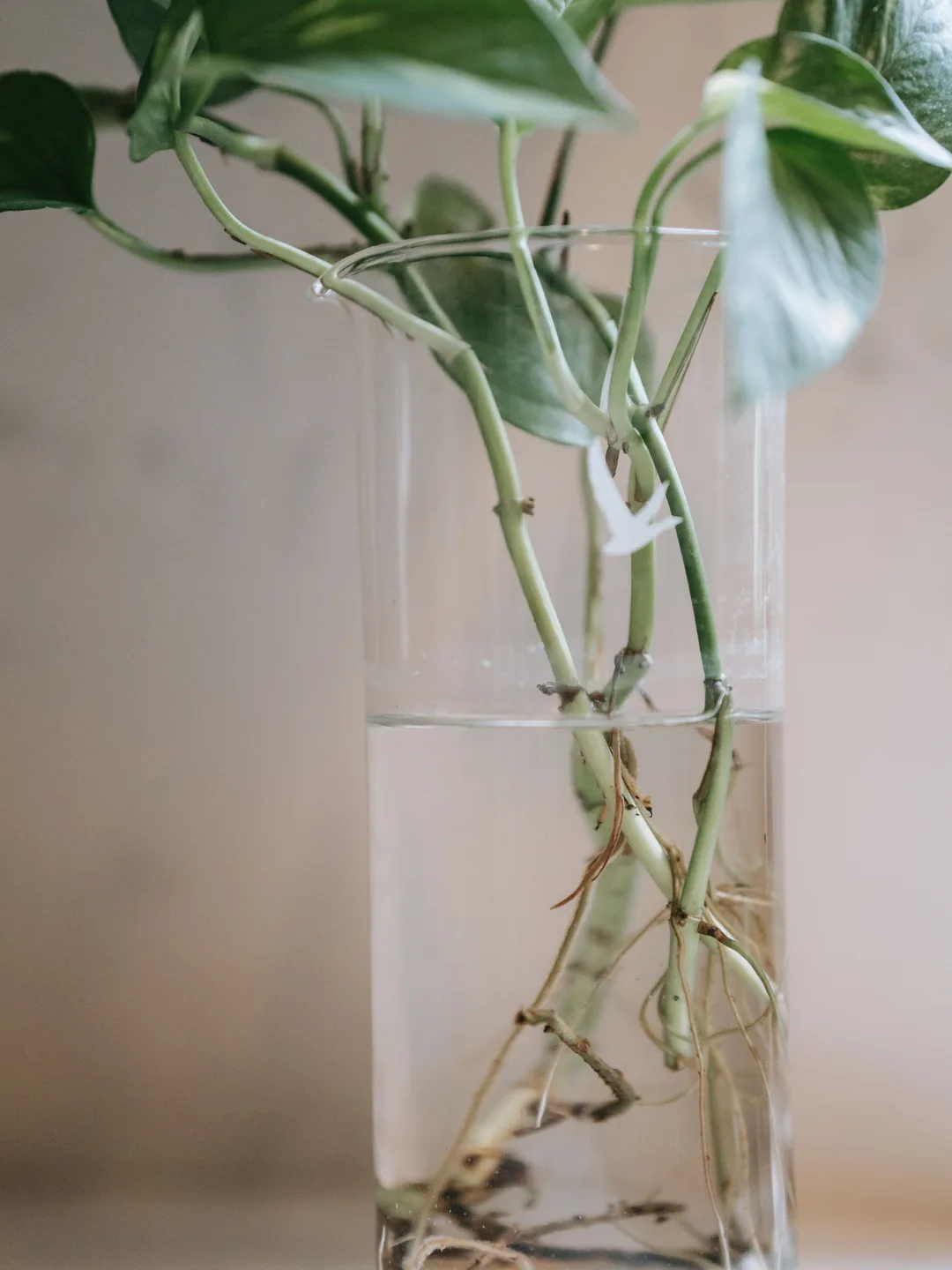
Photo: Sasha Kim, Pexels License, via Pexels (cropped and resized)
Step 2, option B: Root the cuttings in a rooting mix
The New York Botanical Garden roots pothos cuttings in a mix rather than in water. It plants three or four cuttings around the rim of a 3-inch pot filled with a moistened mix of equal parts peat moss and coarse perlite, encloses the pot in a plastic bag and sets it in bright, filtered light. Insert each cutting so that at least one node is under the surface of the mix (University of Nebraska–Lincoln Extension, houseplants in general). University of Wisconsin–Madison Extension notes that cuttings also root in vermiculite.
Keep the mix evenly moist but not soggy (University of Illinois Extension, houseplants in general). For plants in general, Purdue Extension notes that a rooting mix that stays waterlogged has no air in it, and the cuttings rot instead of rooting.
The bag keeps the air humid so that the cuttings don’t dry out before they have roots. For houseplants in general, Iowa State University Extension suggests keeping the bag off the leaves with supports such as chopsticks or straws and not sealing it tightly, so that some air can get in, and South Dakota State University Extension suggests opening it a bit if it gets too wet inside. University of Arkansas Extension (houseplants in general) takes a different approach: it seals the bag and leaves it closed until the cuttings have rooted, in 4 to 6 weeks. Either way, keep a covered pot out of direct sun, because heat builds up under the plastic and can damage the cuttings (University of Nebraska–Lincoln Extension).
Warmth speeds rooting. For houseplant cuttings in general, Iowa State University Extension gives an air temperature of 65 to 75°F as ideal and suggests a heat mat to keep the rooting mix at 75 to 80°F; Penn State Extension and University of Illinois Extension also give 75 to 80°F for the mix, while Purdue Extension (plants in general) suggests keeping cuttings at 65 to 75°F and Virginia Cooperative Extension (plants in general) keeping both air and mix at 70 to 75°F. In the 1987 study of golden pothos, a warm rooting medium (about 82°F) together with brighter light improved both shoot and root growth compared with an unheated medium (about 50 to 61°F) in dimmer light.
To check for roots after two or three weeks, gently lift a cutting or give it a light tug: if you feel resistance, roots are probably forming (Purdue Extension, plants in general; South Dakota State University Extension, houseplants in general). If no roots have formed yet, Purdue suggests firming the cutting back into the mix and checking again in one to two weeks.
Water or mix: which is better?
Both work for pothos, but sources disagree about which is better. Clemson Extension, University of Wisconsin–Madison Extension and NC State Extension all say pothos cuttings root in water. The New York Botanical Garden, by contrast, uses potting mix and not water, because water-grown roots are hard to move into soil.
Several Extension services make the same point for houseplants in general. University of Illinois Extension does not recommend rooting in water, because roots that form in water are often weak and adapt less easily to potting mix. Iowa State University Extension notes that water roots are coarser and that newly potted cuttings may show stress such as wilting, leaf drop or browning leaves, and Virginia Cooperative Extension (plants in general) that roots formed in water may suffer more transplant shock. In an answer about monstera cuttings, University of Maryland Extension notes that water makes it easier to watch the roots grow but brings a greater risk of the cut stems rotting, and may make the move to soil harder.
In the Extension, botanical garden and research sources we checked, we found no study that compares pothos roots grown in water with roots grown in a mix; that doesn’t mean none exists. In short: water is simple and lets you watch the roots, while a rooting mix may give roots that settle into a pot more easily.
How long does a pothos cutting take to root?
Sources give different times:
- University of Wisconsin–Madison Extension: 3 to 4 weeks in water or vermiculite, with new buds starting to grow in 1 to 2 weeks in warm temperatures.
- New York Botanical Garden: 4 to 6 weeks in potting mix, in spring.
- University of Florida IFAS, for commercial growers: roots in 3 to 4 weeks on single-node cuttings, with buds breaking in 2 to 3 weeks.
- Iowa State University Extension, for houseplant stem cuttings in general: 3 to 6 weeks.
Light and warmth make a difference: for houseplants in general, Iowa State University Extension notes that too little light slows root formation, and cuttings may rot or dry out before roots form.
Spring and summer are the easiest seasons. Penn State Extension (in an article by a Master Gardener volunteer) notes that pothos cuttings root more successfully from spring through summer, and the New York Botanical Garden propagates in spring. For houseplants in general, Iowa State University Extension notes that most can be propagated any time of year, with early spring through summer best for the cuttings and the parent plant.
Do you need rooting hormone?
Often not, for pothos, though the evidence is limited and sources differ. A University of Florida IFAS research note for commercial growers (1991) reports no benefit from the rooting hormone IBA on pothos cuttings, without giving details. In an answer about monstera cuttings, University of Maryland Extension notes that rooting hormone is not essential for many houseplants, including aroids (the arum family, to which pothos belongs, as NC State Extension notes), though for cuttings rooted in soil it is usually applied, both to speed root formation and, in brands that include a fungicide, to discourage rot. For houseplants in general, University of Illinois Extension notes that rooting hormone tends to shorten rooting time and often improves the roots, but that many houseplants root so easily on their own that it isn’t important.
Other sources are more positive: for plants in general, Purdue Extension notes that rooting hormone often improves the chance of success, and for houseplants in general, South Dakota State University Extension recommends a rooting powder, and Penn State Extension notes that it speeds root development. If you use it, use only a little: Iowa State University Extension and Penn State Extension note that too much can slow rooting, and Purdue suggests throwing away any leftover powder rather than returning it to the container.
Step 3: Pot up the rooted cuttings
For a full plant, put several rooted cuttings in one pot (University of Wisconsin–Madison Extension). The New York Botanical Garden plants three or four cuttings in a 3-inch pot, removes the plastic once they have rooted and waters moderately. About three months after starting, it moves each plant into its own 3- or 4-inch pot, or several into a hanging basket, and then cares for them like grown plants.
Use a pot with drainage holes and a well-draining potting mix. Don’t leave cuttings in plain perlite for long, because it holds very few nutrients (South Dakota State University Extension, houseplants in general).
Water-rooted cuttings need a little extra care at first. For houseplants in general, University of Maryland Extension suggests keeping the potting mix moist until new leaves start to form, then watering less often, and Iowa State University Extension notes that steady care helps newly potted cuttings recover. For cuttings rooted under a bag, Purdue Extension (plants in general) suggests opening the bag a little more each day before potting, so that the young plants get used to drier air.
Other methods: layering and division
Layering roots a vine while it is still attached to the parent plant. Iowa State University Extension lists pothos for simple layering: for houseplants in general, it suggests burying a section of stem 2 to 4 inches deep in a pot of mix, with at least one node buried and the tip of the vine above the soil, and notes that new roots should form in 6 to 12 weeks, maybe longer. Once the section has rooted, cut it from the parent plant (Penn State Extension, houseplants in general). NC State Extension and Virginia Cooperative Extension also name pothos for compound (serpentine) layering, in which several sections along one vine are buried and the sections between them are left exposed.
Air layering is less clear-cut. University of Wisconsin–Madison Extension notes that pothos can be propagated by air-layering, while University of Arkansas Extension’s propagation table marks air layering as a method that doesn’t work for pothos, and Iowa State University Extension lists pothos only for simple layering.
Division: Penn State Extension (an article by a Master Gardener volunteer) suggests dividing the roots when you repot, and University of Arkansas Extension lists division as a method that works for pothos.
Troubleshooting
The cut end turns brown and mushy
This suggests the cut end is starting to decay. In an answer about monstera cuttings, University of Maryland Extension notes that a cut end turning brown and mushy is common and suggests decay from being constantly wet, and suggests moving such water cuttings into potting soil. In water, bacteria can lead to rotting, so change the water often (University of Maryland Extension). In a mix, a mix that stays waterlogged makes cuttings rot instead of root; Purdue Extension suggests adding vermiculite or perlite if this keeps happening. With too little light, cuttings may rot or dry out before they root (Iowa State University Extension). These points are general, not specific to pothos. The look of the rot doesn’t tell you its cause: a University of Florida IFAS research note for commercial pothos growers (1991) lists more than one disease, fungal and bacterial, that can cause a mushy rot at the base of cuttings, and a UF/IFAS disease guide for commercial growers notes that damage from poor growing practices is frequently mistaken for disease. If a cutting rots away, start again with a fresh one; for houseplants with root rot, University of Maryland Extension advises taking stem cuttings only from healthy tissue. If roots rot in water, it suggests rooting in soil next time instead.
No roots after several weeks
Give it time and warmth. Most of the sources above give 3 to 6 weeks, and roots form more slowly in cool or dim spots (see How long). Make sure every cutting has a node under the water or the mix (see Step 1). Cuttings with thick stems can take longer (University of Maryland Extension, houseplants in general).
The cutting wilts
A cutting has no roots to take up water yet, so it loses water easily (Purdue Extension, plants in general). Long cuttings with many leaves are more likely to wilt (South Dakota State University Extension, houseplants in general). If a cutting with several large leaves wilts, University of Maryland Extension suggests pinching off a few of the larger leaves to reduce water loss until roots form (houseplants in general, golden pothos among them). Plant cuttings promptly, and keep cuttings in a mix covered with a loose plastic bag. In a study of golden pothos cuttings (Wang and colleagues, 1992), delaying planting by six hours caused water loss and slower growth of side shoots.
Leaves droop or brown after potting up
Water-rooted cuttings may show some stress after potting: for houseplants in general, Iowa State University Extension notes that they may wilt, drop leaves or show browning leaves or tip die-back once potted, and that steady care helps them recover. Feel the mix before you water: keep it moist but not soggy, and don’t add water if it is still wet.
Safety: sap, people and pets
Pothos contains calcium oxalate. University of Wisconsin–Madison Extension notes that its sap may irritate the skin, and the Missouri Poison Center that sap from the leaves and stems can cause a skin rash; NC State Extension lists contact dermatitis among the plant’s effects. The Missouri Poison Center advises rinsing any exposed skin with lukewarm water and soap, so wash your hands after taking cuttings.
Pets: the ASPCA lists golden pothos as toxic to dogs and cats, with oral irritation, intense burning of the mouth, tongue and lips, drooling, vomiting and difficulty swallowing as signs. Clemson Extension advises keeping pothos out of reach of children and pets, and that includes jars of cuttings. If you think your pet has eaten some, call your veterinarian or the ASPCA Animal Poison Control Center at (888) 426-4435 (a consultation fee may apply).
People: if someone eats a small amount, the Missouri Poison Center suggests wiping out the mouth with a soft, wet cloth, giving some cool water to drink and washing exposed skin with soap and water, and advises calling Poison Control at 1-800-222-1222 for more instructions. If the person collapses, has a seizure, has trouble breathing or can’t be awakened, call 911 immediately (National Capital Poison Center).
Frequently asked questions
Will a pothos cutting keep its variegation?
Generally, it keeps the parent’s kind of variegation: for plants in general, Purdue Extension notes that a cutting from a variegated parent grows into a plant with the same foliage. How strongly variegated it becomes can vary, though. In a University of Florida IFAS report for commercial growers on ‘Marble Queen’, cuttings that looked the same at first developed a range of variegation after about two months of growth. Light matters too: Clemson Extension, University of Wisconsin–Madison Extension and NC State Extension note that low light can cause variegated leaves to lose color. To keep their parent plants well variegated, commercial growers are advised to cut above a node whose leaf has good variegation (University of Florida IFAS research note, 1991).
Can I propagate pothos in winter?
Yes. For houseplants in general, Iowa State University Extension notes that most can be propagated any time of year, with early spring through summer best. Keep winter cuttings warm and in bright, indirect light, since cuttings root faster in warmth and too little light slows rooting (Iowa State University Extension).
How do I make my pothos look fuller?
Plant several rooted cuttings together in one pot (University of Wisconsin–Madison Extension). The New York Botanical Garden starts three or four cuttings together in a small pot (see Step 3).
Do pothos and philodendron cuttings root the same way?
Yes, as far as the sources go: University of Maryland Extension lists both golden pothos and heartleaf philodendron among houseplants that root in water, and NC State Extension names both for single-node cuttings and compound layering. To tell them apart, Clemson Extension notes that pothos leaf stalks are grooved and philodendron leaf stalks smooth, and University of Illinois Extension that pothos has one small root at a node while philodendron has several.
Sources
- Clemson Cooperative Extension, Home & Garden Information Center: How to Grow Pothos Indoors (HGIC 1568, 2026).
- University of Wisconsin–Madison Extension: Pothos, Epipremnum aureum.
- New York Botanical Garden, Plant Information Service: pothos propagation answer (2024).
- NC State Extension: Epipremnum aureum (Gardener Plant Toolbox); Extension Gardener Handbook, chapter 13: Propagation (2022; plants in general).
- Missouri Botanical Garden: Epipremnum aureum (Plant Finder).
- Penn State Extension: Pothos as a Houseplant (2025; Master Gardener author); Propagating Houseplants (houseplants in general).
- University of Maryland Extension, Home and Garden Information Center: Make More Plants from Cuttings: 5 Plants That Root Easily in Water (Maryland Grows blog, 2017, updated 2021); answer on rooting monstera cuttings (Ask Extension, 2024); Root Rots of Indoor Plants (houseplants in general).
- Iowa State University Extension and Outreach: How to Propagate Houseplants by Stem Tip Cuttings, Propagating Houseplants and How to Propagate Houseplants by Air Layering and Simple Layering (houseplants in general).
- University of Illinois Extension: Houseplant propagation and Cuttings (houseplants in general); Popular houseplants: is it philodendron or pothos? (2020).
- University of Arkansas Cooperative Extension Service: Propagating Houseplants (FSA2095, with propagation table) and Propagating Houseplants (web page).
- Purdue Extension: New Plants from Cuttings (HO-37-W; plants in general).
- South Dakota State University Extension: Propagating Houseplants (2018; houseplants in general).
- Virginia Cooperative Extension: Propagation by Cuttings, Layering and Division (426-002; plants in general).
- University of Nebraska–Lincoln Extension: Propagating House Plants (NebGuide G1853; houseplants in general).
- University of Florida IFAS Extension: Cultural Guidelines for Commercial Production of Interiorscape Epipremnum (ENH894, for commercial growers); Central Florida Research and Education Center, Pothos production guide (Research Note RH-1991-29, 1991, for commercial growers; archived copy) and report on ‘Marble Queen’ variegation (RH-90-17, 1990, for commercial growers; archived copy); Pothos (Epipremnum aureum) Diseases: Identification and Control in Commercial Greenhouse Production (PP340, for commercial growers).
- Wang, Y.-T. (1987). Effect of warm medium, light intensity, BA, and parent leaf on propagation of golden pothos. HortScience 22(4):597–599 (abstract).
- Wang, Y.-T., Hsiao, K.-H. and Gregg, L. L. (1992). Antitranspirant, water stress, and growth retardant influence growth of golden pothos. HortScience 27(3):222–225 (abstract).
- ASPCA Animal Poison Control: Golden Pothos.
- Missouri Poison Center: Devil’s Ivy.
- National Capital Poison Center: First aid guidelines.
