
Plant Problems › Peace Lily Drooping
A drooping peace lily (Spathiphyllum) is often thirsty: the UF/IFAS guide for commercial growers calls underwatering the most common problem indoors, and SDSU Extension notes that drooping or wilting leaves happen when the plant isn’t getting enough water. But Clemson Extension names root and stem diseases, usually linked to overwatering, as the most common peace lily problem, and University of Maryland Extension notes that while a peace lily wilts when it needs water, plants can also wilt when they are overwatered. Clemson also warns, for houseplants in general, that watering a plant whose roots are damaged may make the problem worse. Check the potting mix before you water.
Quick answer
Causes to check:
- Mix is dry and the pot feels light: the plant is thirsty. Act soon
- Mix is wet or soggy, yet the plant droops: too much water or root rot. Act soon
- Droops late in the day in bright light and heat, mix still moist: can be normal. Often normal
- Roots grow out of the drainage holes or circle on top, and it droops soon after watering: pot-bound. Fix this week
- Near a cold window, door or air-conditioning vent: possible cold or draft damage. Act soon
- White crust on the mix or pot, plant fed often: possible fertilizer salt buildup. Fix this week
Labels show how quickly to act if a cause is confirmed. They are not a diagnosis; check the signs in each section first.
Is a drooping peace lily ever normal? Often normal
Sometimes. The UF/IFAS guide for commercial growers notes that peace lilies may droop late in the day in bright light at temperatures above 80 to 85°F even when the potting mix is moist, and calls this normal. The same guide adds that frequent drooping leads to brown tips and edges, so if your plant droops this way often, move it to a spot with less light or heat. Clemson Extension advises against direct sun, because the heat will scorch the foliage.
If the plant is still drooping the next morning, or the mix is dry or soggy, check the causes below.
Thirsty: the mix has dried out
How urgent: Act soon
Clemson Extension notes that if the mix dries out too much, a peace lily wilts and its leaves and leaf edges turn yellow. The UF/IFAS commercial growers’ guide calls underwatering the most common problem indoors: the whole plant wilts so badly that growers call it a “crash,” sometimes drooping to the level of the mix.
How to tell
- The mix feels dry, and the pot feels light: Iowa State Extension notes, for houseplants in general, that a pot weighs less when the mix is dry.
- The whole plant droops at once, not just one or two leaves.
- The plant perks up after a thorough watering.
How to fix
- Water thoroughly: the UF/IFAS growers’ guide notes that a simple, thorough watering is enough and that plants recover within hours. Clemson Extension advises room-temperature water and never leaving the plant in a saucer of excess water.
- If the mix is so dry it is hard to rewet, Clemson Extension suggests, for houseplants in general, watering once and then again half an hour later, or setting the pot in a sink or bucket of water until the surface of the mix is moist, then letting it drain completely.
- Expect some damage on badly wilted plants: the UF/IFAS guide notes that some yellowing or browning may appear after the leaves recover. If the plant doesn’t perk up once the mix is moist, check the roots (too much water or root rot).
Prevent it
Clemson and SDSU Extension advise keeping the mix moist but not soggy and letting it dry slightly between waterings; NC State Extension also says moist but not soggy, drying between waterings. University of Maryland Extension advises, for houseplants in general, checking the mix with your finger rather than watering on a schedule.
Too much water or root rot
How urgent: Act soon
Clemson Extension notes that root and stem diseases are the most common peace lily problem and are usually linked to overwatering, and that letting the plant sit in a saucer of water leads to root rot. It explains, for houseplants in general, that damaged roots can’t take up enough water, so the plant wilts, and that watering it then may make the problem worse.
The UF/IFAS commercial growers’ guide notes that in saturated mix, peace lily leaves can wilt or collapse and sometimes die along the edges, with sparse roots that sometimes have black tips; this is more likely in cold weather, when the plant needs less water. A University of Hawaii fact sheet for nurseries describes a fungal root rot of peace lilies (Cylindrocladium) that causes dull green leaves, wilting and early yellowing of older leaves.
How to tell
- The mix is still wet or soggy, yet the plant droops. University of Maryland Extension notes, for houseplants in general, that plants with some root rots wilt even when the mix is moist enough.
- The pot has no drainage hole, or water collects in the saucer or decorative outer pot; Iowa State Extension lists these, for houseplants in general, among the reasons a mix stays wet.
- Roots or the stem base are rotting. Slide the plant out of its pot to look. Clemson Extension notes, for houseplants in general, that infected roots are brown to black and may be soft, and that stems may be ringed with brown or black tissue at or near soil level. Check how the roots feel, not just their color: Iowa State Extension notes, for houseplants in general, that healthy root tissue is firm and rotted roots are mushy.
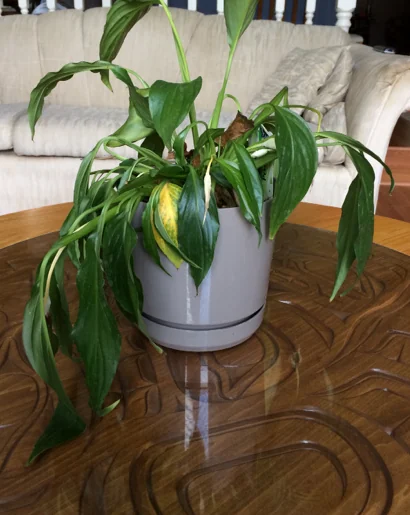
Photo: Scot Nelson, CC0, via Flickr (cropped)
How to fix
- Don’t water. Empty the saucer or outer pot. Clemson Extension advises, for houseplants in general, providing drainage and reducing watering when overwatering makes a plant wilt.
- Check the roots now if the stem base is soft or ringed with brown or black tissue, or if the plant stays limp while the mix stays wet: Iowa State Extension stresses, for houseplants in general, examining the roots and the moisture of the mix before adding more water. If the roots are firm, let the mix dry slightly before you water again. Clemson Extension advises, for houseplants in general, that if only a few roots are infected, you cut them out and repot the plant in sterile potting mix, in a new pot or one scrubbed clean and rinsed in a solution of one part bleach to nine parts water. If most roots are dark, soft and dead, it advises discarding the plant. Clemson’s general repotting guide advises against repotting ailing plants, but its disease guide gives this repotting step specifically for root rot.
- Don’t expect a badly rotted plant to recover: the University of Hawaii nursery fact sheet notes that peace lilies with more than 30 percent of their roots infected by Cylindrocladium rarely recover. University of Maryland Extension advises, for houseplants in general, throwing away severely infected plants.
- When you repot, don’t move the plant into a bigger pot than its remaining roots need: Clemson Extension warns that a pot that is too large can keep the mix too wet and lead to root rot.
Prevent it
Never let the plant sit in water (Clemson Extension). Use a pot with a drainage hole and water only when the top of the mix has started to dry.
Pot-bound: roots have filled the pot
How urgent: Fix this week
Clemson Extension notes that peace lilies like to be slightly pot-bound, but that it is time to repot when roots grow through the drainage holes or circle on top of the mix; SDSU Extension gives the same signs. Clemson’s general repotting guide adds that a plant needs repotting if it needs frequent watering or wilts shortly after watering, and its general disorders guide explains that a pot-bound plant has too little soil to hold water for all its roots, so it wilts.
How to tell
- Roots grow out of the drainage holes or circle on top of the mix.
- The mix dries out within a short time, and the plant droops again soon after watering.
How to fix
- If the plant is drooping from dry mix, water it and wait until it has perked up before you repot: Clemson’s general repotting guide advises against repotting ailing plants.
- Repot into a pot 1 to 2 inches larger, gently loosening the roots so they can grow into the new mix (Clemson Extension). Clemson’s peace lily guide says repotting can be done any time of year, though the plant recovers faster in the growing season; its general repotting guide advises repotting in spring and summer, while the plant is actively growing, and NC State Extension suggests repotting, when necessary, in February or March.
Cold, drafts and vents
How urgent: Act soon
Clemson Extension advises keeping peace lilies away from heat and air-conditioning vents, because hot, cold or drafty exposures damage the plant, and avoiding temperatures below 60°F, where cold damage may occur. NC State Extension notes that temperatures of 40 to 60°F slow growth considerably and that extended periods below 40°F can damage leaves, stems and roots. Iowa State Extension notes, for houseplants in general, that a big temperature swing can cause wilting, yellowing, browning or leaf drop.
How to tell
- The plant sits near a cold window or door, or in the path of a vent.
- It drooped after a cold night or a cold spell, while the mix is neither dry nor soggy.
- Look for leaf damage too: the UF/IFAS commercial growers’ guide notes that cold injury on peace lilies usually begins at the leaf tips and spreads inward, with black areas on leaves and stunted growth.
How to fix
- Move the plant to a spot away from drafts and vents. Clemson and NC State Extension suggest daytime temperatures of 68 to 85°F; Clemson suggests nights about 10°F cooler.
Too much fertilizer (salt buildup)
How urgent: Fix this week
Clemson Extension lists too much fertilizer and salt buildup among the common causes of wilting in houseplants: fertilizer and minerals from hard water build up in the mix and damage the roots. University of Maryland Extension adds, for houseplants in general, that high salt levels can cause reduced growth, brown leaf tips, lower leaf drop, dead root tips and wilting. For peace lilies, Clemson and NC State Extension note that overfertilizing and salt buildup can burn the leaf tips and roots.
How to tell
- A white crust forms on the surface of the mix or on the outside of the pot (University of Maryland Extension). Clemson Extension notes, for houseplants in general, that this crust shouldn’t be confused with white or yellow, mold-like growth of fungi that live on dead matter in the soil, so treat it as a clue, not proof.
- The plant has been fed often or at full strength, and leaf tips are turning brown.
How to fix
- Flush or replace the mix. Flush only a pot that drains freely. University of Maryland Extension advises, for large pots, watering several times with clear water, each time with at least the volume of the pot, and letting it run out of the bottom; for smaller pots, it advises replacing the mix, and it advises repotting when the pot has poor drainage. If the mix is still wet and the plant droops, check for root rot first (too much water or root rot) instead of adding more water. Clemson’s general guide also suggests repotting in fresh soil.
- Feed less. Clemson Extension suggests a balanced liquid houseplant fertilizer at one-quarter of the label strength every six to eight weeks in spring and summer, and NC State Extension advises flushing the mix between feedings.
Peace lily at a glance: bright, indirect light, no direct sun · mix moist but not soggy, slightly dry between waterings · never sitting in water · 68 to 85°F by day, not below 60°F (Clemson) · repot when roots circle or grow out of the holes, 1 to 2 inches larger · quarter-strength fertilizer every six to eight weeks in spring and summer · toxic to dogs and cats (ASPCA: insoluble calcium oxalates) · full peace lily care guide
Not sure which cause fits? Start with the potting mix: if it is dry, see thirsty; if it is wet, see too much water or root rot.
Sources
- Clemson Cooperative Extension, Home & Garden Information Center: Peace Lily (HGIC 1512); Houseplant Diseases & Disorders (HGIC 2251); Indoor Plants – Watering (HGIC 1459); Indoor Plants – Transplanting & Repotting (HGIC 1458).
- UF/IFAS Extension: Cultural Guidelines for Commercial Production of Interiorscape Spathiphyllum (ENH958; a guide for commercial growers).
- University of Hawaii, College of Tropical Agriculture and Human Resources: Cylindrocladium Rot of Spathiphyllum (a fact sheet for nurseries).
- SDSU Extension: Peace Lily: Houseplant How-To.
- NC State Extension Gardener Plant Toolbox: Spathiphyllum.
- University of Maryland Extension: Watering Indoor Plants; Root Rots of Indoor Plants; Fertilizer Toxicity or High Soluble Salts in Indoor Plants.
- Iowa State University Extension and Outreach: How to Care for Houseplants; Diagnosing Houseplant Problems: Improper Environmental Conditions; Root Rots of Houseplants.
- ASPCA Animal Poison Control: Peace Lily.
