
Plant Problems › Spider Plant Brown Tips
Brown leaf tips are common on spider plants (Chlorophytum comosum): South Dakota State University Extension calls them common, and Iowa State Extension names the spider plant as a species on which they are common. Wisconsin Extension notes that tip burn can have many causes: low humidity, excessively dry soil, salt buildup, and chemicals in tap water, particularly fluoride or chlorine. Clemson Extension adds too much fertilizer. Brown tips on their own don’t show which cause is at work, so check your water, the fertilizer, the potting mix and the plant’s spot before you change anything.
A brown tip won’t turn green again: University of Missouri Extension notes that once a leaf tip dies, it can’t return to its normal appearance. Judge a fix by the new leaves, and give them time: the same source notes that new leaves can look normal at first and develop brown tips as they mature.
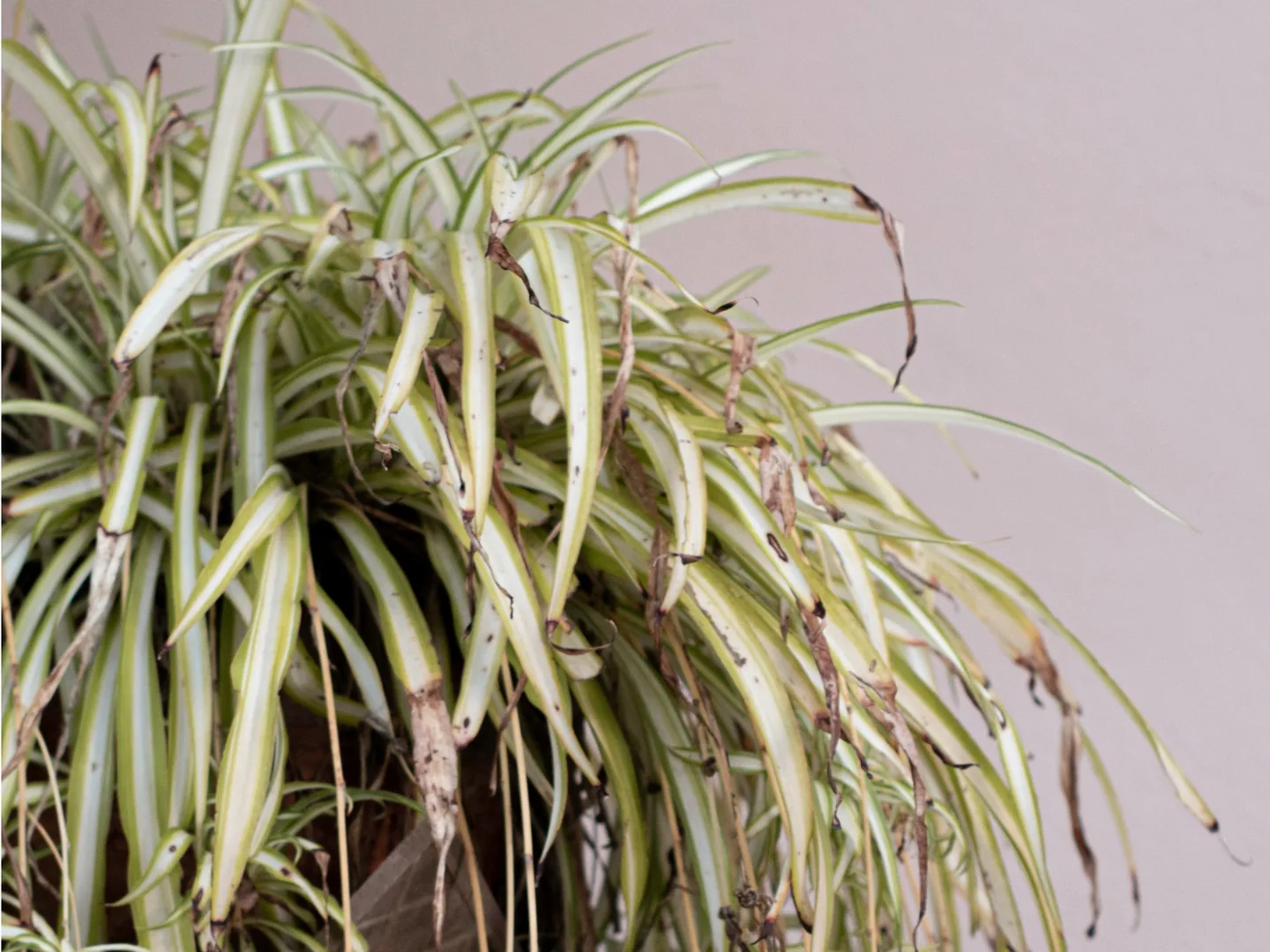
Photo: Agustina R Street, Pexels License, via Pexels (cropped and resized)
Quick answer
Causes to check:
- A few brown tips on an otherwise healthy, growing plant: Missouri Botanical Garden notes that brown tips will occur unless conditions are perfect. Often normal
- Fluoridated or chlorinated city tap water, or water from a softener: possible water quality problem. Fix this week
- Frequent feeding, or a white crust on the mix: too much fertilizer or salt buildup. Fix this week
- The mix often dries out completely, or water runs straight through a pot packed with roots: too little water. Fix this week
- The mix stays soggy, or the pot sits in water: too much water or poor drainage. Fix this week If leaves also wilt or yellow in wet mix, check the roots: Act soon
- Dry indoor air, a heating vent or a drafty window nearby: low humidity or drafts. Fix this week
- Direct sun, especially at midday: too much sun. Fix this week
Labels show how quickly to act if a cause is confirmed. They are not a diagnosis; check the signs in each section first.
Fluoride, chlorine or softened water
How urgent: Fix this week
Several sources name spider plants as sensitive to chemicals in tap water. University of Florida IFAS Extension calls the plant particularly sensitive to fluoridated water, and NC State Extension notes that the chlorine and fluorides in tap water can cause leaf tip burn. Iowa State Extension names the spider plant among the sensitive species on which too much chlorine and other chemicals in the water, such as fluoride, can cause brown leaf tips, especially over an extended period, and Missouri Botanical Garden names spider plants among the few plants that fluoride harms, with brown spots on the leaves or brown leaf tips.
How to tell
- You water with city tap water that is fluoridated or chlorinated, or with water from a water softener.
- Brown tips keep appearing even though watering, feeding, light and humidity seem right.
- Missouri Botanical Garden notes that fluoride damage can also show as brown spots on the leaves.
How to fix
- If your water is fluoridated, switch to another source. University of Florida IFAS Extension suggests rainwater or distilled water, Wisconsin Extension notes that distilled water or rainwater will help prevent tip browning, and Missouri Botanical Garden’s general watering guide also lists water collected from a dehumidifier.
- Letting tap water stand helps with chlorine, not fluoride. Missouri Botanical Garden’s watering guide notes, for houseplants in general, that chlorine evaporates from water left in an open-top bucket for 24 hours, but that fluoride can’t be removed by letting water sit. (South Dakota State University Extension suggests letting water sit for 24 hours so “the chemicals” can evaporate; this applies to chlorine.) If your utility uses chloramine instead of chlorine, standing won’t remove it either: the U.S. EPA notes, about drinking water, that letting water sit at room temperature doesn’t remove monochloramine. (The plant sources cited here don’t say whether chloramine browns spider plant tips.)
- Don’t use softened water. Missouri Botanical Garden warns, for houseplants in general, that the salt a water softener adds is deadly to plants over time and that softened water shouldn’t be used. University of Maryland Extension’s horticulturists, answering a question about a spider plant with brown tips, list water from a softener and bottled water that may contain sodium among the possible reasons.
- If you suspect fluoride and are repotting anyway, University of Missouri Extension suggests, for fluoride-sensitive houseplants in general, starting with a mix free from perlite, because perlite contains fluorides. A UF/IFAS spider plant production guide for commercial growers lists perlite among good mix components and advises using components that don’t add significant fluoride, so perlite in a mix doesn’t by itself mean fluoride damage.
Too much fertilizer or salt buildup
How urgent: Fix this week
Clemson Extension notes that leaf tip burn is caused by too much fertilizer or by water that is high in soluble salts, and Wisconsin Extension notes that excessive fertilizer may lead to tip browning. Spider plants don’t need much: Missouri Botanical Garden notes that their tubers store reserve food and that heavily fertilized plants may form fewer plantlets.
How to tell
- You feed often or at full strength.
- A whitish crust forms on top of the mix: University of Missouri Extension notes, for houseplants in general, that this residue shows the mix should be flushed. University of Maryland Extension adds that hard water can leave mineral salt deposits too.
- The mix is old: University of Maryland Extension’s horticulturists, answering a question about a spider plant with brown tips, note that after a year or two, old mix can hold too many mineral residues from tap water and fertilizer, which can damage the roots.
How to fix
- Flush the salts out: University of Maryland Extension advises, for houseplants in general, watering until it runs out of the bottom of the pot and repeating several times with a volume at least equal to the pot size. For a smaller pot with salty mix, it advises replacing the mix. Flush only a pot that drains freely; if the mix is already soggy, check the roots first (see too much water).
- Feed less. Wisconsin Extension notes that feeding every three to four months is usually enough, or more often at half strength, and South Dakota State University Extension also suggests every three to four months. Colorado State University Extension suggests once a month during active growth. The sources differ on how often; Wisconsin and Colorado State both warn that overfeeding can contribute to brown tips.
- After repotting, wait four to six months before feeding (Clemson Extension; South Dakota State University Extension).
- If the plant hasn’t had fresh mix in a year or two, consider repotting: University of Maryland Extension’s horticulturists suggest replacing the potting mix every few years.
Too little water or a pot full of roots
How urgent: Fix this week
Clemson Extension and Wisconsin Extension list excessively dry soil among the causes of brown tips, and Missouri Botanical Garden lists too little water. Spider plants store water in thick, fleshy roots, which Wisconsin Extension notes lets them survive inconsistent watering. Still, University of Maryland Extension’s horticulturists, answering a question about a spider plant with brown tips, list root loss from underwatering as well as overwatering among the causes.
How to tell
- The mix often dries out completely, or you water on an irregular schedule. Iowa State Extension notes, for houseplants in general, that inconsistent watering, especially letting plants dry out too long between waterings, causes brown leaf tips and edges.
- Water runs straight through the pot, and roots fill the pot or push the plant up. University of Maryland Extension notes, for houseplants in general, that water can pass through a pot-bound plant too quickly, leaving the center of the root ball dry, and that such plants can show tip dieback. Colorado State University Extension notes that spider plant roots can push the plant out of its pot or even break plastic pots.
- Thick, fleshy roots are normal: Clemson Extension notes that spider plants form thick, fleshy tuberous roots.
How to fix
- Water thoroughly when the top inch of the mix has dried, until water runs out of the drainage hole, then empty the saucer. University of Florida IFAS Extension advises letting the upper inch of soil dry out briefly between waterings, and Wisconsin Extension advises letting the soil dry slightly between thorough waterings. Sources differ a little here: NC State Extension notes that the plant grows best in moist soil, and Missouri Botanical Garden advises keeping it moderately moist, so don’t let the mix dry out completely either.
- Repot or divide a crowded plant. Wisconsin Extension notes that spider plants grow best when slightly pot bound, but that their roots can easily get too crowded, so they need frequent repotting. Clemson Extension advises dividing and repotting before the roots crack the container.
- Don’t jump to a much bigger pot: Missouri Botanical Garden notes, for houseplants in general, that a pot too large for the root ball can lead to root rot, because the extra mix doesn’t dry out enough between waterings.
- Water less in fall and winter, when the plant grows less (Colorado State University Extension; NC State Extension). Colorado State notes the exception of a plant in a drafty spot near a heat register.
Too much water or poor drainage
How urgent: Fix this week Act sooner if leaves wilt or yellow while the mix stays wet: Act soon
Too much water can brown the tips too. Colorado State University Extension lists overwatering among the causes of brown tips, and University of Maryland Extension’s horticulturists, answering a question about a spider plant with brown tips, list root loss from overwatering. Wisconsin Extension notes that overwatering or poorly drained soil can lead to root rot, and Clemson Extension notes that root rot usually results from a mix that doesn’t drain quickly or from excessive watering. University of Maryland Extension explains, for houseplants in general, that excess water damages the fine roots so the plant can’t take up water. It notes that the main sign is wilting or yellowing of lower and inner leaves, and that later the plant can show drought symptoms such as scorch.
How to tell
- The mix stays wet for days, the pot has no drainage hole, or the pot sits in water in a saucer or outer pot.
- Leaves wilt or yellow, especially lower and inner leaves, while the mix is wet (University of Maryland Extension, houseplants in general).
- There is a layer of gravel, stones or pot shards in the bottom of the pot: University of Maryland Extension’s horticulturists note that this worsens drainage rather than improving it.
How to fix
- Let the mix dry more between waterings: University of Maryland Extension’s horticulturists note that spider plants don’t do well if kept constantly moist, and that the top inch or more of the mix should get fairly dry to the touch between waterings. Empty the saucer promptly after watering.
- If leaves wilt or yellow while the mix is wet, take the plant out of its pot and look at the roots: Missouri Botanical Garden notes, for houseplants in general, that this can show whether the mix is very wet and the roots are rotting. For houseplants in general, University of Maryland Extension notes that healthy roots are light-colored and firm and that diseased roots look dark and soft, and it advises cutting out rotten portions and replanting the healthy sections. Remember that thick, fleshy roots are normal on a spider plant, and that color alone can mislead, so check firmness too.
- Use potting mix all the way through a pot with an open drainage hole, and no drainage layer (University of Maryland Extension’s horticulturists).
Low humidity, vents and drafts
How urgent: Fix this week
Clemson Extension, Wisconsin Extension, Missouri Botanical Garden and South Dakota State University Extension all list low humidity among the causes of brown tips on spider plants, and Colorado State University Extension adds drafty air flow. Iowa State Extension, writing about houseplants in general, calls low humidity the most likely cause of brown leaf tips and notes that indoor humidity is often low, especially in winter.
How to tell
- Brown tips appear in winter, when the heat is on.
- The plant sits near a heating or air-conditioning vent, or near a cold, drafty window.
How to fix
- Move the plant away from heating and air-conditioning vents (Missouri Botanical Garden, houseplants in general). In winter, Clemson Extension advises moving spider plants a few feet from windows to protect them from drafts.
- Raise the humidity around the plant. NC State Extension suggests a humidifier or a tray of pebbles with water; set the pot on the pebbles, above the water, not standing in it. Iowa State Extension adds, for houseplants in general, a terrarium or grouping plants together.
Too much direct sun
How urgent: Fix this week
Spider plants grow best in bright, indirect light (Clemson Extension; Colorado State University Extension); NC State Extension says medium light and notes that the plant can tolerate deep shade. Sources differ on direct sun: NC State Extension calls the plant intolerant of direct sunlight, Colorado State University Extension and Missouri Botanical Garden note that direct sun scorches or scalds the leaves, and Clemson Extension notes that it can tolerate some direct sun but that midday light may scorch the leaves.
How to tell
- The plant gets direct sun, especially at midday, for example in a south or west window.
- University of Maryland Extension notes, for houseplants in general, that sun damage first shows as pale, bleached or faded areas that later turn brown and brittle, and that it is worse when strong sun comes with dry soil.
How to fix
- Move the plant out of direct midday sun into bright, indirect light (Clemson Extension).
- Don’t overcorrect into a dim spot: although the plant tolerates low light, Oklahoma State University Extension lists low light among the causes of browning leaf tips, and University of Maryland Extension’s horticulturists, answering a question about a spider plant with brown tips, note that a plant several feet from a window may get too little light to cope with other stresses.
What to do with brown tips
- Trim them if you like: Missouri Botanical Garden suggests cutting off brown tips. Iowa State Extension notes that trimming the brown parts with scissors can improve the plant’s appearance, but that new browning will occur if the cause isn’t fixed.
- Remove shriveled or discolored leaves with clean, sharp pruners or scissors (Missouri Botanical Garden, houseplants in general).
Spider plant at a glance: bright, indirect light; avoid midday sun (Clemson Extension) · let the top inch of the mix dry briefly between waterings (University of Florida IFAS Extension), then water thoroughly (Wisconsin Extension) · light feeding: every three to four months, or more often at half strength (Wisconsin Extension) · 65 to 75°F by day and 50 to 55°F at night (Clemson Extension); sources give different lower limits, from 45°F (NC State Extension) to 55°F (University of Florida IFAS Extension) · rainwater or distilled water if your tap water is fluoridated (University of Florida IFAS Extension) · repot or divide before the roots crack the pot (Clemson Extension) · non-toxic to cats and dogs (ASPCA) · full spider plant care guide
Not sure which cause fits? Start with your water and fertilizer (see fluoride and softened water and fertilizer and salts), then feel the mix (see too little water or too much water). Look closely at the leaves too: University of Maryland Extension’s horticulturists, answering a question about a spider plant with brown tips, identified fine speckling on the leaves as feeding damage from spider mites or a similar pest, and Oklahoma State University Extension lists spider mites among the causes of browning tips.
Sources
- University of Wisconsin–Madison Extension, Wisconsin Horticulture: Spider plant, Chlorophytum comosum.
- Clemson Cooperative Extension, Home & Garden Information Center: Spider Plant (HGIC 1513).
- NC State Extension Gardener Plant Toolbox: Chlorophytum comosum.
- University of Florida IFAS Extension, Gardening Solutions: Spider Plant.
- Colorado State University Extension, PlantTalk Colorado: Spider Plant (#1328).
- South Dakota State University Extension: Spider Plants: Houseplant How-To.
- Oklahoma State University Extension, Plant ID: Spider Plant.
- Missouri Botanical Garden: Chlorophytum comosum (Plant Finder); How to Water Indoor Plants; Houseplants (fact sheet).
- University of Maryland Extension, Home and Garden Information Center: answer on Ask Extension, Need help for my ailing spider plant? (2024); Fertilizer Toxicity or High Soluble Salts in Indoor Plants; Mineral and Fertilizer Salt Deposits on Indoor Plants; Pot-Bound Indoor Plants; Overwatered Indoor Plants; Excess Light on Indoor Plants; Diagnose Indoor Plant Problems.
- Iowa State University Extension and Outreach: Why does my houseplant have brown leaf tips and edges?
- University of Missouri Extension, Integrated Pest Management: Leaf Tipburn on Houseplants (2021).
- University of Florida IFAS, Central Florida Research and Education Center: Spider Plant (Foliage Plant Research Note RH-91-33, 1991; written for commercial growers; archived copy).
- U.S. Environmental Protection Agency: How can I remove monochloramine from my drinking water?
- ASPCA Animal Poison Control: Spider Plant.
