
Plant Problems › Yellow Leaves › Orchid
When orchid leaves turn yellow, a single yellow leaf at the bottom is often just normal aging. Several yellow leaves at once, yellowing new leaves, or yellow leaves that are also wrinkled, soft or blotched point to a problem with the roots, water, light, temperature or feeding, or to a pest or disease. This guide helps you tell which one fits your plant and fix it.
This guide is written for moth orchids (Phalaenopsis), the mass-produced orchids that University of Maryland Extension notes are readily available in big box stores. A moth orchid grows its leaves from a single point at the top (Missouri Botanical Garden), has no swollen pseudobulbs at the base, and often sends thick aerial roots out over the pot (University of Maryland Extension). If yours looks different, read other orchids before you change its care.
Quick answer
Causes to check:
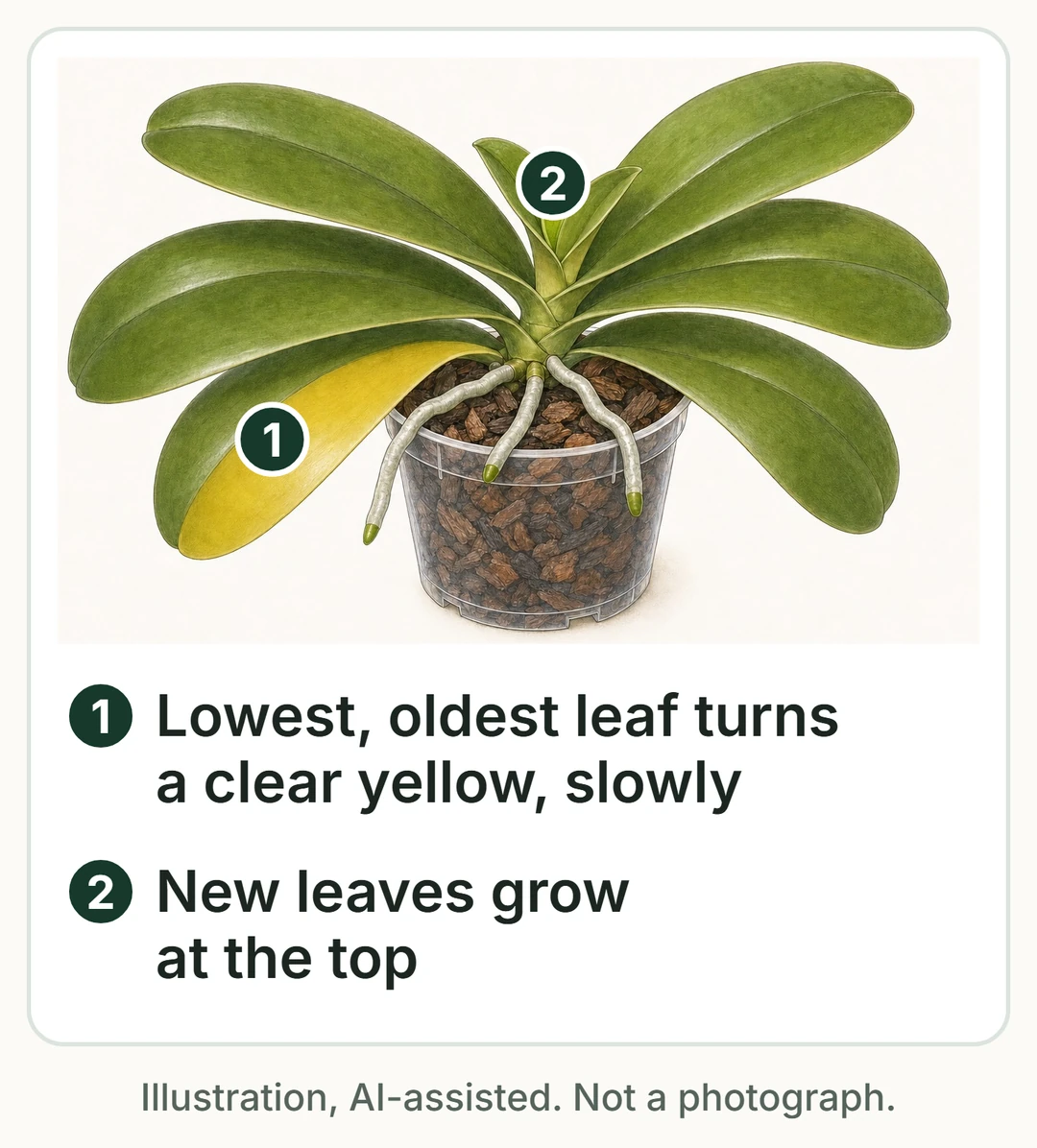
- Natural aging: the lowest leaf slowly turns a clear yellow while new leaves grow at the top. Often normal
- Overwatering or old, broken-down mix: yellow leaves, a mix that stays wet or has broken down, and roots that are soft or shriveled instead of firm and plump. Fix this week
- Crown rot: the center of the plant, where the leaves meet, turns soft and dark and may collapse. Act soon
- Too little water: leaves turn limp, wrinkled or leathery, and the mix is dry. Fix this week
- Too much light: in very high light, leaves turn yellow-green or almost yellow, sometimes with pink or reddish edges. Fix this week
- Cold: leaves damaged where they touched cold window glass. Fix this week Leaves that turned black after freezing or near-freezing temperatures: Act soon
- Feeding: too much fertilizer (yellow leaves, brown tips, a salt crust) or possibly too little (many leaves yellowing during a growth spurt, once other causes are ruled out). Fix this week
Also check for leaf spot diseases, pests such as scale and mealybugs, and viruses. Clemson Extension lists these among the pests and diseases common on orchids.
Labels show how quickly to act if a cause is confirmed. They are not a diagnosis; check the signs in each section first.
Is a yellow orchid leaf normal? Often normal
Often. A moth orchid grows upward from a single growing point at the top. Missouri Botanical Garden notes that one or two new leaves appear at the top each year, while the older leaves at the base die. An American Orchid Society magazine article (Orchids, 2024) notes that it is not unusual for a moth orchid to lose one of its bottom leaves in spring: the leaf turns a clear yellow gradually as the plant reabsorbs its nutrients for new growth. University of Maryland Extension likewise calls it normal for the oldest leaves to turn yellow and dry up as they age.
Worth checking: several leaves yellowing at once; uniform yellowing and shriveling of newer leaves, which University of Maryland Extension calls a sign of distress; or yellow leaves that are also wrinkled, soft, spotted or blotched. The American Orchid Society adds that if an unusually large number of leaves yellow in spring, the plant may be sacrificing older growth to build new growth, so once the roots, water and light check out, ask whether it was fed enough in the months before.
Should you remove the yellow leaf?
There’s no hurry. The American Orchid Society advises letting the plant reabsorb the leaf’s minerals first; once a separation layer forms at the base, the leaf comes away with a gentle tug. University of Maryland Extension suggests cutting old yellowed leaves off at the base of the plant. For removing brown or dead leaves, Iowa State Extension advises sharp pruners or scissors, sterilized between plants.
If your orchid isn’t a moth orchid
The light, temperature and watering advice in this guide is for moth orchids. Other orchids differ:
- Cattleyas and dendrobiums need twice as much light as moth orchids (Clemson Extension).
- Orchids with pseudobulbs, the swollen stems at the base of the leaves on orchids such as Cattleya and Oncidium, should dry out completely between waterings, Iowa State Extension advises, while Clemson Extension’s general orchid fact sheet says to let actively growing orchids dry slightly before the next watering. Moth orchids should be watered just as the mix dries.
- Some leaf loss is part of their cycle. The American Orchid Society notes that a yellowing leaf on an older cattleya pseudobulb may simply be aging, and that some soft-caned (nobile-type) dendrobiums yellow and drop their leaves during a cool, dry winter and then bloom in spring.
The sections on old potting mix, pests, leaf spots, rots and viruses rely mainly on guidance written for orchids in general, so they apply more broadly.
Match what you see
Compare your orchid with these signs, then jump to the matching section.
What you see: The lowest leaf turns a clear yellow slowly; the newer leaves look firm and green.
Likely cause: Natural aging
Often normal
What you see: Leaves yellow; the mix stays wet long after watering or has broken down; roots feel soft or look shriveled instead of firm and plump.
Likely cause: Overwatering or old mix
Fix this week
What you see: The plant is soft, dark or collapsing at the center, where the leaves meet.
Likely cause: Crown rot
Act soon
What you see: Leaves are limp, wrinkled or leathery; the mix is dry and the pot feels light.
Likely cause: Too little water
Fix this week
What you see: Leaves look yellow-green or almost yellow, sometimes pink or red at the edges, in a very bright or sunny spot.
Likely cause: Too much light
Fix this week
What you see: Leaves were damaged where they touched a cold window, or turned black and sunken after a freeze or near-freeze (act soon in that case).
Likely cause: Cold
Fix this week
What you see: Yellow leaves with brown leaf or root tips, and a salt crust on the pot.
Likely cause: Too much fertilizer
Fix this week
What you see: Many leaves yellow during a spring growth spurt on a plant that may not have been fed enough; roots, water and light check out.
Likely cause: Possibly too little fertilizer
Fix this week
What you see: Yellow spots on top of leaves with small bumps underneath, cottony masses, or sticky leaves.
Likely cause: Pests
Act soon
What you see: Yellow, brown or black blotches, streaks or rings, or a yellow-and-green mosaic.
Likely cause: Cold or sun damage, leaf disease or a virus
Act soon
Overwatering and old, broken-down mix
How urgent: Fix this week Act sooner if most roots are dead: Act soon
University of Illinois Extension notes that most people tend to overwater moth orchids, which kills the roots and ultimately the plant. Clemson Extension calls letting an orchid sit in a waterlogged pot one of the fastest ways to kill it.
Old potting mix can cause the same damage. The American Orchid Society explains that organic mixes break down over time, become compressed and smother the roots, and that root loss from a degraded mix can cause once-healthy roots to rot and leaves to yellow. University of Maryland Extension adds that if an orchid hasn’t been repotted in a couple of years, its mix may have become too dense to drain well.
How to tell
- The mix stays wet long after watering, or has broken down so that it looks like mulch, drains poorly and holds too much moisture (University of Maryland Extension).
- Brown particles of broken-down bark wash out of the pot when you water, or the bark you feel through the bottom drainage hole is no longer firm (Missouri Botanical Garden).
- Newer leaves yellow and shrivel. University of Maryland Extension explains that roots in poor condition can’t take up water, and that overwatering can cause roots to rot.
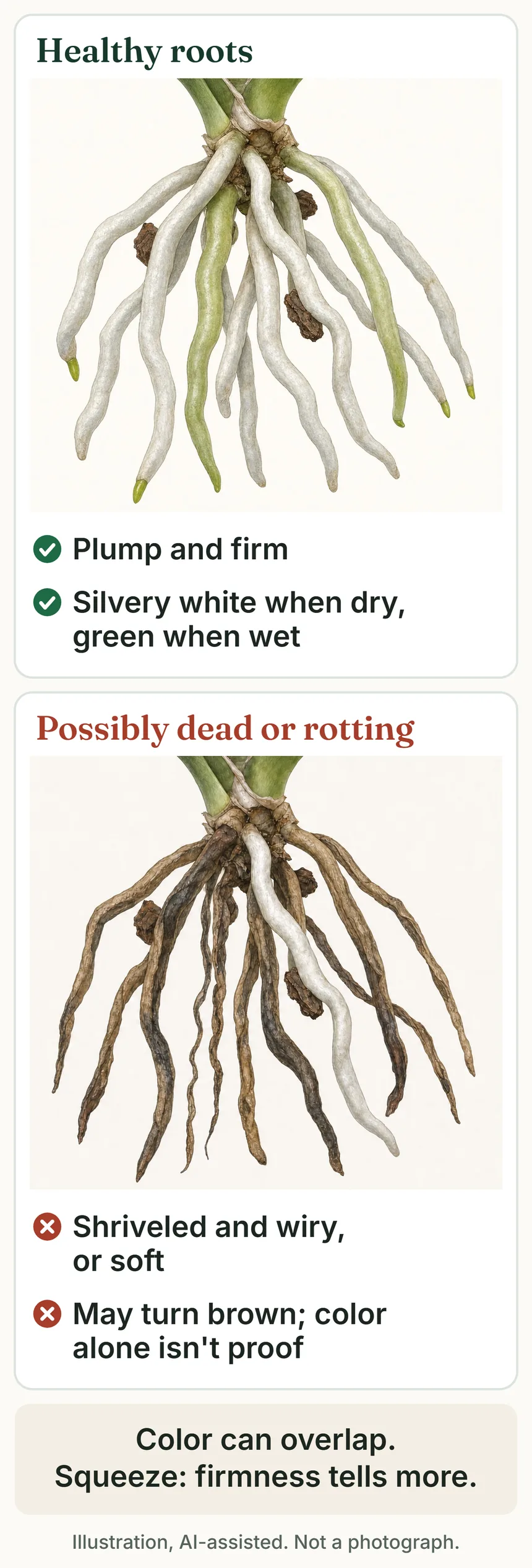
- The roots are shriveled and wiry, or soft, instead of firm and plump. Iowa State Extension calls brown, shriveled roots a sign of potential root rot, and Missouri Botanical Garden describes dead roots as brown, wiry and dry; for houseplants in general, UF/IFAS notes that rotted roots turn soft and brown, or even black. Healthy roots are green or white, firm and plump (Iowa State Extension; Missouri Botanical Garden). Color alone can mislead, because healthy aerial roots change from silvery to green when they are wet (University of Maryland Extension), so squeeze a few: firmness and texture tell you more than color.
- Roots growing over the rim of the pot are normal. University of Maryland Extension notes that moth orchids send out aerial roots that sprawl outside the pot, and advises against cutting them off.
How to fix
- Ease the plant out of its pot. If roots cling to the pot or the old bark, University of Maryland Extension suggests soaking the plant long enough that they can be gently pried off without breaking.
- Rinse away the old, broken-down bark (University of Maryland Extension).
- Remove only roots that are dead or damaged. Check each one by feel as well as color: keep roots that are firm and plump, and cut off dead or damaged ones: roots that are brown, wiry and dry (Missouri Botanical Garden), soft, or broken. If you aren’t sure a root is dead, leave it. University of Maryland Extension also lists discolored roots, but color varies, so don’t cut a firm, plump root for its color alone. Use a sterile razor blade or pruners, and sterilize your tools between plants (Missouri Botanical Garden).
- Repot in fresh orchid bark mix, never standard potting mix: Missouri Botanical Garden warns that standard potting mix results in root rot and plant death. Choose a pot with good drainage that fits the root mass rather than a larger one; that may mean a smaller pot (Missouri Botanical Garden). Timing: Clemson Extension cautions against repotting a plant in bloom, which can damage or kill it, and Missouri Botanical Garden prefers spring or summer, just after blooming. University of Maryland Extension instead says the best time to repot is when new growth has started, not necessarily after blooming. If the roots are rotting, an Extension expert answering a Maryland reader through Ask Extension notes that repotting is more urgent: a plant can be repotted in bloom, though the flower spike breaks more easily, so wait for the flowers to finish only if the roots don’t need urgent attention.
- Water again only when the mix is nearly dry. Clemson Extension advises watering thoroughly, then not watering again until the mix is nearly dry throughout the pot.
Prevent it
Repot before the bark breaks down: every one to two years, University of Maryland Extension suggests, while other guides allow up to three. Never let the pot stand in water: Iowa State Extension advises emptying saucers, trays and outer pots within 30 minutes of watering. If your orchid came in sphagnum moss, water it less often than you would bark, because moss holds more water (Missouri Botanical Garden; Iowa State Extension).
Root rot or crown rot? Sources describe them separately, though Iowa State Extension groups decay near the crown under root rot. Root rot affects the roots inside the pot: the roots turn soft or shriveled, and the leaves yellow and shrivel because water can’t reach them (University of Maryland Extension). Crown rot affects the crown, the center of the plant where the leaves meet: it can start when water sits there (University of Maryland Extension; Missouri Botanical Garden), and the center turns soft and dark and may collapse. If the center is soft, check the roots as well, and see crown rot below.
Too little water
How urgent: Fix this week
Unlike many other orchids, moth orchids have no pseudobulbs, the swollen stems some orchids use to store water. Clemson Extension notes that this makes water especially critical for them, and both Clemson and Missouri Botanical Garden advise never letting them dry out completely.
How to tell
- Leaves are shriveled, limp, leathery or folded into accordion-like pleats. Iowa State Extension lists all of these as signs of too little water, and University of Maryland Extension notes that low humidity and too little water cause wrinkled leaves.
- The mix is dry. Iowa State Extension notes that dry mix is lighter in color and weight, and a wooden chopstick pushed into it comes out completely dry.
- After watering, the aerial roots stay dull silver or white. University of Maryland Extension notes that they turn pale green once you have applied enough water.
- Check the roots before you water more. Wrinkled leaves can also mean the roots are too damaged to take up water (University of Maryland Extension). If the roots are shriveled or soft in a wet mix, see overwatering and old mix.
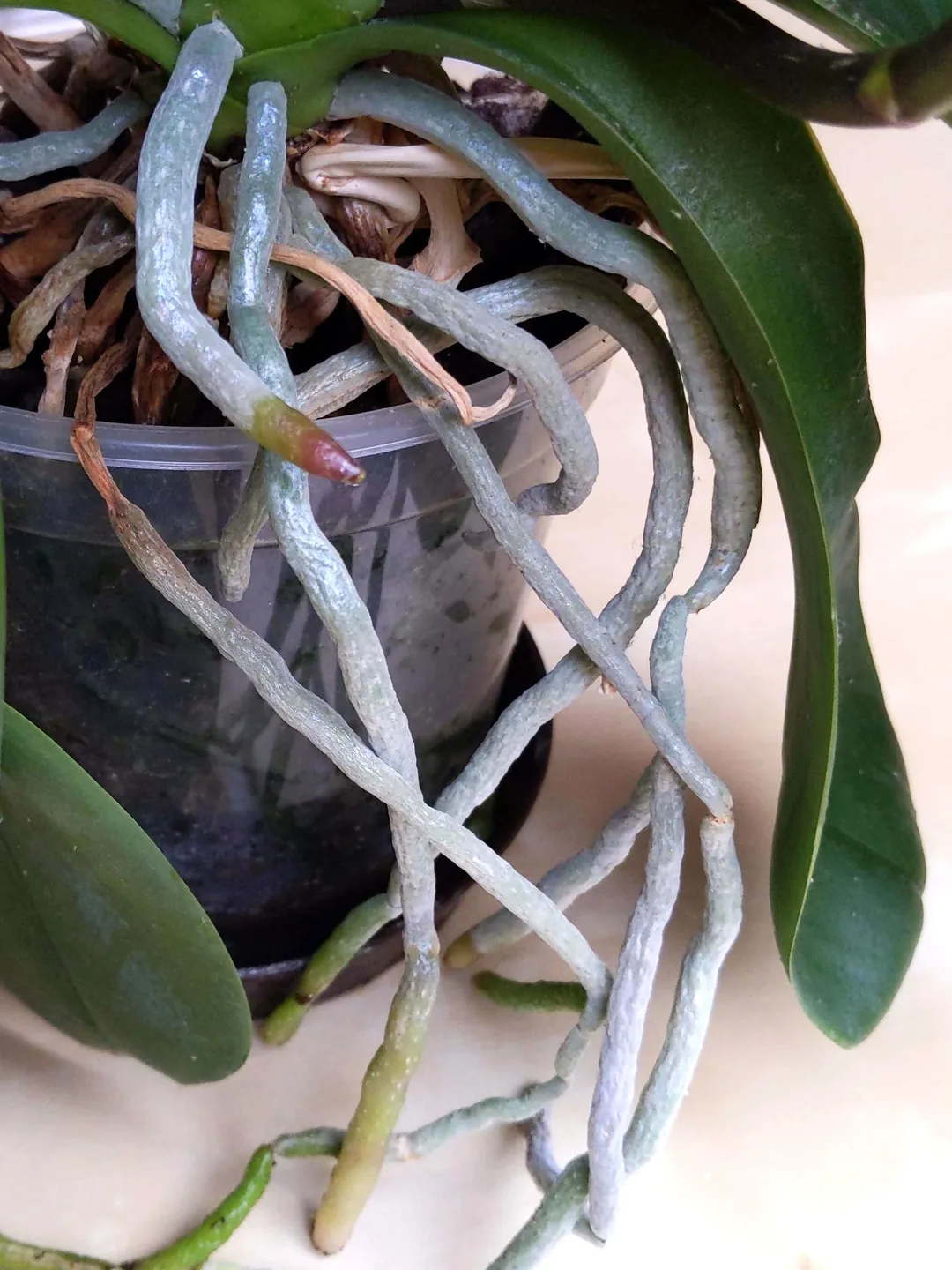
Photo: Nefronus, CC BY-SA 4.0, via Wikimedia Commons (cropped and resized)
How to fix
- Check the roots first. Iowa State Extension advises looking for green or white, plump roots in a mix that is still coarse and intact.
- Soak the plant thoroughly. University of Maryland Extension suggests setting it in a sink and running warm water over the plant, bark and roots in three or four drenches over 10 minutes, then letting it drain completely. Missouri Botanical Garden advises lukewarm, never cold, water.
- Water more often if the mix stays dry too long between waterings, but don’t overwater (Iowa State Extension).
- Raise the humidity. Iowa State Extension gives 40 to 60 percent relative humidity for moth orchids and notes that most homes are well below that in winter. A room humidifier or a tray of pebbles and water helps; keep the bottom of the pot above the water line.
Prevent it
Water just as the mix dries (Iowa State Extension). For a mature plant in bark, Missouri Botanical Garden notes that a thorough watering once a week is usually enough; small plants and plants in warmer or brighter spots may need water more often, and plants in sphagnum moss less often. Clemson Extension adds that moth orchids need more frequent watering in summer and less in winter. Water in the morning so the leaves dry before nightfall (University of Maryland Extension; Missouri Botanical Garden).
What about ice cubes? Missouri Botanical Garden advises against them: moth orchids are shocked by cold temperatures, causing root death, and a few ice cubes don’t provide enough moisture. Iowa State Extension notes that most experts advise against ice cubes, though one study found no harm to growth or bloom duration in some species.
Too much light
How urgent: Fix this week
Moth orchids need indirect light, not strong direct sun. Missouri Botanical Garden, Penn State and Clemson Extension call them low-light orchids, while Iowa State Extension recommends bright, indirect light; in practice, Clemson’s orchid fact sheet suggests a bright window with little or no direct sun. Iowa State Extension notes that direct sun may harm the foliage, and Missouri Botanical Garden that sunburn can occur very rapidly in strong, direct sunlight.
How to tell
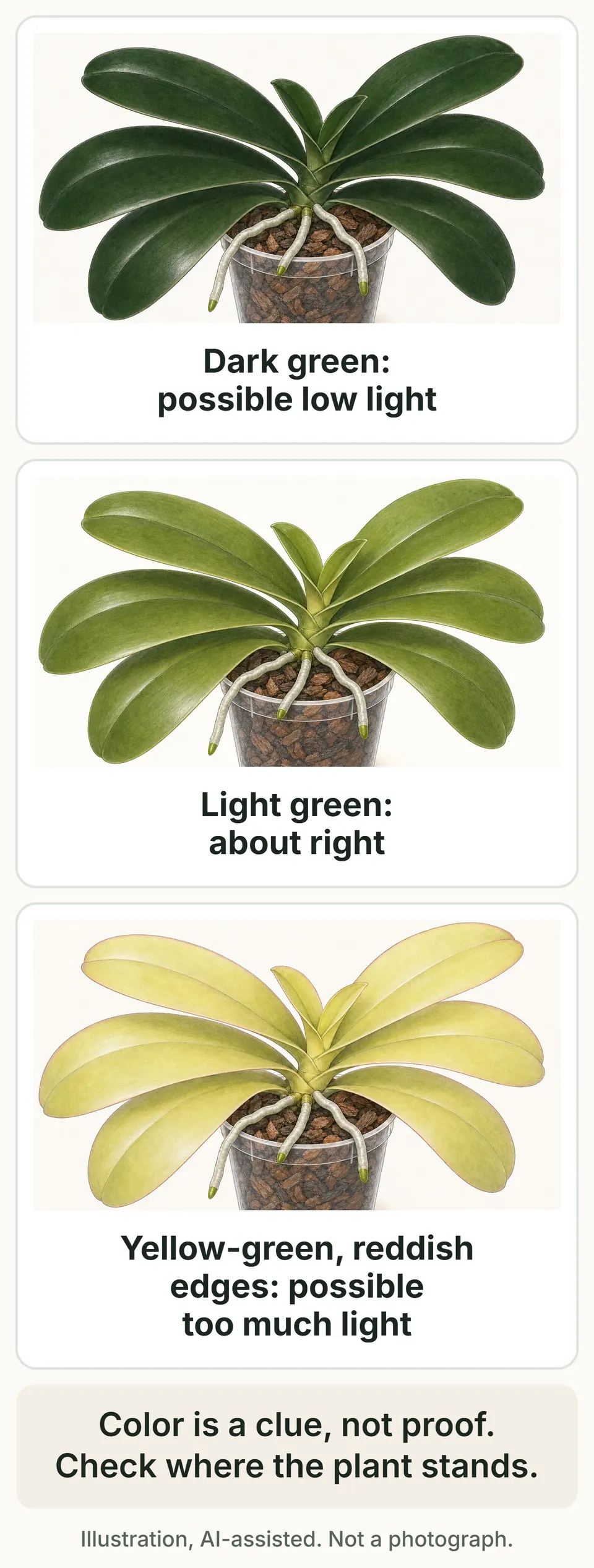
- Under very high light, leaves turn yellow-green or almost yellow and may develop a pink or reddish color along the edges (University of Maryland Extension). Iowa State Extension describes leaves turning yellow-green or sometimes red.
- Compare the color with a healthy leaf. University of Maryland and Iowa State Extension describe leaves in the right light as light green; Missouri Botanical Garden calls them olive green. Dark green leaves can be a sign of too little light, but color alone isn’t proof. Look for other signs too: University of Maryland Extension notes that leaves grown in low light also feel very stiff, and Iowa State and Clemson Extension link too little light with orchids that don’t flower.
- White, then brown spots appear. Iowa State Extension notes that the damage can progress very quickly, and that this is a common problem when orchids are moved outdoors in spring.
How to fix
- Move the plant out of direct sun or shade it as soon as you see symptoms. Iowa State Extension advises providing more shade as quickly as possible.
- Choose indirect light with little or no direct sun. Clemson Extension recommends an east window. Iowa State Extension suggests east- or north-facing windows, with a sheer curtain to shade a south window. University of Maryland Extension notes that in the short days of winter, moth orchids can even take direct light or a south window.
- Change the light gradually. Iowa State Extension advises moving orchids to a new light level slowly to prevent leaf scald.
Prevent it
If you move your orchid outdoors for the summer, Iowa State Extension advises waiting until nights stay above 55°F, choosing a spot in full shade, and moving it to light shade over a couple of weeks.
Cold
How urgent: Fix this week Act sooner if leaves turned black after freezing or near-freezing temperatures: Act soon
Moth orchids are warm-growing: Missouri Botanical Garden gives night temperatures in the 60s °F and day temperatures of 70–80°F as their preference. The guides differ on how cold is too cold, with lower limits from 65°F at night (Clemson Extension’s orchid fact sheet) down to 50°F (Missouri Botanical Garden); Iowa State Extension advises avoiding temperatures below 55°F. The guides describe cold damage on moth orchids as damaged leaves or roots without naming yellowing as the symptom; an American Orchid Society magazine article describes cold-induced yellowing and leaf drop in some other orchids, such as phalaenopsis-type dendrobiums and vandas.
How to tell
- Leaves are damaged where they touched a window. Clemson Extension warns that letting moth orchid leaves touch cold glass in winter damages the foliage, and Missouri Botanical Garden notes that the temperature close to a window may be hotter or colder than in the room.
- Leaves turned black and sunken overnight after freezing or near-freezing temperatures. The American Orchid Society describes this for orchids in general.
- The plant was watered with cold water. Missouri Botanical Garden advises lukewarm, never cold, water, and notes that moth orchids are shocked by cold temperatures, which causes root death.
How to fix
- Move the plant away from cold windows and drafts, and keep its leaves off the glass.
- Keep it within the temperature range above, and water with lukewarm water.
- Remove leaves that turned black after freezing or near-freezing temperatures. The American Orchid Society article advises removing severely damaged leaves to prevent secondary infections from spreading.
Prevent it
Check the temperature where the plant stands, not just in the room. Iowa State Extension suggests a thermometer that records daily minimum and maximum readings. Iowa State Extension notes that cool nights of 55 to 60°F in fall help initiate flower development, while advising against temperatures below 55°F.
Feeding: too much or too little
How urgent: Fix this week
Orchids need fertilizer, but less of it than most houseplants, as Iowa State Extension notes. Too much does harm: Clemson Extension warns that too much fertilizer can quickly damage plants.
How to tell
- Too much fertilizer: brown or dead root and leaf tips, yellowing leaves and a salt crust on the pot (Iowa State Extension).
- Possibly too little: many leaves yellow during a spring growth spurt. The American Orchid Society notes that the plant may be sacrificing older growth to build new growth, and names magnesium as one often overlooked nutrient. Yellowing alone doesn’t confirm a shortage: the same American Orchid Society article notes that degraded mixes and rotting roots can also cause leaf yellowing.
How to fix
- Rule out the roots, water, light and temperature first. Fertilizer won’t fix damaged roots or poor growing conditions.
- For a salt crust or suspected overfeeding, flush the pot thoroughly with plain water. Clemson Extension and Missouri Botanical Garden both advise flushing with plain water once a month to rinse out fertilizer salts, and Iowa State Extension recommends repotting in fresh mix regularly.
- Feed lightly. Iowa State Extension recommends a low dose often (quarter strength or less, “weakly weekly”) in spring and summer, using a fertilizer without urea; University of Maryland Extension suggests an orchid fertilizer every third or fourth watering while the plant is growing or flowering. The guides differ on winter: University of Maryland and Iowa State Extension skip it, while Missouri Botanical Garden feeds at quarter strength.
- Water before you feed. Iowa State Extension advises watering with plain water first and fertilizing once the mix is thoroughly wet, to prevent fertilizer burn.
- If those check out and many leaves yellowed in spring, a nutrient shortage is one possibility. The American Orchid Society article, written from Florida, notes that water there tends to lack magnesium and that many fertilizers contain none; it suggests regularly applying a dilute fertilizer that contains magnesium. Check your fertilizer label before adding anything.
Prevent it
Don’t use softened water. Iowa State Extension notes that it can cause salt buildup, and Missouri Botanical Garden advises against salt-softened water for moth orchids.
Rots, leaf spots, pests and viruses
- Crown rot and soft rot Act soon
- Crown rot is a decay of the crown, the center of the plant where the leaves meet, rather than of the roots (for root rot, see overwatering and old mix). The center turns soft and dark, and the plant may collapse there. Iowa State Extension describes this decay and collapse near the crown under orchid root rot and links it almost always to too much water.
- University of Maryland Extension notes that bacterial rot can occur if water sits in the center of the plant or in the leaf bases for a long time. Missouri Botanical Garden advises wicking water out of the crown with a paper towel to avoid crown rot.
- UF/IFAS notes that among houseplants, bacterial disease is most likely to affect fleshy plants such as orchids, causing soft rot that looks dark, wet and mushy. The director of its Plant Diagnostic Center advises throwing out houseplants with bacterial disease, since it can’t be sprayed or pruned out.
- The Extension guides cited here don’t give a home treatment for crown rot on moth orchids. For decay near the crown, Iowa State Extension’s advice is to let the plant dry out between waterings and to change a mix that holds too much water. For a moth orchid, that means watering again only when the mix is nearly dry, not letting it dry out completely (Clemson Extension; Missouri Botanical Garden).
- Leaf spots and blotches Act soon
- The American Orchid Society notes that yellow, brown and black blotching and streaking along with yellow discoloration is a reason to worry: it can follow cold or too much sun, but it can also be a bacterial or fungal infection. Bacterial infections tend to move fast, over hours to days; fungal infections over days to weeks.
- Iowa State Extension describes Phyllosticta leaf spot as small, elongated black or purple spots surrounded by tan or gray along the leaf veins. It spreads readily in low light and wet conditions, so don’t let leaves stay wet overnight, and remove affected leaves.
- Pests Act soon
- Scale insects can cause yellow spotting on the upper side of leaves as they feed, so check the undersides when you see it (American Orchid Society). Clemson Extension notes that scales are usually attached to the undersides of leaves.
- Mealybugs form cottony masses with sticky honeydew, often hide in the potting mix as well, and are very difficult to control (Iowa State Extension).
- Spider mites cause mottled foliage, with fine webbing in heavy infestations, and are common in dry conditions (Iowa State Extension).
- Act quickly. For scale and mealybugs, Iowa State Extension suggests cleaning with rubbing alcohol as a start, followed by several rounds of an insecticide such as neem, horticultural oil or insecticidal soap; for spider mites, regularly washing the foliage and raising the humidity. Clemson Extension advises using pesticides only according to the directions on the label. Both Iowa State and Clemson Extension advise discarding heavily infested plants.
- Viruses Act soon
- Iowa State Extension lists yellow, brown or black spots or lines on leaves, often sunken, and ringspots or a mosaic of yellow and green as common signs.
- It notes that nutrient imbalance, excess salts, pests and other diseases can mimic these signs, and infected plants may show none. A precise visual diagnosis is virtually impossible, so confirmation requires a test, which plant diagnostic labs can do.
- There is no cure, so infected plants should be discarded. To keep viruses from spreading, disinfect cutting tools after each plant. The PNW Plant Disease Management Handbook notes that a soak in trisodium phosphate, 10% bleach or Physan 20 helps prevent the spread, and suggests using two knives so one can soak while you cut with the other. Iowa State Extension’s current orchid guide says to dip tools in alcohol or use a 10% bleach solution, while its older virus article describes dipping them in alcohol and then flaming them for several seconds, or dipping them in a 10% bleach solution. The PNW handbook doesn’t list alcohol, so a 10% bleach solution is the option all three sources share.
Moth orchid at a glance: indirect light with little or no direct sun, such as an east window · water when the mix is nearly dry, and never let the pot stand in water · orchid bark mix, renewed before it breaks down · nights in the 60s °F, days 70–80°F · extra humidity in winter, when most homes are drier than moth orchids like · full orchid care guide
Not sure which cause fits? Go back to the signs above and start with the roots and the potting mix.
Sources
- University of Maryland Extension: Care of Phalaenopsis Orchids (Moth Orchids); Q&A: What causes orchid leaves to turn yellow and shrivel? (Maryland Grows blog, 2018).
- Iowa State University Extension and Outreach: Diagnosing Issues with Orchids Grown Indoors; Growing Orchids Indoors; What is the proper care of a moth orchid?; Virus Diseases of Orchids (1996)
- PNW Plant Disease Management Handbook (Oregon State University, Washington State University and University of Idaho Extension): Orchid virus diseases.
- Clemson Cooperative Extension, Home & Garden Information Center: General Care for Phalaenopsis Orchids; Orchids (HGIC 1560).
- Missouri Botanical Garden, William T. Kemper Center for Home Gardening: Phalaenopsis (Moth Orchid) fact sheet (2020, PDF).
- Penn State Extension: Orchids as Houseplants.
- University of Illinois Extension: Phalaenopsis: beautiful and picky (blog, 2018).
- UF/IFAS Emerging Pathogens Institute: Diagnosing houseplants 101: Is your plant diseased or just overwatered? (2024).
- American Orchid Society: Leaf Yellowing in Orchids, by Sue Bottom, Orchids magazine, July 2024.
- Ask Extension: Orchid question #892783 (Extension expert’s answer to a Maryland reader, February 2025).

