
Care Basics › How to Propagate Snake Plant
The snake plant, now classified as Dracaena trifasciata and formerly as Sansevieria trifasciata (New York Botanical Garden), can be propagated in two ways: by dividing the plant or its offsets, and by leaf cuttings (Iowa State University Extension). The Royal Horticultural Society calls sansevierias quite easy to propagate. The method matters for variegated plants: Iowa State University Extension notes that division keeps the leaf pattern, while leaf cuttings may produce plain green leaves. This guide covers both methods, how long they take, potting up and what to do when a cutting rots. Where sources disagree, we show both views.
Snake plant propagation at a glance
- Easiest method: division of offsets (pups) or of the clump, usually at repotting
- Leaf cuttings: sections of a leaf, 2 to 4 inches long in most Extension guides (sources give 1 to 8 inches), planted with the end that grew nearest the base down
- Variegated plants: divide yellow-edged cultivars such as ‘Laurentii’ and silvery ‘Moonshine’ to keep their pattern; leaf cuttings usually grow into plants without it
- Best time: spring; Iowa State University Extension notes that most houseplants can be propagated at any time of year
- How long: roots in several weeks; new shoots from leaf cuttings often take months
- Rooting mix: well-drained and moist, not wet; cuttings rot if kept too wet
- Safety: toxic to dogs and cats (ASPCA); the sap can irritate skin (see Safety)
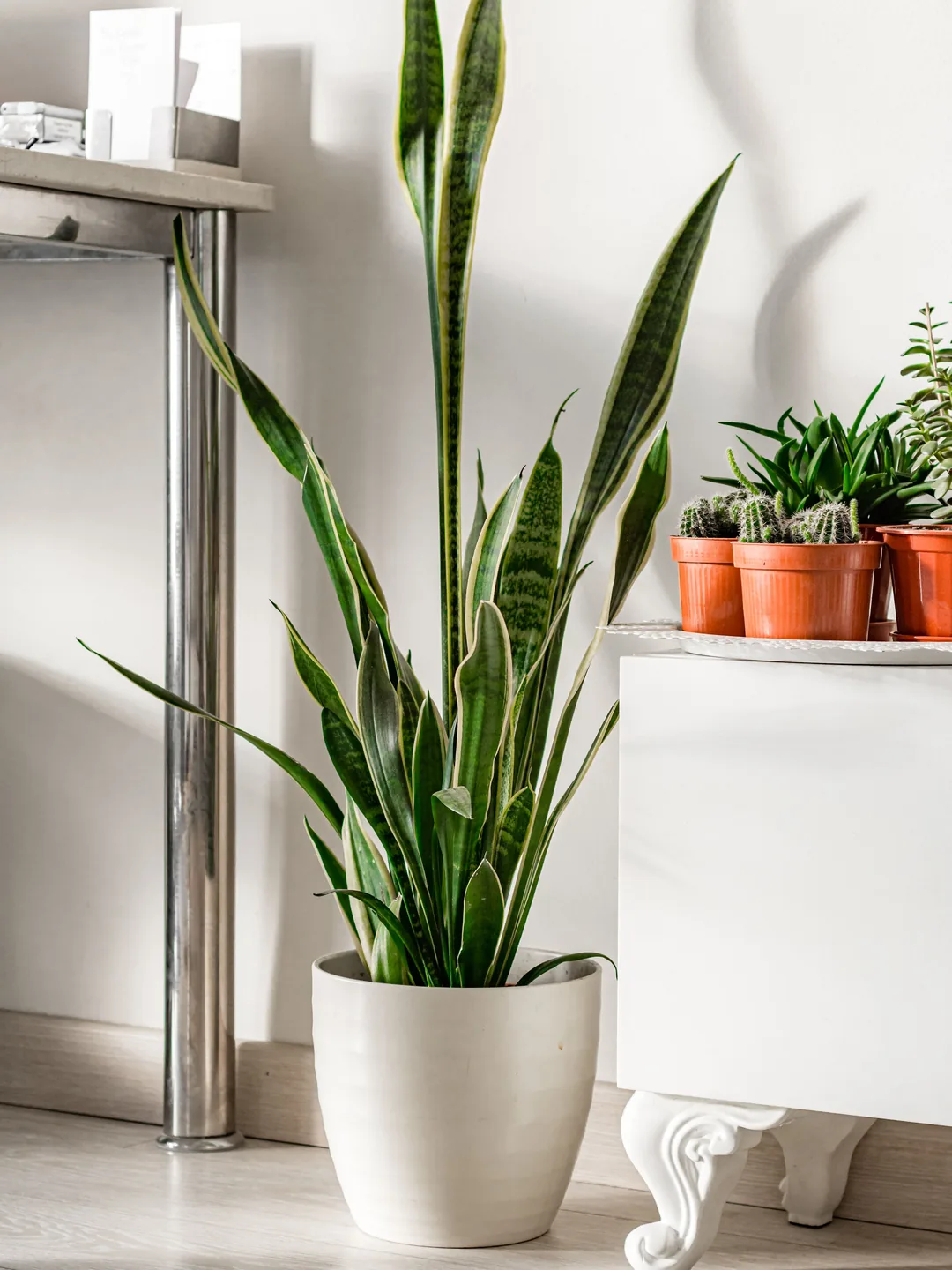
Photo: Nadiye Odabaşı, Pexels License, via Pexels (cropped and resized)
Which method should you use?
Division is the simplest and keeps the plant exactly as it is. A University of Arkansas Extension propagation table marks division as the most commonly used method for the snake plant, and leaf cuttings as a method that works but is less common, and Penn State Extension (in an article by a Master Gardener volunteer) notes that the plant is most easily propagated by division. Leaf cuttings give you more new plants from one leaf but take longer, and on many variegated cultivars they usually lose the pattern (see Variegated snake plants).
You will need clean, sharp tools. The New York Botanical Garden suggests a sterile cutting tool for removing offsets, and, for plants in general, Virginia Cooperative Extension suggests dipping the tool in rubbing alcohol or a mix of one part bleach to nine parts water to avoid spreading disease.
Method 1: Divide offsets or the clump
Snake plants spread by rhizomes, and the New York Botanical Garden notes that some produce offsets on runners coming from the base of the plant above ground or as rhizomes under the soil, which can be removed to start new plants. Its advice on when an offset is ready varies a little: once it has four or five leaves, once it is a couple of inches tall, or once it is several inches high and has its own roots. It is also fine to leave offsets in the pot unless they begin to crowd it.
- Take the plant out of its pot. For a single offset, the New York Botanical Garden suggests following it under the soil to where it has roots of its own and cutting the connection to the parent below a few roots with a sterile knife.
- For a crowded clump, the Royal Horticultural Society suggests splitting it into several pieces, each with one or more leaves attached to roots, pulling the root ball apart by hand and using a sharp knife on tougher parts, and discarding damaged or dead sections. For houseplants in general, Iowa State University Extension notes that larger pieces recover more quickly, while smaller pieces give you more plants.
- Pot each piece in a small pot with a drainage hole. The New York Botanical Garden suggests a succulent potting mix without added fertilizer, with the lighter white and green part of the plant above the soil line, because a buried stem will rot.
- Water to settle the soil and place the pot in bright, indirect light (Iowa State University Extension, houseplants in general), and wait a few weeks before fertilizing so the roots can recover.
An offset with no roots
The New York Botanical Garden notes that an offset without roots has a somewhat lower chance of success, but can be treated as a cutting: let it callus for several days until the wound is dry, plant it in a quick-draining soil, dampen the soil occasionally, and keep it warm (70°F) in bright, indirect light until new growth appears and it resists a gentle tug.
Method 2: Leaf cuttings
A leaf cutting doesn’t root like a stem. University of Arkansas Extension notes that the cutting forms a rhizome, from which a new leaf emerges, and Iowa State University Extension that new roots and leaves form at the base of the buried section, eventually creating a small plantlet.
- Cut a healthy leaf off at its base with a clean, sharp tool.
- Cut it crosswise into sections. Sources suggest different lengths: 1 to 2 inches (a University of Arkansas Extension column), 2 inches (Virginia Cooperative Extension; Royal Horticultural Society), 2 to 4 inches (Purdue Extension), 3 to 4 inches (Iowa State University Extension; University of Illinois Extension) or 3 to 5 inches (Iowa State University Extension’s succulent guide). A University of Florida IFAS guide for commercial growers uses 4- to 8-inch sections from tall plants and notes that shorter sections give fewer plantlets and take longer.
- Keep track of which end was nearer the base of the plant: that end goes down. A cutting stuck upside down will not root (University of Florida IFAS; Purdue Extension). Iowa State University Extension and University of Illinois Extension suggest cutting a small notch in the top of each section. Slanted cuts are used the opposite ways round: Virginia Cooperative Extension slants the lower cut and keeps the upper cut straight, while Iowa State University Extension’s succulent guide cuts the bottom straight and the top at an angle. Pick one marking and use it on every section; the University of Florida IFAS commercial guide also advises marking one end consistently.
- Optionally, let the cut ends dry. The Royal Horticultural Society suggests leaving sections in a dry place for a day or two so the cut surfaces callus over, and Iowa State University Extension’s succulent guide suggests a day; its leaf-section guide plants them right away. We found no source that tested whether drying helps.
- Optionally, dip the bottom end in rooting hormone (Iowa State University Extension; Purdue Extension). The 1991 University of Florida IFAS commercial guide notes little if any benefit from rooting hormones on snake plants, while a 2024 trial in Iran on two cultivars found that the rooting hormone IBA reduced rot and increased root number and length (Taghizadeh and Khajeh). Iowa State University Extension notes that too much rooting hormone can sometimes hinder root development.
- Insert the bottom end 1 to 2 inches deep into a moistened, well-drained rooting medium such as perlite (Iowa State University Extension; Purdue Extension).
- Keep the medium moist but not wet: the University of Florida IFAS guide notes that cuttings in a wet medium may become infected with bacterial soft rot, and Virginia Cooperative Extension that succulent cuttings rot if kept too moist.
- Keep the cuttings warm and in bright, indirect light. Iowa State University Extension’s leaf-section guide gives an air temperature of 65 to 75°F as ideal, suggests 4 to 6 hours of bright, indirect light, and suggests a plastic bag or dome for humidity, not sealed tightly; the University of Florida IFAS guide gives 70 to 75°F for the rooting medium.
Once the new plant is established, the original leaf section can be cut away; Iowa State University Extension notes that this isn’t necessary but can improve the look. A University of Florida IFAS guide for commercial growers notes that one leaf cutting usually produces 1 to 5 plantlets, depending on the cultivar, the cutting size and the part of the leaf used.
Can you root snake plant leaves in water?
One Extension source says yes: a UConn Home & Garden Education Center article suggests that you can place cuttings in water to root, changing the water daily. No other snake plant source we found describes water rooting. For houseplants in general, University of Illinois Extension and Iowa State University Extension note that roots formed in water are often weaker or coarser and adapt less easily to potting mix than roots formed in a rooting medium.
Variegated snake plants: why leaf cuttings come up green
Many variegated snake plants don’t come true from leaf cuttings. The University of Florida IFAS commercial guide notes that variegated cultivars such as ‘Laurentii’, ‘Futura’ and ‘Golden Hahnii’ must be propagated by division to keep their variegation, because several snake plant cultivars are periclinal chimeras: plants whose tissue layers differ genetically. Its table lists the yellow-edged ‘Laurentii’, ‘Laurentii Compacta’, ‘Futura’ and ‘Golden Hahnii’ and the silvery ‘Moonshine’ as not coming true from leaf cuttings; for ‘Futura’, it notes that practically all plantlets from leaf cuttings lack the yellow edge. Iowa State University Extension notes that cultivars with variegated leaf edges, such as ‘Laurentii’, lose their coloration when propagated by cuttings.
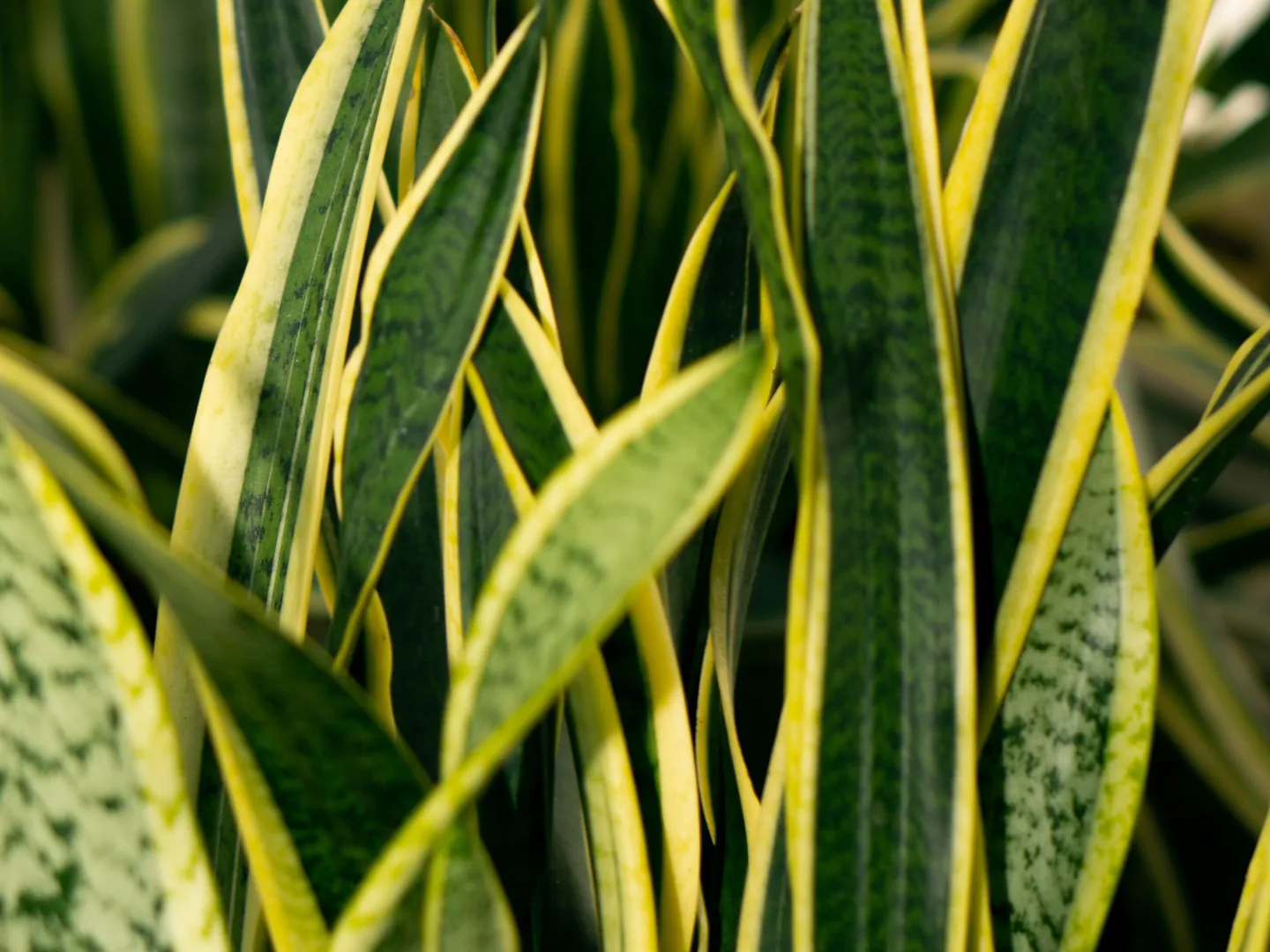
Photo: Olha Ruskykh, Pexels License, via Pexels (cropped and resized)
The reason lies in where new shoots come from. A plant propagation guide from University of Florida IFAS, the University of Kentucky and Texas A&M notes that new shoots on leaf cuttings come from one particular inner cell layer, and shows leaf cuttings of variegated Sansevieria producing all-green shoots. Sources word this with different certainty. The University of Florida IFAS guide says that these cultivars don’t come true from leaf cuttings and must be divided, and University of Arkansas Extension and Virginia Cooperative Extension also state it without qualification, while Iowa State University Extension says “most” variegated forms don’t come true, the Royal Horticultural Society that cuttings “tend to” revert to green, and NC State Extension that offspring “might differ”. Not every cultivar reverts: the University of Florida IFAS guide lists ‘Silver Queen’ and ‘Silver Hahnii’, as well as the plain species and the banded ‘Hahnii’, as coming true from leaf cuttings. To be sure of keeping a variegated pattern, divide the plant.
How long does it take?
Leaf cuttings are slow, and new shoots lag well behind the roots. The University of Florida IFAS commercial guide notes that roots begin to develop within 4 to 6 weeks if the medium is kept at 70 to 75°F, and that one or more leaves appear within another 3 to 4 months. Iowa State University Extension notes that new shoots should appear in two months, and an older University of Arkansas Extension column says that plants root and send up a new shoot in about three months. Root and shoot development is slower at lower temperatures, and the University of Florida IFAS guide advises avoiding temperatures below 60°F.
Spring is the usual time. Iowa State University Extension notes that early spring is the ideal time to propagate by cuttings or division, though most houseplants can be propagated at any time of year, and the Royal Horticultural Society suggests spring, when the plants come back into growth. The New York Botanical Garden suggests removing offsets in spring or summer.
Potting up and aftercare
Pot up a rooted leaf section once adequate roots and shoots have formed (Iowa State University Extension). University of Arkansas Extension suggests starting new plants in small pots and gradually increasing the pot size, and the New York Botanical Garden suggests a pot with a drainage hole and a quick-draining mix. Iowa State University Extension suggests keeping the new plant well watered in bright, indirect light. The New York Botanical Garden, which treats a rooted offset like an adult plant, advises letting the soil just dry between waterings in active growth, because snake plants have shallow roots and rot easily if overwatered, so feel the mix before you water.
Don’t be surprised by the first leaves: the University of Florida IFAS commercial guide notes that the first few leaves on plants grown from cuttings are juvenile, and on many snake plants shorter and more curved back than mature leaves, while plants from divisions usually produce mature-looking leaves.
Troubleshooting
The cutting turns soft or mushy
This suggests the base is rotting. The University of Florida IFAS commercial guide notes that cuttings in a medium kept wet may become infected with bacterial soft rot, and Virginia Cooperative Extension that succulent cuttings rot if kept too moist. The look alone doesn’t confirm the cause, but the fix is the same: start again with a fresh, healthy section in a medium that is only moist, and keep the cuttings warm and in good light (too little light can leave cuttings to rot or dry out before they root, Iowa State University Extension notes).
No roots after several weeks
Check that the section is the right way up: upside-down cuttings will not root. Then check the warmth and light, because roots form more slowly in cool or dim conditions, and give it time (see How long).
Roots but no new leaves
This is normal for a while, as long as the section stays firm. The University of Florida IFAS commercial guide gives roots in 4 to 6 weeks but new leaves only within another 3 to 4 months, and notes that shorter sections take longer.
The new plant is all green
If you took leaf cuttings from a yellow-edged or other variegated cultivar, this is common, not a failure (see Variegated snake plants). Divide the parent plant if you want more plants with its pattern.
Safety: pets, people and sap
Pets: the ASPCA lists the snake plant as toxic to dogs and cats because of saponins, with nausea, vomiting and diarrhea as signs, and its entry under the name golden bird’s nest also lists horses. Keep cuttings and divisions out of pets’ reach. If you think your pet has eaten some, call your veterinarian or the ASPCA Animal Poison Control Center at (888) 426-4435 (a consultation fee may apply).
Sap: the Royal Horticultural Society notes that the sap can be a skin irritant and suggests wearing gloves when handling cut leaves, and NC State Extension also notes that the sap can cause skin irritation.
People: the University of Kansas Health System Poison Control Center notes that eating the plant may cause minor symptoms such as a rash, vomiting or diarrhea, and advises contacting Poison Control at 1-800-222-1222 in case of accidental exposure or ingestion. If the person collapses, has a seizure, has trouble breathing or can’t be awakened, call 911 immediately (National Capital Poison Center).
Frequently asked questions
Which part of the leaf should I use?
The evidence is limited. In a 2019 study in Sri Lanka with leaf sections about 6 inches long, sections from the tip of the leaf produced the most roots and more shoots, and sections from the base the longest roots, but the difference in shoot numbers between sections was not statistically significant (Hematharshini and Seran). No Extension source we found favors one section, though the University of Florida IFAS commercial guide notes that the part of the leaf used affects how many plantlets a cutting produces.
Do I need rooting hormone?
It is optional. Iowa State University Extension and Purdue Extension include a dip in rooting hormone. The 1991 University of Florida IFAS commercial guide notes little if any benefit for snake plants, while a 2024 trial found that IBA reduced rot and increased rooting (see Leaf cuttings).
Can I propagate a cylindrical snake plant the same way?
Probably, but we found no step-by-step method for it. NC State Extension notes that the cylindrical snake plant (Dracaena angolensis) is often sold as rooted leaf cuttings, and the University of Florida IFAS commercial guide lists it as coming true from both division and leaf cuttings.
Sources
- New York Botanical Garden, Mertz Library: Snake plant (plant guide, 2026); Plant Information Service answers on propagating offsets (2026) and snake plant pups (2023).
- Iowa State University Extension and Outreach: How to Propagate Houseplants by Leaf Section Cuttings, How to Propagate Houseplants by Division and Offsets, Easy, Low-Maintenance Houseplants, How to Propagate Succulents and How to Propagate Houseplants by Stem Tip Cuttings (houseplants in general).
- University of Florida IFAS, Central Florida Research and Education Center: Sansevieria production guide (Foliage Plant Note RH-91-30, 1991, for commercial growers; archived copy).
- Plant Propagation (PropG) glossary, University of Florida IFAS with the University of Kentucky and Texas A&M: Leaf cuttings (2023).
- University of Arkansas Cooperative Extension Service: Propagating Houseplants (FSA2095, with propagation table); Sansevieria (2018 column); Mother-in-Law’s Tongue (Plant of the Week, 1999).
- Purdue Extension: New Plants from Cuttings (HO-37-W).
- University of Illinois Extension: Cuttings and Houseplant propagation (houseplants in general).
- Virginia Cooperative Extension: Propagation by Cuttings, Layering and Division (426-002; plants in general).
- Penn State Extension: Snake Plant: A Forgiving, Low-Maintenance Houseplant (2023; Master Gardener author).
- NC State Extension Gardener Plant Toolbox: Dracaena trifasciata, Dracaena angolensis and Dracaena.
- UConn Home & Garden Education Center: Sensational Sansevieria (2024).
- Royal Horticultural Society (UK): Sansevieria growing guide.
- Research: Hematharshini and Seran (2019), Turkish Journal of Agriculture – Food Science and Technology 7(11):1743–1747; Taghizadeh and Khajeh (2024), Plant Production Technology 23(2):107–121 (English abstract).
- ASPCA Animal Poison Control: Snake Plant; Golden Birds Nest.
- University of Kansas Health System Poison Control Center: Snake Plant; National Capital Poison Center: First aid guidelines.
