
Plant Care Guides › Prayer Plant Care
The prayer plant (Maranta leuconeura) is a low, spreading tropical plant grown for its patterned leaves, which, as NC State Extension notes, fold up at night to resemble praying hands. NC State Extension gives its height as 6 inches to 1 foot. This guide is for Maranta; related plants often called prayer plants, such as calatheas, aren’t covered here. Sources differ on how easy it is: Missouri Botanical Garden rates its maintenance as low and University of Maryland Extension calls it easy to care for, while the New York Botanical Garden calls it tricky and notes that it is hard to get right in a home. The main challenges in these sources are moisture, humidity and water quality. Where care guides disagree in ways that matter for your plant, we show both views.
Prayer plant care at a glance
- Light: bright, indirect light; no strong direct sun, which bleaches the leaf colors
- Water: keep the mix evenly moist but never soggy while the plant is growing, and let the top of the mix dry in winter (sources say from the top inch to the top half); check the mix before you water
- Water quality: sensitive to fluoride, hard water and softened water
- Soil and pot: a well-drained potting mix in a pot with a drainage hole; a shallow pot suits its shallow roots
- Temperature: 65 to 70°F is ideal (New York Botanical Garden); keep it above 60°F (Missouri Botanical Garden) and away from cold drafts
- Humidity: high; a humidifier or a pebble tray helps
- Feeding: during the growing season; much less or none in winter
- Pet safety: no ASPCA entry for this exact species; its “Prayer Plant” entry, which is non-toxic, names a calathea (see Pets and people)
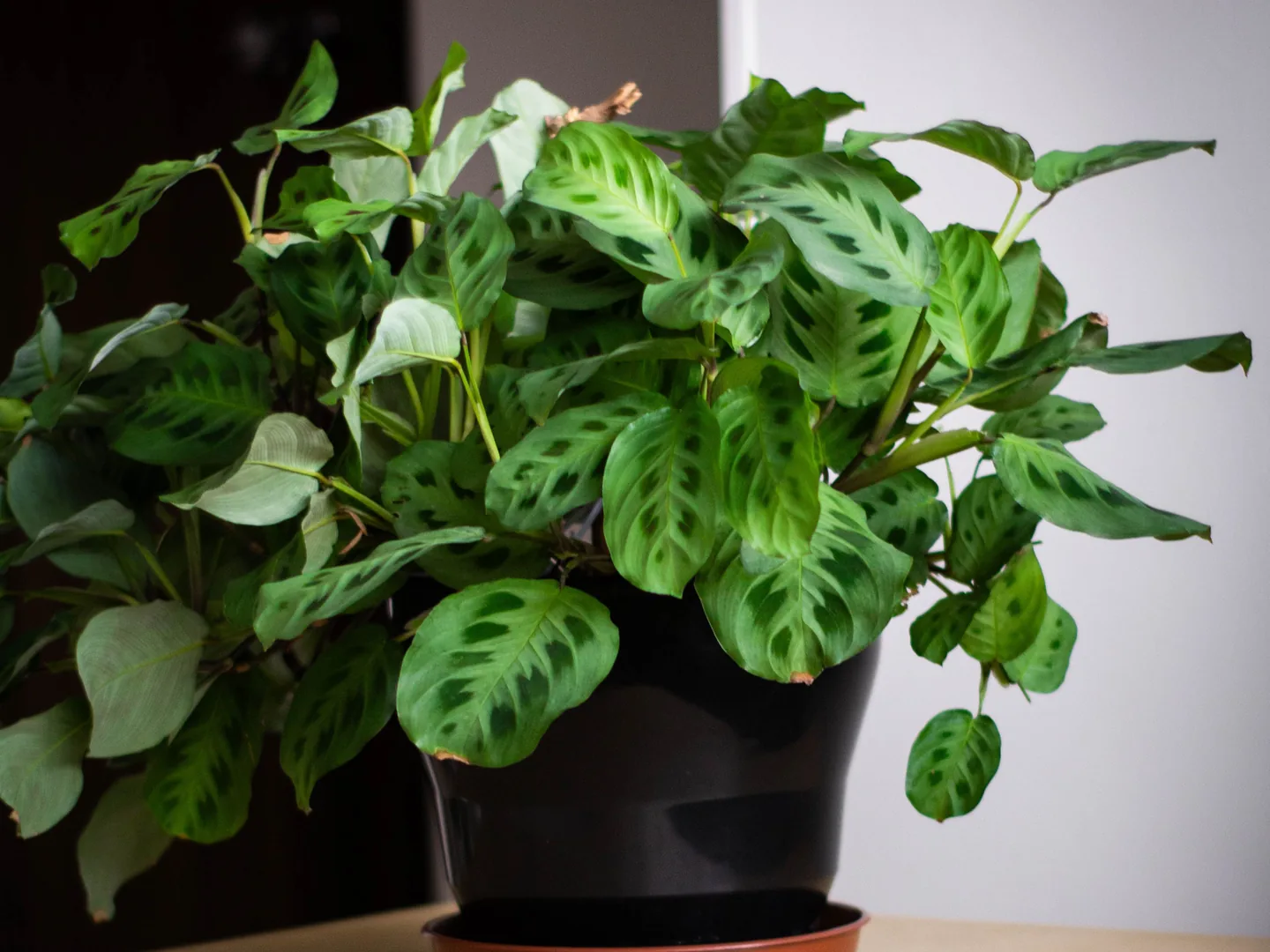
Photo: Jardín De Neko, Pexels License, via Pexels (cropped and resized)
Prayer plant or calathea?
Several plants in the same family are sold as prayer plants. NC State Extension notes that Maranta leuconeura is often confused with species of Ctenanthe and Goeppertia, and the New York Botanical Garden notes that Maranta is closely related to Goeppertia. Many plants sold as calatheas are now classified as Goeppertia: a 2012 study found that Calathea as then defined was not one natural group and moved many of its species to Goeppertia, and NC State Extension notes that you may still find them referred to as Calathea. Check the botanical name on the label; this guide covers Maranta.
Common forms of Maranta leuconeura include the red-veined prayer plant, which Missouri Botanical Garden describes as having prominent red veins in a herringbone pattern, and the green form whose leaves have rows of dark green patches, sometimes called rabbit tracks (a 1991 University of Florida IFAS Extension guide for commercial growers). NC State Extension also lists cultivars such as ‘Lemon’, also called Lemon Lime prayer plant. None of these sources gives different care for the different forms.
Why the leaves fold at night
NC State Extension notes that the leaves are held flat by day and move to an upright “prayer” position at night, and Missouri Botanical Garden and University of Illinois Extension describe the same folding in the evening or in darkness. This is normal. In a 2010 University of Arkansas Extension answer about a prayer plant kept outdoors in a carport in summer heat, leaves that stayed folded during the day were judged a sign of stress, possibly from the heat or too little light, and the answer suggested moving the plant indoors to a room with good morning light.
Light
Give it bright, indirect light. NC State Extension and Missouri Botanical Garden note that too much sun bleaches the leaf colors, and NC State Extension calls the plant intolerant of direct sunlight. The New York Botanical Garden suggests partial shade, such as a shady window or a sheer curtain between the plant and strong light. NC State Extension notes that the plant tolerates low to medium light, though the leaves lose color in low light and when the plant is underfed. Sources differ slightly on direct sun: a Purdue Extension table lists the green prayer plant among plants needing 4 hours of direct sun or bright, indirect light. In an answer to a question about a struggling prayer plant in winter (the answer calls the plant a calathea), University of Maryland Extension suggests a grow light if the winter sun is too low.
Watering
Most sources say to keep the mix moist while the plant is growing. NC State Extension suggests keeping it evenly moist during the growing season, Missouri Botanical Garden consistently moist, and the New York Botanical Garden thoroughly moist with tepid water from March through September. Some sources let the surface dry a little first: in an answer about a prayer plant, University of Maryland Extension suggests watering when the top inch is becoming somewhat dry, and a University of Georgia Extension table, based on 1978 data, lists prayer plants among plants whose soil surface should dry before watering.
Never let it stay soggy. University of Illinois Extension warns not to let water stand on the crowns, because the stems rot easily, and NC State Extension and Missouri Botanical Garden note that root rot can occur in poorly drained soil. The New York Botanical Garden suggests emptying the saucer 15 minutes after watering, and University of Maryland Extension notes that water left in the saucer can soak back up and keep the roots soggy.
Water less in fall and winter. The New York Botanical Garden suggests letting the top inch of mix dry in winter, and in one of its answers, the top half; University of Illinois Extension suggests letting the soil dry between waterings in winter. Feel the mix before every watering: if leaves are drooping and the mix is still wet, don’t add water; check the roots instead (see Root rot).
Water quality
Prayer plants are sensitive to what is in the water. In an answer about a prayer plant, University of Maryland Extension notes sensitivity to fluoride in municipal tap water, to hard water and to the sodium in water from household softeners or some bottled water, and NC State Extension notes that the leaves burn with high fluoride. For houseplants in general, Iowa State University Extension names prayer plant among plants on which chlorine and fluoride can cause brown leaf tips. The New York Botanical Garden suggests rainwater or distilled water to avoid mineral residue on the leaves. Sources disagree on letting tap water stand: for houseplants in general, University of Georgia Extension suggests letting it stand for several days so that some chlorine and fluorine are released, and Clemson Extension for 24 hours, while Missouri Botanical Garden notes that letting tap water sit for 24 hours lets chlorine evaporate but does not remove fluoride. So standing water may help with chlorine, but it is not a reliable fix for fluoride. In a follow-up reply (which calls the plant a calathea), University of Maryland Extension adds that a household pitcher filter may not remove fluoride either. For a fluoride-sensitive plant, rain or distilled water avoids the problem. In its disease table, which is written mainly for growers, Penn State Extension also advises avoiding superphosphate fertilizer and perlite, because they contain excessive fluoride.
Soil and pots
The New York Botanical Garden suggests a soil-based mix with some peat and sharp sand, kept loose, in a pot with a drainage hole, and notes that marantas don’t have deep roots and grow well in half pots (shallow pots). Repot in spring every one to two years, moving up only one pot size if the roots need more room (New York Botanical Garden). In an answer about a prayer plant, University of Maryland Extension notes that repotting also refreshes mix in which salts and minerals have built up. For houseplants in general, University of Maryland Extension advises against a gravel layer in the bottom of the pot.
Temperature and humidity
The New York Botanical Garden gives 65 to 70°F as ideal, advises avoiding sudden changes and keeping the plant above 55°F, and notes that it needs more humidity when temperatures rise above the low 60s. Missouri Botanical Garden suggests keeping it above 60°F, and NC State Extension notes that it is intolerant of low temperatures and cold drafts. For houseplants in general, University of Maryland Extension advises keeping plants away from heat and air-conditioning sources, and in an answer about a prayer plant it notes that leaves touching cold window glass may yellow where they touch.
Prayer plants need humid air, but sources give different targets: the New York Botanical Garden suggests keeping humidity well above 50% in its guide and 60 to 80% or 70% and more in its answers, while a University of Georgia Extension table, based on 1978 data, puts them in its average-humidity group (25 to 49%). NC State Extension and Missouri Botanical Garden suggest a humidified room or a tray of wet pebbles; the New York Botanical Garden notes that the water shouldn’t touch the bottom of the pot, and that in a dry winter a pebble tray may not be enough, while a humidifier or a terrarium works. Sources disagree about misting: the New York Botanical Garden suggests frequent misting with distilled or rain water as one option, while University of Maryland Extension, in an answer about a prayer plant, advises stopping, because wet leaves can let disease spores infect them; for houseplants in general, it also calls misting questionable as a way to raise humidity.
Feeding
Feed mainly while the plant is growing. The New York Botanical Garden suggests a standard liquid fertilizer every two weeks from March through September, and Missouri Botanical Garden suggests monthly feeding in the growing season, with much less from autumn to late winter. In an answer about a prayer plant, University of Maryland Extension suggests weaker doses or plain water in winter, and notes that overfeeding builds up salts that can damage the roots; NC State Extension notes that over-fertilization can burn the leaves. Neither of the plant-specific sources gives a dilution; for houseplants in general, Iowa State University Extension suggests half or quarter strength indoors.
Trimming and propagation
Prayer plants have short, rhizomatous stems and spread sideways (NC State Extension). The 1991 University of Florida IFAS guide for commercial growers notes that the stems of the green form tend to grow along the surface of the mix or cascade, and Missouri Botanical Garden calls the plant excellent for pots or hanging baskets. In an answer about a prayer plant, University of Maryland Extension suggests cutting off an infected leaf once the damage spreads over most of it. Missouri Botanical Garden notes that the plant can be propagated by cuttings or division, and NC State Extension by dividing the rhizomes.
Common problems
These are short summaries; check the signs before you change anything. Visual signs are clues, not proof of a cause.
Brown tips and edges
Several causes can look alike. The New York Botanical Garden notes that browning tips and edges probably mean the plant needs more consistently moist soil or more humidity. Water quality and feeding can also be causes: NC State Extension notes that the leaves burn with high fluoride and with over-fertilization, and Penn State Extension’s disease table, written mainly for growers, lists phosphate fertilizer, fluoride and high light as causes of tip burn. For houseplants in general, Iowa State University Extension names low humidity and letting plants dry out too long between waterings. Brown tips alone don’t confirm a cause; check the moisture of the mix, the humidity, your water and your feeding.
Brown spots
Leaf spots on prayer plants can come from disease. Penn State Extension describes Helminthosporium leaf spot as small, water-soaked spots that turn yellow and merge into large tan areas with a yellow halo, and advises avoiding overhead watering; the 1991 University of Florida IFAS guide for commercial growers notes that leaves must stay wet for hours for infection, so shortening the time leaves stay wet reduces it. In an answer about a plant the asker called a prayer plant, University of Maryland Extension suspected from photos a bacterial disease with no cure, and suggested pruning the affected leaves and keeping the foliage dry. University of Maryland Extension also notes that few fungicides are labeled for indoor use. A virus can cause yellow line patterns and small, distorted leaves (Penn State Extension), but only a lab test can confirm a virus. Spots alone don’t confirm a cause: keep the leaves dry, water at the soil, and remove badly spotted leaves.
Drooping or wilting
No prayer-plant-specific source in our research explains drooping, so these are general houseplant points. For houseplants in general, Iowa State University Extension notes that wilting can come from either too little or too much water, and University of Maryland Extension that rotted roots can make a plant wilt even when the soil is wet. Feel the mix: if it is dry, water thoroughly; if it is still wet, don’t add water; check the roots.
Root rot
NC State Extension and Missouri Botanical Garden note that root rot can occur in poorly drained soil, and University of Illinois Extension that the stems rot easily if water stands on the crowns. To check, ease the plant out of its pot. For houseplants in general, University of Maryland Extension describes roots with Pythium root rot as brown to black and soft, with an outer layer that pulls away easily; root color varies, so judge firmness as well as color. For houseplants in general, Clemson Extension suggests that if only a few roots are infected, you cut them out and repot in sterile soil.
A dying or declining plant
No single cause explains a declining prayer plant. Check the mix and the roots first, then humidity, water quality, light and temperature. In an answer about a prayer plant, University of Maryland Extension notes that losing a few old leaves over a season is not unexpected if new growth is normal, but that faster leaf loss may suggest stress. If the plant dried out rather than rotted, the New York Botanical Garden notes that you can try to bring it back.
Curling and yellow leaves
The New York Botanical Garden notes that leaves that curl, brown or drop probably point to soil that needs to be more consistently moist or to too little humidity. In an answer about a prayer plant, University of Maryland Extension notes that the oldest leaves, those furthest from the center of the clump, tend to be shed normally if new growth is normal. Yellowing leaves can also come with root rot (University of Maryland Extension, houseplants in general), so feel the mix before you water, and if it is still wet, check the roots (see Root rot).
Pests
NC State Extension and Missouri Botanical Garden suggest watching for spider mites and mealybugs, and Missouri Botanical Garden also thrips. Spider mites leave light speckling on the leaves and a faded look (Clemson Extension, houseplants in general); Iowa State University Extension suggests tapping leaves over white paper to spot them. In an answer to a question about a struggling prayer plant (the answer calls the plant a calathea), University of Maryland Extension suggests checking the undersides of the leaves for mites, washing them off with water first, and testing an insecticidal soap or oil on one leaf before treating the whole plant.
Is a prayer plant safe for pets and people?
Pets: the ASPCA has no entry under Maranta leuconeura itself. Its entries named “Prayer Plant” and “Maranta” list those plants as non-toxic to dogs, cats and horses, but they give a calathea’s botanical name (Calathea insignis), so they don’t directly classify this species, and we found no veterinary source that does. The ASPCA also notes that eating any plant material may cause vomiting and stomach upset in dogs and cats. Keep pets from chewing the plant, and call your veterinarian if your pet eats some and seems unwell.
People: the University of Kansas Health System Poison Control Center lists Maranta leuconeura as non-toxic, and the University of Connecticut and the poison center for Massachusetts and Rhode Island list it among safe plants. If someone eats part of any plant: if the person collapses, has a seizure, has trouble breathing or can’t be awakened, call 911 immediately; for other questions, call Poison Control (in the US) at 1-800-222-1222 (National Capital Poison Center).
Frequently asked questions
Why does my prayer plant fold its leaves at night?
That is what gives it its name: the leaves lie flat by day and fold upward at night (NC State Extension; Missouri Botanical Garden). It is normal. See Why the leaves fold at night.
Is a prayer plant a calathea?
Not botanically. They are in the same family and often confused, but the prayer plant in this guide is Maranta leuconeura, while many plants sold as calatheas are now classified as Goeppertia (NC State Extension). Some sources, including the ASPCA, use the name prayer plant for calatheas too, so check the botanical name on the label; this guide covers Maranta.
How often should I water a prayer plant?
There is no fixed schedule. Keep the mix evenly moist but not soggy while the plant is growing (NC State Extension; New York Botanical Garden), and water less in winter, letting the top inch to the top half of the mix dry (New York Botanical Garden). Feel the mix before you water.
Why are the tips of my prayer plant brown?
Common causes in these sources are soil that isn’t moist enough, low humidity, fluoride or minerals in the water, and too much fertilizer. See Brown tips and edges.
Sources
- NC State Extension Gardener Plant Toolbox: Maranta leuconeura; Goeppertia.
- Missouri Botanical Garden: Maranta leuconeura and var. erythroneura (Plant Finder); How to water indoor plants (houseplants in general).
- New York Botanical Garden, Mertz Library: Prayer plant (2026); answers on winter care (2021), a dried-out plant (2021) and brown edges (2021).
- University of Illinois Extension: Prayer Plant.
- University of Maryland Extension, Home and Garden Information Center: answers on Ask Extension about prayer plants, water quality and leaf damage (2023), a struggling plant (2023) and leaf spots (2019); Selecting Indoor Plants; Root Rots of Indoor Plants, Potting and Repotting Indoor Plants, Winter Indoor Plant Problems and Temperature and Humidity (houseplants in general).
- Penn State Extension: Maranta Diseases (2025).
- University of Florida IFAS Extension: Maranta, Foliage Plant Research Note RH-91-22 (1991, for commercial growers; archived copy).
- Borchsenius, Suárez Suárez and Prince, Molecular Phylogeny and Redefined Generic Limits of Calathea (Marantaceae), Systematic Botany 37(3), 2012.
- Iowa State University Extension and Outreach: Why does my houseplant have brown leaf tips and edges?, Diagnosing Houseplant Problems Related to Poor Culture, Why is my houseplant wilting? and Diagnosing Houseplant Problems Caused by Insect Pests (houseplants in general).
- University of Georgia Extension: Growing Indoor Plants with Success (Bulletin 1318, 2022). Purdue Extension: Indoor Plant Care (HO-39). University of Arkansas Extension: Prayer plant (reference desk, 2010).
- Clemson Cooperative Extension, Home & Garden Information Center: Houseplant Diseases & Disorders and Common Houseplant Insects & Related Pests (houseplants in general).
- ASPCA Animal Poison Control: Prayer Plant; Maranta; Toxic and Non-Toxic Plants.
- University of Kansas Health System Poison Control Center: Prayer Plant. University of Connecticut Home and Garden Education Center: Houseplants: Safe and Toxic Varieties. Regional Center for Poison Control and Prevention (Massachusetts and Rhode Island): Safe Plants.
- National Capital Poison Center: First aid guidelines.
