
Plant Care Guides › Fiddle Leaf Fig Care
The fiddle leaf fig (Ficus lyrata), also called banjo fig, is a tree from tropical Africa grown indoors for its large, lyre-shaped leaves, which NC State Extension notes can reach 18 inches long; indoors it grows 2 to 10 feet tall. The common name is also used for a philodendron (Philodendron bipennifolium), so check the botanical name on the label (University of California Master Gardeners). Sources differ on how easy it is: NC State Extension calls it relatively low-maintenance, while the New York Botanical Garden calls it sometimes fussy and University of Maryland Extension says it can be tricky indoors. The New York Botanical Garden counts too much water among the most frequent causes of fig failure, and names a stable environment, watering restraint and some humidity as keys to success. This guide covers light, water, soil, temperature, feeding and pruning, with a short guide to common problems. Where care guides disagree, we show both views.
Fiddle leaf fig care at a glance
- Light: bright light, kept out of the sun’s direct rays; protect it from afternoon sun (sources differ on gentle morning sun)
- Water: water thoroughly when the top two inches of the mix are dry, then empty the saucer; water less in fall and winter
- Soil and pot: a well-draining potting mix with some perlite added, in a pot with a drainage hole (sources differ on soil-based vs soilless mixes)
- Temperature: a steady 65 to 75°F, away from vents and drafts (New York Botanical Garden)
- Humidity: above 40% (New York Botanical Garden)
- Feeding: spring and summer only, at half strength
- Pet safety: mildly toxic to dogs and cats (ASPCA)
- Difficulty: moderate; it reacts to changes in light, water and temperature by dropping leaves
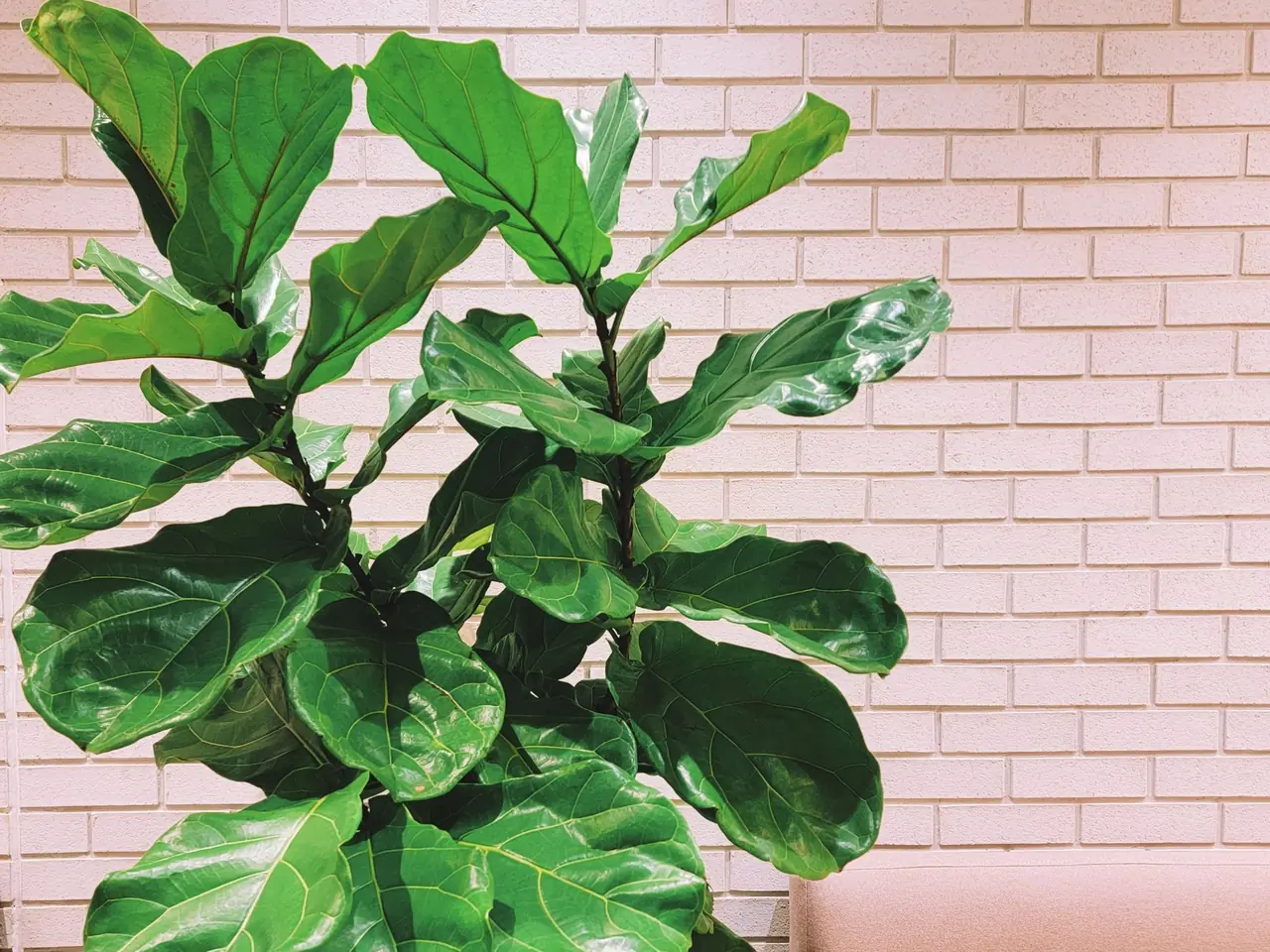
Photo: Em Everyday Living, Pexels License, via Pexels (cropped and resized)
Light
Give it bright light without direct sun on the leaves. The New York Botanical Garden suggests the brightest room in your home, with the plant just far enough from the window that the sun’s direct rays don’t touch it, or a sheer curtain in between. NC State Extension and Missouri Botanical Garden suggest bright indirect light or part shade, with protection from afternoon sun, and NC State Extension notes that too much direct sun can scorch the leaves. Sources differ on gentle morning sun: the University of California Master Gardeners write that fiddle leaf figs love morning sun, while the New York Botanical Garden keeps all direct rays off the leaves, and University of Maryland Extension, in an answer about a fiddle leaf fig, advises avoiding direct sun to prevent leaf burn.
Too little light shows in the plant’s shape. The New York Botanical Garden notes that leggy, weak growth and long, drooping limbs with leaves far apart mean too little light, and that lower leaves that don’t get enough light may drop. It suggests turning the plant a quarter turn every time you water, so all sides get light, and raising it on a stand if the windows are high. For Ficus in general, University of Missouri Extension suggests placing the plant within about 4 feet of a good-sized east-, west- or south-facing window, or adding plant lights.
Watering
Too much water is among the most frequent causes of fig failure, the New York Botanical Garden notes, and the roots rot easily if overwatered. Wait until the top two inches of the mix feel dry, then water thoroughly until water runs out of the bottom of the pot (New York Botanical Garden; the University of California Master Gardeners give the same two-inch rule). In answers about fiddle leaf figs, University of Maryland Extension suggests feeling the soil a couple of inches down and watering when it is dry at that depth, and notes that houseplant figs grow best when allowed to get fairly dry between soakings. Some sources lean moister: one older University of Maryland Extension answer suggests evenly moist soil while warning against overwatering, NC State Extension’s plant database describes moist, well-drained soils, and a University of Florida IFAS guide for commercial growers, covering Ficus in general, says the mix should be kept moist. The two-inch rule is the one most of the fiddle-leaf-fig-specific sources give.
Never leave the pot standing in water. The New York Botanical Garden suggests checking back about 15 minutes after watering and emptying the saucer; University of Maryland Extension notes that water left in the saucer can soak back up through the drainage holes and drown the lowest roots.
Water less in fall and winter. The New York Botanical Garden notes that in the low light of October through February the plant may take up water more slowly, and Missouri Botanical Garden suggests reducing watering from fall to late winter. In an answer about a fiddle leaf fig, University of Maryland Extension suggests letting the top half of the mix dry from late fall through winter. Before you water at any time of year, feel the mix: if leaves are drooping or dropping and the mix is still wet, don’t add water; check the roots instead (see Root rot).
If the mix has dried out so far that water runs straight through, the New York Botanical Garden suggests watering from the bottom: stand the pot in a tub of tepid water and let it soak up through the drainage hole.
Soil, pots and repotting
The New York Botanical Garden suggests a conventional, soil-based potting mix with some perlite added for drainage, and Missouri Botanical Garden also suggests a soil-based mix. Not every source agrees on the wording: for houseplants in general, University of Maryland Extension advises against dense products sold as “potting soil” and suggests a soilless mix, or adding perlite or vermiculite to loosen potting soil. The pot must have a drainage hole: the New York Botanical Garden notes that many fig problems start with a decorative container that has none. If you use one, keep the plant in a plastic pot with a drainage hole inside it, take the inner pot out to water, and let it drain completely before putting it back (New York Botanical Garden).
The New York Botanical Garden notes that fiddle leaf figs like to be slightly root-bound and can stay in the same pot for several years; when roots show above the soil or through the drainage hole, or fill the pot, move up just one pot size in spring. In an answer about a fiddle leaf fig, University of Maryland Extension adds that if overwatering is hard to avoid even with careful attention, old potting mix may be the reason, because it compresses and drains more slowly; a plant kept in the same mix for more than a year or two would then benefit from repotting. Spring is a good time, but if the plant is struggling, it can be done any time. For Ficus in general, University of Missouri Extension notes that they put up with being root-bound but don’t prefer it, and that under ideal growing conditions repotting every year or two helps growth. For houseplants in general, University of Maryland Extension advises against filling the bottom of the pot with gravel.
Temperature, humidity and drafts
Keep the temperature steady. The New York Botanical Garden suggests 65 to 75°F, lowered gradually to around 65°F in winter, and notes that fiddle leaf figs are very sensitive to temperature changes and react by dropping leaves. NC State Extension notes that the plant performs best above 55°F, and a University of Florida IFAS guide for commercial growers advises keeping Ficus above 60°F at all times to avoid chilling injury. Protect the plant from drafts: the New York Botanical Garden lists air-conditioning vents, open windows, open doors and heat vents, and NC State Extension notes that brown spots can follow temperature swings near heating or cooling vents.
The New York Botanical Garden suggests keeping humidity above 40% to prevent brown leaf tips, using a tray of wet pebbles during dry months and a simple hygrometer to check. In an answer about a fiddle leaf fig, University of Maryland Extension notes that it prefers humid air and that homes are often too dry in winter. For Ficus in general, University of Missouri Extension considers average household humidity fine. Sources disagree about misting: University of Maryland Extension, in an answer about a fiddle leaf fig, recommends stopping because misting can cause leaf disease, while the University of California Master Gardeners suggest misting the leaves and wiping them with a soft cloth to remove dust; for humidity, they suggest grouping plants or a small humidifier.
NC State Extension notes that the plant can spend the summer on a sheltered deck or patio and should come back indoors as fall temperatures drop; the New York Botanical Garden suggests this where summers are humid, and advises keeping it out of direct, burning sun outdoors and watching its increased water needs. Before bringing it back in, University of Maryland Extension suggests checking it for insects.
Feeding
Feed only while the plant is growing. The New York Botanical Garden suggests a balanced organic fertilizer at half strength every other week in spring and summer only, and notes that overfeeding can cause leaves to drop. The University of California Master Gardeners suggest feeding at least once or twice a year in spring and summer, at half the recommended strength, and note that overfeeding burns leaf margins. In an answer about a fiddle leaf fig, University of Maryland Extension suggests a general-purpose houseplant fertilizer if the plant hasn’t been fed in months. For houseplants in general, Iowa State University Extension advises fertilizing only when plants are actively growing.
Pruning, shaping and cleaning
Prune for shape in spring (New York Botanical Garden). Cut just above a node, the joint where a leaf attaches, because the plant branches where it is cut (University of Maryland Extension). In an answer about cutting back the main stem of an 8-foot fiddle leaf fig, University of Maryland Extension notes that this permanently turns the single-stemmed tree into more of a shrub, which is not a health concern. The New York Botanical Garden notes that a new branch is most likely to grow from the node just below the cut, and advises leaving at least two-thirds of the leaves on the tree so it can recover. For a plant with bare lower branches, University of Maryland Extension suggests pruning to just above the bottom set of leaves in late February or March. For leggy branches, the New York Botanical Garden also suggests moving the plant to brighter, indirect light. Wear gloves: NC State Extension notes that the milky sap can irritate the skin, particularly when pruning or propagating.
Wipe the large leaves regularly with a damp cloth, supporting each leaf as you go: the New York Botanical Garden notes that dust interferes with photosynthesis, that young leaves are easily damaged by touch, and that dusting also helps reduce mites. It advises against leaf polishes and oils, which build up on the leaves. Raised white dots that don’t wipe off are normal cell structures, most often seen on rubber plants (Ficus elastica) but possible on fiddle leaf figs (New York Botanical Garden).
Propagation
Fiddle leaf figs can be propagated from stem cuttings (NC State Extension) or by air layering, which Iowa State University Extension and University of Nebraska–Lincoln Extension list for this plant. For houseplants in general, Iowa State University Extension notes that large or lanky plants that need pruning are good candidates for layering, and University of Maryland Extension suggests you can try rooting the pieces you prune off. The University of California Master Gardeners root tip cuttings in water, though for houseplants in general, University of Illinois Extension notes that roots formed in water often adapt less easily to potting mix.
Varieties
NC State Extension lists ‘Bambino’, a dwarf that grows a few feet tall; ‘Compacta’, up to 5 feet with smaller leaves; and ‘Variegata’, an uncommon form with green and cream leaves.
Common problems
These are short summaries; check the signs before you change anything. Visual signs are clues, not proof of a cause, and in an answer about a fiddle leaf fig, University of Maryland Extension notes that a minor leaf infection and a response to environmental stress can be hard to tell apart.
Dropping leaves
Some lower-leaf loss is normal: the New York Botanical Garden and University of Maryland Extension note that the oldest, lowest leaves yellow and drop with age. Sudden leaf drop is different; the New York Botanical Garden calls it the plant’s language of distress. Common triggers in these sources are too much or too little water (NC State Extension), temperature changes, drafts and being moved (New York Botanical Garden; University of Maryland Extension), too little light (New York Botanical Garden) and overfeeding (New York Botanical Garden). A new plant may also have trouble adjusting after the trip home from the nursery, particularly in very hot or cold weather (New York Botanical Garden). Feel the mix first, then think about what changed recently.
Brown spots
Brown spots have several causes. The New York Botanical Garden notes that tiny red or brown spots on new leaves usually indicate that the soil is staying too moist, and that leaves can burn in spots in direct sun; NC State Extension notes brown spots after temperature swings near vents. In an answer about a fiddle leaf fig, University of Maryland Extension notes that spots are hard to diagnose because a minor infection and environmental stress can look alike, and that there are few, if any, fungicides labeled for indoor use. Spots alone don’t confirm a cause; feel the mix two inches down and look at where the spots are and what changed recently. For each cause and its fix, see fiddle leaf fig brown spots.
Brown edges and tips
The New York Botanical Garden notes that brown edges frequently indicate too little humidity, and the University of California Master Gardeners agree. Other causes are possible: in an answer about a fiddle leaf fig, University of Maryland Extension notes that over- or underwatering can also brown the edges and that the cause is hard to say from the leaf alone, and the University of California Master Gardeners note that overfeeding burns leaf margins. Brown tips alone don’t confirm a cause; check the humidity, the mix and your feeding.
Drooping or curling leaves
No fiddle-leaf-fig-specific source in our research explains drooping or curling leaves, so these are general houseplant points. For houseplants in general, Iowa State University Extension notes that wilting can come from either too little or too much water, University of Maryland Extension that rotted roots can make a plant wilt even when the soil is wet, and Clemson Extension that chronic underwatering leads to wilting and leaf curling. So feel the mix first: if it is dry two inches down, water thoroughly; if it is still wet, don’t add water; check the roots. Long, drooping limbs with widely spaced leaves point to too little light (New York Botanical Garden).
Root rot
The New York Botanical Garden notes that the roots rot easily if overwatered and that roots rotted from overwatering may be damaged beyond repair, and in an answer about a fiddle leaf fig, University of Maryland Extension notes that root rot is possible when the mix has been too wet for too long. To check, ease the plant out of its pot. For houseplants in general, University of Maryland Extension describes roots with Pythium root rot as brown to black and soft, with an outer layer that pulls away easily; root color varies, so judge firmness as well as color. For houseplants in general, Clemson Extension suggests that if only a few roots are affected, you cut them out and repot in sterile soil.
A dying or declining plant
No single cause explains a declining fiddle leaf fig. The New York Botanical Garden’s checklist for sudden leaf drop asks about temperature swings, drafts, watering that hasn’t been adjusted for the season or is irregular, drainage and water left in the saucer, and light, and notes that roots rotted by overwatering may be damaged beyond repair. In an answer about a fiddle leaf fig with brown tips, University of Maryland Extension suggested that if the soil is too wet, you let it dry out; it noted that root rot was possible if the soil had stayed too wet for too long, and that you could wait to see whether new growth appears on the upper stem. Feel the mix first; if it is still wet and leaves keep dropping, check the roots (see Root rot).
Pests
NC State Extension notes that the fiddle leaf fig has no serious insect pests, but suggests watching for scale, aphids, mealybugs, thrips and spider mites indoors. In an answer about a fiddle leaf fig, University of Maryland Extension suggests wiping a mild mealybug infestation off the leaves with a damp paper towel, and notes that mealybugs can also infest the roots, where they are hard to control. Fungus gnats prefer moist soil, so they are a sign of overwatering (Iowa State University Extension, houseplants in general).
Yellow leaves
The oldest, lowest leaves yellow and drop with age (New York Botanical Garden). For houseplants in general, University of Maryland Extension notes that the main sign of too much water is wilting or yellowing of the lower and inner leaves, so check the mix before you water.
Is fiddle leaf fig safe for pets and people?
Pets: mildly toxic. A 2019 ASPCA article lists the fiddle leaf fig as mildly toxic to dogs and cats: eating small amounts carries a risk of mild gastrointestinal irritation, most often vomiting and diarrhea, and the sap could also irritate the skin. NC State Extension also lists it as toxic to cats and dogs if eaten, noting that oral irritation, excessive drooling and vomiting may occur. Don’t rely on the ASPCA’s plant-database entry named “Fiddle-Leaf”: it is the philodendron that shares the common name, not this fig. If you think your pet has eaten some, call your veterinarian or the ASPCA Animal Poison Control Center at (888) 426-4435.
People: NC State Extension notes that the milky sap can irritate the skin and recommends gloves when pruning, and lists the plant as toxic to people if eaten. Poison centers differ on figs: Utah Poison Control lists Ficus species as a skin irritant, while the Michigan Poison Center lists fig tree and weeping fig among plants not considered poisonous. Keep the plant away from children and pets (University of California Master Gardeners). If the person collapses, has a seizure, has trouble breathing or can’t be awakened, call 911 immediately; for other questions, call Poison Control (in the US) at 1-800-222-1222 (National Capital Poison Center).
Frequently asked questions
How often should I water a fiddle leaf fig?
There is no fixed schedule. Water thoroughly when the top two inches of the mix are dry, empty the saucer, and expect to water less often in fall and winter (New York Botanical Garden; University of Maryland Extension). Feel the mix before every watering (see Watering).
Why is my fiddle leaf fig dropping leaves?
A few old lower leaves dropping is normal. Sudden leaf drop is a sign of stress; common triggers in these sources are too much or too little water, a move, a draft or a temperature swing, or too little light (New York Botanical Garden; NC State Extension). See Dropping leaves.
How do I make my fiddle leaf fig branch?
Prune in spring just above a node at the height where you want branches; the plant branches where it is cut (University of Maryland Extension). Leave at least two-thirds of the leaves on the tree (New York Botanical Garden).
Should I mist my fiddle leaf fig?
Sources disagree. University of Maryland Extension, in an answer about a fiddle leaf fig, advises against misting because it can cause leaf disease, while the University of California Master Gardeners suggest misting and wiping the leaves to remove dust. For humidity, the New York Botanical Garden suggests a pebble tray and aiming for above 40%, and the University of California Master Gardeners suggest grouping plants or a small humidifier.
Sources
- New York Botanical Garden, Mertz Library: Fiddle-leaf fig (Ficus lyrata) (plant guide, 2026); answers on leggy growth (2020) and watering (2025).
- NC State Extension Gardener Plant Toolbox: Ficus lyrata.
- Missouri Botanical Garden: Ficus lyrata (Plant Finder).
- University of Maryland Extension, Home and Garden Information Center: answers on Ask Extension about fiddle leaf figs, dropping leaves and spots (2020), brown spots and mealybugs (2024), brown edges (2025), leaf spots (2019), pruning (2021) and bare lower stems (2019); Root Rots of Indoor Plants, Potting and Repotting Indoor Plants, Winter Indoor Plant Problems and Overwatered Indoor Plants (houseplants in general).
- University of California Master Gardeners (Humboldt and Del Norte), The Coastal Gardener: Fiddle Leaf Fig Houseplant – Proper Care (2021).
- University of Missouri Extension, Integrated Pest Management: Ficus: 2026 Houseplant of the Year (Ficus in general).
- University of Florida IFAS Extension: Cultural Guidelines for Commercial Production of Interiorscape Ficus (ENH879, for commercial growers).
- Iowa State University Extension and Outreach: How to Propagate Houseplants by Air Layering and Simple Layering, Diagnosing Houseplant Problems Related to Poor Culture, Why is my houseplant wilting? and Diagnosing Houseplant Problems Caused by Insect Pests (houseplants in general).
- University of Nebraska–Lincoln Extension: Propagating House Plants (NebGuide G1853).
- Clemson Cooperative Extension, Home & Garden Information Center: Houseplant Diseases & Disorders (houseplants in general).
- University of Illinois Extension: Houseplant propagation (houseplants in general).
- ASPCA: Is That Houseplant Safe for Your Pets? (2019; the article spells the botanical name “Ficus lyrate”); Animal Poison Control plant database: Fiddle-Leaf (a philodendron, not this fig).
- Utah Poison Control Center: Rubber Tree (Ficus Species).
- Michigan Poison Center: Plants Poison Prevention Guide.
- National Capital Poison Center: First aid guidelines.
