
Plant Problems › Monstera Leaves Curling
Curling leaves on a monstera (Monstera deliciosa, the Swiss cheese plant) are a symptom, not a diagnosis. The monstera guides cited here don’t describe leaf curling on this plant specifically, so the causes below come from Extension and botanical-garden guidance for houseplants in general, paired with what monstera guides say about water, light, temperature and pests. The sources on this page are about Monstera deliciosa unless a section names another plant; the Swiss cheese vine (Monstera adansonii) and the “mini monstera” (Rhaphidophora tetrasperma) are different species.
Start by checking which leaves curl, then feel the potting mix, and look at the plant’s spot and the undersides of the leaves before you change anything.
First, check whether it’s a new leaf opening
New monstera leaves open from a rolled shape. Research on a related species, Monstera obliqua, describes the leaf blade expanding almost fully while still rolled in the bud and then unfurling. University of Maryland Extension’s horticulturists, answering a question about a monstera, mention moisture getting trapped on unfurling leaves and describe the new leaf as tender at that stage.
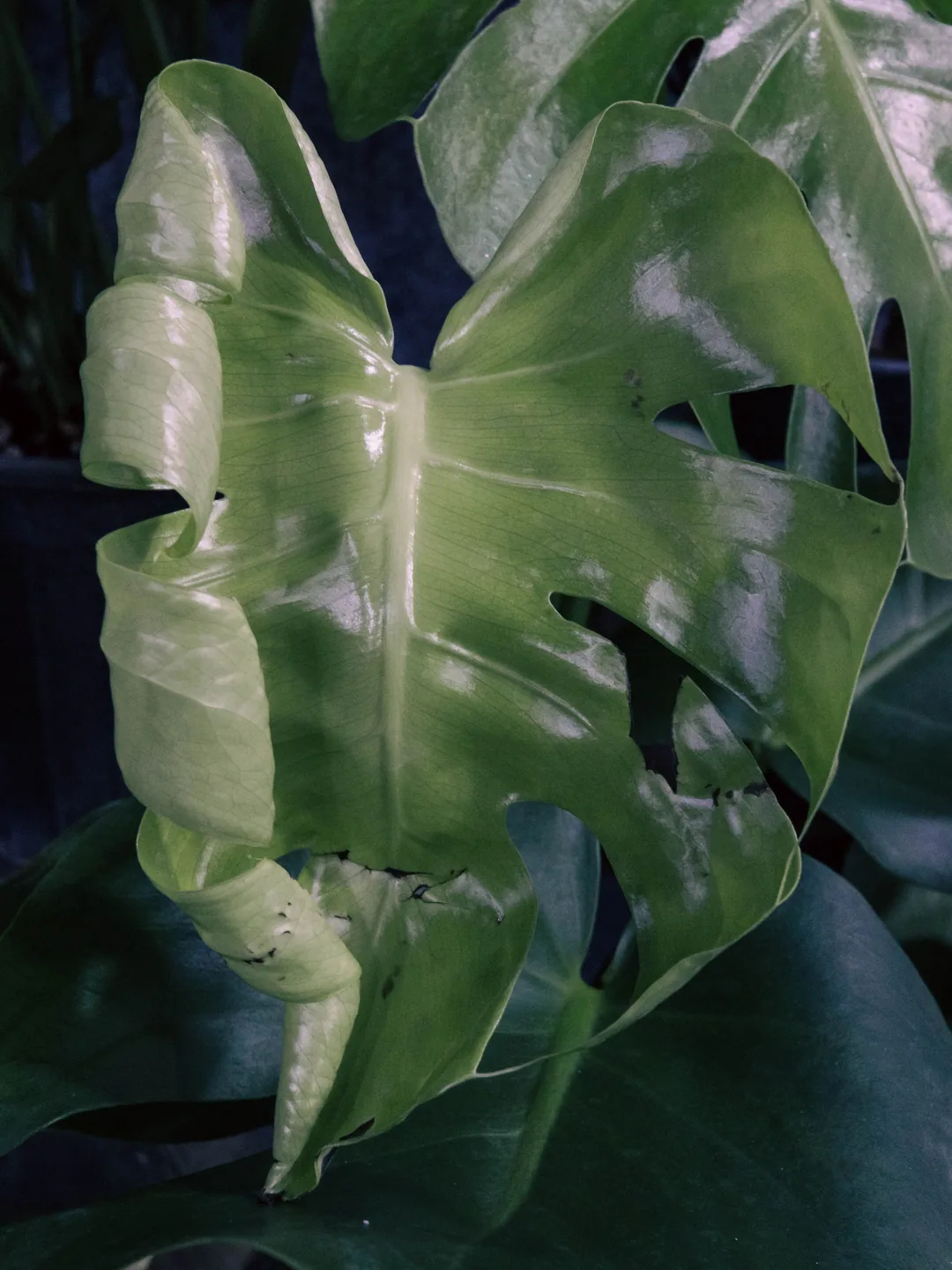
Photo: Mr. Pugo, Pexels License, via Pexels (cropped and resized)
Young plants also look different from older ones: Penn State Extension notes that juvenile leaves are small and mostly uncut, and become large and split as the plant matures. Fewer splits on new leaves can also point to low light: Wisconsin Extension notes that the plant won’t develop the leaf perforations when light is inadequate.
A new leaf that is still unrolling is expected growth. If a new leaf comes out crinkled, stunted or marked, or leaves that had already opened flat start to curl, look at the causes below, including pests.
Quick answer
Causes to check:
- Only the newest leaf is curled, and it is still unrolling: part of normal growth. Often normal
- The mix is dry well below the surface, and leaves curl or droop: possibly too little water. Fix this week
- The mix stays wet, and leaves curl, wilt or yellow: possibly too much water or a root problem. Check the roots: Act soon
- The plant sits near a heater, a vent or a hot window: possibly heat or dry air. Fix this week
- Direct sun on the leaves, with pale or brown patches: possibly too much light. Fix this week
- A cold window or draft, and curled leaves that brown or drop: possible cold damage. Fix this week
- New leaves crinkled or distorted, with specks, silvery streaks or tiny insects: possible pests. Act soon
- Frequent or full-strength feeding, or a white crust on the mix, with curled, brown leaf tips: possible fertilizer or salt damage. Fix this week
Labels show how quickly to act if a cause is confirmed. They are not a diagnosis; check the signs in each section first.
Too little water
How urgent: Fix this week If the plant is wilted and the mix is dry all the way through, water it right away.
For houseplants in general, Clemson Extension notes that chronic underwatering results in wilting and leaf curling, and University of Maryland Extension notes that plants wilt and leaves curl when the roots can’t supply enough moisture. NC State Extension notes that drooping or curling leaves result from a lack of water on the “mini monstera” (Rhaphidophora tetrasperma), a related plant in a different genus.
How to tell
- The mix is dry well below the surface.
- The mix has shrunk away from the sides of the pot (University of Maryland Extension, houseplants in general).
- The mix dries out within a day of watering, and the plant wilts between normal waterings even after a thorough watering. For houseplants in general, University of Minnesota Extension lists soil that dries out within 24 hours, and Illinois Extension lists wilting between normal waterings, as signs that a plant needs repotting. If the plant wilts while the mix is still moist, see too much water.
How to fix
- If the mix is dry through the pot, water thoroughly, until water runs out of the drainage hole, then empty the saucer. If the mix has pulled away from the pot, University of Maryland Extension notes, for houseplants in general, that it may need several waterings to rewet. If the leaves don’t firm up within a day or so of a thorough watering, check the roots (see too much water): Clemson Extension notes, for houseplants in general, that watering may make the problem worse when the roots are injured, and Missouri Botanical Garden, also for houseplants in general, notes that roots that have died in a drought can rot once the plant is watered again.
- From then on, water when the top of the mix has dried. Penn State Extension and University of Minnesota Extension suggest letting the top 1 to 2 inches dry between waterings. Sources differ on how far: NC State Extension suggests the top quarter to one-third of the mix, and the New York Botanical Garden several inches during active growth.
- If the pot is packed with roots, repot. University of Minnesota Extension, writing about young plants grown from cuttings, suggests repotting a monstera every one to two years, in late winter or early spring, into a container about 2 inches wider. The New York Botanical Garden disagrees in part: it notes that monsteras like to be root-bound and suggests moving up one pot size only when roots grow out of the drainage hole.
Too much water or a root problem
How urgent: Act soon Wilting or curling in wet mix can mean the roots can’t take up water.
Wet mix can make leaves curl too. A University of California Master Gardener handout on houseplant ailments lists leaves that curl and wilt, with the mix usually wet, as a sign of too much water. University of Maryland Extension explains, for houseplants in general, that excess water damages the fine roots so the plant can’t take up water, and that the main sign is wilting or yellowing of lower and inner leaves. For houseplants in general, Missouri Botanical Garden notes that a wilting plant may look dry when it has in fact been overwatered, and that watering it then can be the plant’s “death knell.” For monsteras, Penn State Extension notes that overwatering can result in root rot, and Wisconsin Extension notes that the leaves will “sweat” if the mix is too moist.
How to tell
- The mix stays wet for days, the pot has no drainage hole, or the pot sits in water in a saucer or outer pot.
- Leaves curl, wilt or yellow even though the mix is wet.
- The roots are mushy. University of Maryland Extension’s horticulturists, answering a question about a wilting monstera, note that roots killed by overwatering tend to be mushy, pull apart easily and separate into an outer layer with a stringy core. They add that dead roots tend to be brown and live ones creamy, but that root color isn’t always reliable by itself.
How to fix
- Don’t water again while the mix is wet.
- Take the plant out of its pot and look at the roots: the University of California’s houseplant pest guide advises inspecting the roots whenever a plant wilts. For houseplants in general, University of Maryland Extension advises cutting out rotten portions and replanting the healthy sections. In the wilting-monstera answer, its horticulturists add that a plant with suspected root decline should be repotted promptly in fresh mix. Healthy roots are light-colored and firm (University of Maryland Extension, houseplants in general); if yours look like that, put the plant back, let the mix dry before watering again, and check the other causes on this page.
- Empty the saucer after watering, and use a pot with a drainage hole. Don’t move the plant into a much bigger pot: for houseplants in general, Missouri Botanical Garden notes that a small root ball in a large pot can stay too wet, and suggests going up one pot size, usually 2 inches wider, at a time.
- Hold off on fertilizer: University of Maryland Extension’s horticulturists note that a plant that isn’t healthy can’t use the nutrients.
Heat, dry air and vents
How urgent: Fix this week
The New York Botanical Garden advises protecting monsteras from blasts of cold or heat from open windows, air conditioners and heating vents. For houseplants in general, the University of California Master Gardener handout lists leaves that curl downward or wilt as a sign of too much heat, and Missouri Botanical Garden lists wilting lower leaves with brown margins as a sign that conditions are too warm.
Monstera guides link dry air to brown leaf edges, not to curling: Wisconsin Extension notes that the leaf edges turn brown if humidity is too low. Penn State Extension notes that monsteras prefer humidity above 50% and may benefit from a humidifier in a very dry room.
How to tell
- The plant sits near a heating vent, a radiator, an air conditioner or a hot window.
- If the curled leaves are the ones closest to the heat or moving air, that fits this cause, but it isn’t proof.
- Leaf edges are brown as well as curled, especially in winter, when Iowa State Extension notes that indoor humidity can drop as low as 10%.
How to fix
- Move the plant away from heating and air-conditioning vents (New York Botanical Garden).
- Raise the humidity with a humidifier or a tray of wet pebbles (NC State Extension). Keep the bottom of the pot out of the water in the tray: Iowa State Extension notes that otherwise the mix never dries out and the roots can rot.
- Sources disagree on misting. The New York Botanical Garden suggests misting daily, but University of Maryland Extension’s horticulturists advise against misting monstera leaves, because the humidity it adds is minimal and fleeting, and moisture on the leaves, including moisture trapped on unfurling leaves, can encourage disease. Iowa State Extension also notes that misting raises humidity for only a few minutes. A humidifier avoids the question.
Too much direct sun
How urgent: Fix this week
Penn State Extension advises bright light but not direct sun, and Missouri Botanical Garden advises bright indoor light without strong direct sun. Sources differ on winter: Wisconsin Extension suggests direct sun in winter, and the New York Botanical Garden notes that the plant needs more direct, bright light in winter. Wisconsin Extension also notes that a monstera moved outdoors needs to get used to more light gradually or its leaves will suffer sunburn.
For houseplants in general, the University of California Master Gardener handout lists older leaves curling under, with new leaves smaller than old ones, as a sign of too much light. University of Maryland Extension notes that sun damage appears as pale, bleached or faded areas that later turn brown and brittle, and that it is worse when strong sun comes with dry soil.
How to tell
- The plant gets direct sun, especially through a south- or west-facing window in summer, or it was recently moved into brighter light.
- Curled leaves also have pale, bleached or brown patches.
How to fix
- Move the plant back from the window, or filter the light through a sheer curtain (University of California Master Gardener handout, houseplants in general).
- Change light gradually rather than all at once.
Cold and drafts
How urgent: Fix this week
Penn State Extension and NC State Extension give 60 to 85°F as the monstera’s preferred range, and Penn State notes that monsteras abhor cold drafts. Wisconsin Extension notes that the plant doesn’t grow below 50°F. The New York Botanical Garden suggests a cooler winter range of 55 to 65°F. For houseplants in general, Missouri Botanical Garden notes that curling leaves that turn brown and drop indicate that it is too cold, and University of Maryland Extension advises protecting plants from temperatures below 50°F and notes that cold injury symptoms may continue for up to a week after exposure.
How to tell
- The plant sits near a cold window or door, or was moved in cold weather.
- Curled leaves turn brown or drop.
How to fix
- Move the plant to a warm spot away from cold windows, doors and drafts.
- Symptoms may keep appearing for up to a week after the cold exposure (University of Maryland Extension, houseplants in general); judge recovery by the new leaves.
Pests
How urgent: Act soon Iowa State Extension advises dealing with houseplant pests right away, before their numbers become unmanageable.
Monstera guides list pests to watch for. Penn State Extension names scale, aphids, mealybugs, spider mites and thrips, and Missouri Botanical Garden names aphids, mealybugs, thrips, scale and spider mites. Others call pests uncommon: NC State Extension lists no significant problems, and Wisconsin Extension notes few pests indoors.
None of these monstera guides links a particular pest to curling, but general guides do. University of Maryland Extension names the aroid family, to which Penn State Extension notes monstera belongs, among the indoor plants commonly affected by mites, and notes that young leaves fed on by mites while still expanding can become permanently stunted, crinkled or curled. The University of California’s houseplant pest guide notes that aphids can make leaves curl and become distorted, and that broad and cyclamen mites usually leave new growth stunted, thickened and brittle, with downward-cupped leaf edges; Missouri Botanical Garden notes instead that cyclamen mite damage tends to curl leaves upward and broad mite damage downward. The New York Botanical Garden, answering a question about thrips on a houseplant, describes speckled leaves and some leaf curl.
How to tell
- New leaves are crinkled, distorted or stunted, not just curled. Other causes can look similar: the University of California’s houseplant guide notes that mite damage can be mistaken for chemical injury.
- Leaves show fine speckling (stippling) or silvery streaks; University of Minnesota Extension describes both on houseplants in general.
- Tiny black dots on the leaves: University of Maryland Extension’s horticulturists, answering a question about a monstera, note that thrips, when persistent or abundant, leave frass that looks like tiny tar spots glued to the leaves.
- Insects or webbing on the undersides of the leaves. University of Minnesota Extension suggests tapping a leaf over white paper and watching for tiny moving specks. Broad and cyclamen mites are too small to see without strong magnification (Missouri Botanical Garden).
How to fix
- Move the plant away from other plants right away (University of California IPM).
- Start without chemicals: wipe the leaves with a damp paper towel, changing towels often so you don’t spread the pests, and prune badly infested leaves (University of Minnesota Extension). For mites, the University of California’s houseplant guide suggests washing the leaves often and removing infested parts, with soap or oil only as a last resort.
- If you can still see pests, or a pest has been identified, use only a product labeled for houseplants and for the pest, such as an insecticidal soap or horticultural oil (University of California IPM; University of Minnesota Extension). Test it on a small part of the plant first and wait at least 48 hours to see whether the leaves are injured (Clemson Extension). Keep the plant out of direct sun until the spray has dried, and don’t treat a plant that is short of water: if the mix is dry, water it a day or two before treating (University of Minnesota Extension).
- Skip homemade sprays. University of Maryland Extension’s horticulturists, answering a question about a monstera, warn that home-remedy sprays with household soap or rubbing alcohol can easily damage leaves, and University of Minnesota Extension advises against mixing homemade soap products.
- Repeat as the label directs and keep checking. For thrips treated with insecticidal soap, the New York Botanical Garden suggests repeating every ten days until sticky indicator cards show no new insects, and Clemson Extension notes that spider mites often need weekly sprays for several weeks.
- Don’t throw a plant away on a guess. Broad and cyclamen mites are too small to confirm without strong magnification, and the University of California’s houseplant guide notes that their damage can be mistaken for chemical injury. Have the problem confirmed first, for example at a local Extension or Master Gardener plant clinic. If cyclamen mites are confirmed, University of Minnesota Extension advises throwing the plant away, because pesticides aren’t practical, and the University of California suggests discarding a mite-infested plant if the infestation persists or gets worse.
Too much fertilizer or salt buildup
How urgent: Fix this week
Clemson Extension notes, for philodendrons, in the factsheet that also covers monsteras, that too much fertilizer can make leaf tips curl and turn brown. University of Maryland Extension’s horticulturists, answering a question about a monstera, note that fertilizer burn tends to dry out leaf margins or tips first, though other causes can do the same. For houseplants in general, University of Maryland Extension lists brown leaf tips, wilting and dead root tips among the signs of salt buildup.
How to tell
- You feed often, or at full strength, including in winter.
- A white to gray crust forms on the mix or the rim of the pot (Clemson Extension, houseplants in general).
How to fix
- Leach the mix with plain water: University of Maryland Extension suggests doing this every four to six months for houseplants in general. Do it only in a pot that drains freely; if the mix is soggy, check the roots first (see too much water).
- Feed less. Sources differ: Penn State Extension suggests feeding every two weeks in the growing season and monthly in winter, the New York Botanical Garden suggests half-strength feeding every two to four weeks from March through September, and University of Maryland Extension’s horticulturists, answering one owner’s question in November, advised against feeding a monstera over the winter, when growth is limited.
- If the mix is more than a couple of years old, University of Maryland Extension’s horticulturists suggest replacing it rather than adding fresh mix on top.
What to do with leaves that are already curled
- Damaged tissue doesn’t heal: University of Maryland Extension’s horticulturists, answering a question about a monstera, note that plant leaves cannot heal from damage, and University of Maryland Extension’s page on mites notes that young leaves fed on by mites can stay stunted, crinkled or curled. Judge a fix by the new leaves.
Monstera at a glance: bright light, not direct sun (Penn State Extension); sources differ on winter sun · water thoroughly, then let the top 1 to 2 inches of the mix dry (Penn State Extension; University of Minnesota Extension) · 60 to 85°F (Penn State Extension; NC State Extension); no growth below 50°F (Wisconsin Extension) · humidity above 50% is ideal (Penn State Extension) · away from heating and air-conditioning vents (New York Botanical Garden) · toxic to cats and dogs (ASPCA, listed as cutleaf philodendron); the sap can irritate skin, so wear gloves (Penn State Extension; NC State Extension) · full monstera care guide
Not sure which cause fits? Look at which leaves curl. If it is only the newest leaf, still unrolling, give it time (see new leaves). Otherwise, feel the potting mix first (see too little water or too much water), then check the plant’s spot and the undersides of the leaves (see pests).
Sources
- Penn State Extension: Monstera as a Houseplant.
- University of Wisconsin–Madison Extension: Swiss-Cheese Plant, Monstera deliciosa.
- NC State Extension Gardener Plant Toolbox: Monstera deliciosa; Rhaphidophora tetrasperma.
- University of Minnesota Extension: Propagating Monstera deliciosa; Insects on indoor plants.
- Missouri Botanical Garden: Monstera deliciosa (Plant Finder); Indoor Plants or Houseplants (factsheet); Environmental Problems of Indoor Plants; Cyclamen and Broad Mites.
- New York Botanical Garden, Mertz Library: Monstera (plant guide); Plant Information Service answer on Ask Extension: thrips on houseplants (2021).
- University of Maryland Extension, Home and Garden Information Center: answers on Ask Extension about monsteras, unfurling leaves (2020), leaf spots and thrips (2023), a wilting plant (2024) and yellowing leaves (2021); Drought Stress to Indoor Plants; Overwatered Indoor Plants; Excess Light on Indoor Plants; Mites in Home Gardens; Watering Indoor Plants; Diagnose Indoor Plant Problems.
- Clemson Cooperative Extension, Home & Garden Information Center: Philodendron (HGIC 1509, with pothos and monsteras); Houseplant Diseases & Disorders (HGIC 2251); Indoor Plants: Watering (HGIC 1459); Common Houseplant Insects & Related Pests (HGIC 2252).
- University of California Statewide IPM Program: Pest Notes: Houseplant Problems. University of California Cooperative Extension Master Gardeners of Tulare-Kings Counties: Common Ailments of Houseplants (adapted from a 1976 Washington State University Extension bulletin).
- Iowa State University Extension and Outreach: How to Care for Houseplants; Diagnosing Houseplant Problems Caused by Insect Pests.
- University of Illinois Extension: Repotting.
- Gunawardena and others, leaf development in Monstera obliqua, Planta 221 (2005).
- ASPCA Animal Poison Control: Cutleaf Philodendron (Monstera deliciosa).
